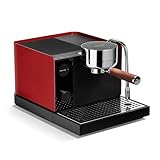
- Top Pick: Fellow Espresso Series 1 – Espresso Machine, Pressure Profiling
- Best Value: Flair UPDATED 49 PRO (Black) – All manual 49mm lever espresso maker with handled portafilter, pressure gauge and no plastics in brew path
- Premium Choice: Fellow Espresso Series 1, Home Espresso Machine, Pressure Profiling
Last updated: October 20, 2026
As an Amazon Associate we earn from qualifying purchases at no extra cost to you.




Disclosure: As an Amazon Associate we earn from qualifying purchases. This page contains affiliate links and we may earn a commission at no extra cost to you.
Pressure profiling is the idea that the pressure pushing water through your espresso puck should not be a single flat number, but a shape — a curve that rises, holds, and tapers in ways that change what ends up in the cup. Cafés pay five figures for machines that draw those curves on demand. But the principles behind profiling are free, and a surprising amount of the benefit is available on ordinary home machines once you understand what pressure is actually doing to your coffee bed second by second.
In classic espresso, a pump drives water at around nine bars through the compressed puck. Modern profiling breaks the shot into phases: a gentle low-pressure pre-infusion that wets and settles the bed, a ramp to full pressure for the heart of extraction, and often a declining taper that eases off as the puck erodes and becomes prone to channeling. Each phase has an audible effect on taste — pre-infusion forgives prep flaws and tames harshness, while a tapered finish trims bitterness from the final third of the shot. We cover the pre-infusion phase in depth in our espresso pre-infusion guide; this article tackles the whole curve.
None of it works blind, though. Profiling begins with seeing your pressure, which is why the gauges below — from drop-in Breville replacements to E61 group gauges — are the real starting line for home experimentation.
🛒 Best Price Today on Amazon
Prime members get fast, free shipping on everything above, plus member-only deals. New members get a 30-day free trial — cancel anytime.
Quick Comparison
| Product | Price | Rating |
|---|---|---|
| Replacement Gauge for Breville BES870 | Check on Amazon | 5.0/5 |
| 0-200 Psi Gauge, 2.5″ Dial (Stainless) | Check on Amazon | 5.0/5 |
| 16-Bar Espresso Pressure Gauge | Check on Amazon | 5.0/5 |
| E61 Group Head Pressure Gauge | Check on Amazon | 5.0/5 |
| Winters 4″ Economy Utility Gauge | Check on Amazon | 4.9/5 |
| Winters 4″ Liquid Filled Industrial Gauge | Check on Amazon | 4.7/5 |
Why Trust This Guide
See also: How Much Caffeine Is in a Cup of Coffee? • How to Descale a Breville Espresso Machine Step by Step
Replacement Gauge for Breville BES870
The Barista Express and Impress ship with a front-panel gauge that is the machine’s only window into extraction pressure, and when it fogs, sticks, or dies, owners lose their feedback loop. This direct replacement restores it. For a machine whose whole appeal is teaching espresso fundamentals, a working needle is not cosmetic — it is the difference between dialing in by evidence and guessing.
Fitting it is a careful screwdriver job rather than a technician visit, well within reach of anyone comfortable opening the case with the machine unplugged. If your Barista Express gauge reads nothing during a choked shot, this part plus an hour returns the machine to full eloquence.
0-200 Psi Gauge, 2.5″ Dial (Stainless)
This compact stainless gauge is the tinkerer’s component: a 0–200 psi range (espresso’s nine bars is roughly 130 psi, sitting usefully mid-scale), a 1/8″ NPT lower mount, and a 304 stainless case. It is the kind of part home-espresso modders plumb into pump lines and portafilter test rigs to learn what their machine actually does, as opposed to what the brochure said.
To be clear about fit: this is a general-purpose instrument, not a drop-in espresso accessory, and installing it means owning your modifications. For the DIY crowd building a pressure-reading portafilter or instrumenting a pump circuit, the price makes experimentation nearly free. Everyone else should choose one of the purpose-built options here.
16-Bar Espresso Pressure Gauge
Scaled in bars with a 16-bar sweep, this gauge speaks espresso’s native language — nine bars lands mid-dial where the needle is easiest to read at a glance. It is positioned as an easy-install part for lever-style and compact espresso machines, with a metal housing that suits a kitchen-facing instrument.
A bar-scaled dial removes the mental psi conversion, which matters when you are watching a shot and a timer simultaneously. Confirm thread fit against your specific machine before ordering, as small espresso gauges vary in mount standards. Installed where you can see it mid-shot, it turns abstract advice like “taper toward the end” into something you can actually watch happen.
E61 Group Head Pressure Gauge
For owners of E61-group machines — Rocket, ECM, Lelit, Expobar, Faema heritage designs — this gauge threads into the group itself and reads pressure right where extraction happens. That placement matters: pump-side gauges read high of true puck pressure because of losses along the way, while a group-mounted needle shows what the coffee actually experiences.
E61 machines are also where manual profiling is most alive, since many allow flow restriction or lever manipulation mid-shot. With this gauge fitted, those adjustments stop being folklore: you can watch pre-infusion build, hold nine bars through the middle, and ease the taper — the full curve, drawn by hand on a classic group.
Winters 4″ Economy Utility Gauge
Winters is an instrumentation maker, and this four-inch dial with brass internals is the bench-and-workshop choice: big, legible, and dependable for anyone building or servicing espresso equipment. The large face reads from across the room, which is genuinely useful when you are watching a needle and operating a machine at the same time.
Like the small stainless gauge above, it is a component for people comfortable with fittings and plumbing rather than a drop-in accessory — espresso-machine work sits within its range but it is not marketed for potable-line permanence, so position it as test gear. For flushing out a mystery — is the pump weak, is the OPV misadjusted, is the puck choking? — a big honest dial is the fastest answer.
Winters 4″ Liquid Filled Industrial Gauge
The liquid-filled sibling adds a damping fluid that steadies the needle against vibration and pulsation — and pulsation is exactly what home espresso pumps produce. On a vibratory-pump machine, a dry gauge needle can flutter too fast to read; a filled gauge averages that chatter into a smooth, readable sweep.
That makes this the diagnostic instrument for serious tinkering: OPV calibration, pump health checks, and profiling experiments where you care about the shape of the curve rather than a single peak number. It is the most expensive instrument here and overkill for casual curiosity, but for the home barista who likes their espresso with a side of engineering, it is the gauge that tells the whole truth.
What to Look For in Espresso Pressure Profiling
Whether you are buying a gauge or evaluating your machine’s potential, these are the factors that determine how far you can take profiling at home:
- Where pressure is measured — group-head or puck-side readings reflect true extraction pressure; pump-side gauges read higher than the puck ever sees.
- Scale and readability — a bar-scaled dial with nine bars near mid-sweep is easiest to use mid-shot; tiny or psi-only dials add friction.
- Needle stability — liquid filling or damping matters on vibratory-pump machines where dry needles flutter.
- Your machine’s adjustability — pre-infusion modes, adjustable OPVs, flow-control devices, or lever groups define which parts of the curve you can actually shape.
- Fit and threading — gauges are plumbing; verify thread standard and clearance for your specific machine before buying.
- Diagnostic honesty — beyond profiling, a gauge that reveals choked pucks, weak pumps, and misadjusted valves pays for itself in troubleshooting alone.
Tips for Getting the Most Out of Pressure Profiling
Start with the free profile every machine already has: the grind-driven one. Resistance comes from the puck, so a finer grind raises effective pressure and a coarser one lowers it — your grinder is a crude but real profiling lever. Add the poor barista’s pre-infusion if your machine allows: pulse the pump briefly, pause two or three seconds while the puck wets and swells, then run the shot. On many Breville machines a low-pressure ramp is built in; learn to hear it. These two habits capture a large share of profiling’s benefit with zero new hardware, and they stack directly on the recipe discipline from our espresso ratio guide.
When you do instrument your machine, change one phase at a time and taste in pairs. Compare a straight nine-bar shot against the same recipe with three seconds of pre-infusion; then against a version that tapers after twenty seconds. Lighter roasts tend to reward gentler ramps and longer pre-infusion; darker roasts often taste cleanest with a classic flat profile cut slightly short. Log what you taste — harshness retreating, body shifting — next to what the needle did, and patterns appear within a dozen shots. Our standalone espresso pressure gauge explainer covers reading those curves in more detail.
And keep profiling in its place: it is the final polish, not the foundation. An uneven puck makes every pressure curve lie, because water finds the crack regardless of what the pump intends. If your prep is not yet ritual, fix that first. If you find yourself genuinely hooked on shaping curves by hand, the rabbit hole has a bottom — it is called a lever machine, and our manual lever espresso machine review is the map.
Frequently Asked Questions
Is nine bars really the magic number for espresso?
Nine bars is the convention because it balances flow, contact time, and puck integrity well for classic recipes — but it is a region, not a law. Many superb shots run six to nine bars at the puck, and profiles that pass through several pressures can outperform any single flat value.
Can I pressure profile on a Breville or other entry-level machine?
Within limits, yes. You cannot draw arbitrary curves, but you can exploit built-in low-pressure ramps, pause-and-pulse pre-infusion, and grind-driven resistance changes. Those capture much of profiling’s practical benefit. True freehand curves require a lever, a flow-control E61, or a profiling-capable machine.
What does pre-infusion actually do?
Low-pressure wetting lets the puck swell and seal against the basket before full force arrives, closing small gaps that would otherwise become channels. In the cup, that usually reads as less harshness, more evenness, and extra forgiveness for imperfect prep — the most valuable single phase of any profile.
Why does my pressure gauge sit high even when shots taste fine?
Pump-side gauges include resistance from valves and tubing, so they read above true puck pressure; many machines also idle their gauge against the OPV’s relief point. Judge by taste and flow first, and treat the needle’s behavior — steady versus erratic, normal versus suddenly different — as the real signal.