- Top Pick: Dioomod Espresso WDT Tool, Adjustable Range Coffee Needle Stirrer, Black
- Best Value: Mcufams WDT Tool Espresso Distribution Tool Coffee Distributor Stirrer
- Premium Choice: Master Commercial-Quality Espresso in Your Own Kitchen.: A Practical Guide to Beans, Grinders, Water Ratios, and Everyday Brewing Methods (The Ultimate Coffee & Brewing Library: Books 1–4 Book 2)
Last updated: October 20, 2026


Disclosure: As an Amazon Associate we earn from qualifying purchases. This page contains affiliate links and we may earn a commission at no extra cost to you.
As an Amazon Associate we earn from qualifying purchases at no extra cost to you.
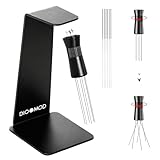
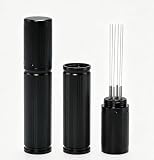

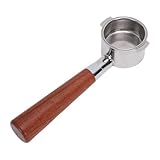

Channeling is the invisible defect behind most disappointing espresso. Water under nine bars of pressure is opportunistic: the instant it finds a weak point in the coffee bed — a crack, a clump, a low-density pocket — it bores a path through and floods that channel while the rest of the puck sits under-used. The result is a shot that is simultaneously harsh and hollow: bitter from the over-extracted channel, sour and weak from everything else. If your shots spray sideways from a bottomless portafilter, gush blonde early, or taste worse than the same beans did at a café, channeling is the prime suspect.
The encouraging news is that channeling is a preparation problem, and preparation is completely fixable with technique plus a few inexpensive tools. This guide explains how channels form, how to spot them, and the exact prep sequence — distribution stirring, leveling, tamping, and puck screens — that eliminates them. For the taste-side diagnosis of the same problem, our guide to bitter espresso causes and fixes is the natural companion read.
Follow the sequence below for a week and watch your bottomless portafilter go from spraying like a shower head to pouring a single, syrupy center stream.
Quick Comparison
| Product | Price | Rating |
|---|---|---|
| 5PCS 51mm Espresso Accessories Kit | Check on Amazon | 5.0/5 |
| 51mm WDT Kit with Funnel & Puck Screen | Check on Amazon | 4.8/5 |
| 53.5mm WDT Tool with Magnets & Stand | Check on Amazon | 4.8/5 |
| KitchenTour 58mm Accessories Kit | Check on Amazon | 4.7/5 |
| GdHaHSP 54mm WDT Kit | Check on Amazon | 4.6/5 |
| GdHaHSP 51mm WDT Kit | Check on Amazon | 4.6/5 |
Why Trust This Guide
See also: How Much Caffeine Is in a Cup of Coffee? • How to Descale a Breville Espresso Machine Step by Step
We diagnose channeling the unglamorous way: bottomless portafilter, repeated shots, and naked-eye observation of spritzes, dead spots, and extraction color, comparing prep methods on the same beans and machine. Tool recommendations reflect weeks of daily use in that routine — how needles survive, whether stands get used, how funnels fit real baskets — not spec sheets.
5PCS 51mm Espresso Accessories Kit
This five-piece kit is the full anti-channeling toolbox for 51mm machines: tamper, WDT stirring tool, distributor, puck screen, and dosing funnel. Owners of compact machines usually have the worst channeling problems — small baskets amplify edge gaps and clumps — and this kit addresses every stage of prep in their size.
The sequence it enables is the one we teach: funnel on, grounds in, WDT stir, distributor spin, tamp, screen on top. Each piece removes one failure mode, and together they make a 51mm machine pull shots it simply cannot pull from a spooned-and-thumbed puck. Build quality is solid for the price; the tamper is basic rather than calibrated, which is the kit’s only real compromise.
51mm WDT Kit with Funnel & Puck Screen
At under ten dollars, this is the cheapest legitimate fix for channeling we have found. You get the three pieces with the highest impact-per-dollar in espresso: fine stainless needles for breaking up clumps, a dosing funnel that keeps grounds inside the basket instead of on the counter, and a puck screen that protects the puck surface from the shower screen’s initial blast.
The six-needle head stirs effectively if you work in gentle circles from the bottom of the basket upward. There is no tamper or distributor in the box, so it suits owners who already have those basics and just need the clump-busting step. As a first response to spritzy, uneven shots on a 51mm machine, the value here is unbeatable.
53.5mm WDT Tool with Magnets & Stand
Tools you can grab one-handed get used every shot; tools that roll into a drawer do not.
Breville machines are notorious for clumpy grinds from their built-in grinders, which makes WDT the single highest-leverage fix for owners of the Barista Express BES870XL and its siblings. Stir bottom-to-top in small circles until the bed looks like fluffed flour, then level and tamp. The transformation in shot evenness is usually visible on the very first pull.
KitchenTour 58mm Accessories Kit
Prosumer machines with 58mm commercial portafilters deserve prep tools to match, and KitchenTour’s kit packages WDT, dosing funnel, and puck screen in the larger size. Bigger baskets distribute water over a wider bed, which forgives small errors but punishes systematic ones — a persistent low spot near the wall channels just as badly at 58mm as at 51mm.
The funnel sits securely on commercial portafilter rims, the screen covers the wider puck evenly, and the needles are long enough to reach the bottom of deep 18–20g baskets. For anyone stepping up to an E61 machine or pairing prep tools with a 58mm bottomless portafilter for diagnosis, this kit completes the workflow at a sensible price.
GdHaHSP 54mm WDT Kit
This 54mm kit bundles the WDT tool with a dosing funnel and puck screen for Breville-format machines, covering the full clump-to-cup prep chain in one purchase. The funnel matters more than people expect: grounds that mound against one side of the basket while dosing are the seed of a channel before stirring even begins, and a funnel keeps the dose centered.
The included screen spreads the brew water’s first contact across the puck face, which protects your carefully prepared bed from being gouged by individual shower-screen jets. Pieces store together neatly. The needle head is fixed rather than magnetic, a minor convenience loss against the 53.5mm tool above, but function in the basket is equivalent.
GdHaHSP 51mm WDT Kit
The same sensible bundle in 51mm trim, for compact De’Longhi-class machines. Small baskets are where dosing funnels stop being optional: with so little rim to work with, ungrooved dosing throws grounds over the edge and leaves the basket lopsided, so funnel-plus-WDT delivers a disproportionate jump in consistency on these machines.
Against the five-piece 51mm kit above, this set trades the tamper and distributor for a lower price — the right call if your machine came with a usable tamper. Whichever route you take, the goal is identical: a uniformly dense, level, undisturbed puck presented to the water. On entry-level machines that one change often outweighs any accessory upgrade you can make.
What to Look For in Espresso Channeling Fix Tools
The market is flooded with near-identical prep kits, but a few attributes separate tools that fix channeling from tools that just accessorize it:
- Needle gauge — thinner needles (around 0.35mm) comb through grounds without compacting them; thick pins drag furrows that become channels themselves.
- Correct diameter — funnels, screens, and distributors must match your basket’s true size: 51mm, 53.3–54mm for Breville, or 58mm commercial.
- Needle reach — the tool must touch the basket floor; stirring only the top layer leaves the deep clumps that cause late-shot channeling.
- Puck screen mesh — a fine, rigid screen diffuses water evenly and lifts off cleanly; flimsy screens warp and create their own low spots.
- Funnel fit — magnetic or snug-sitting funnels stay put while you stir; loose rings shift and spill mid-prep.
- Bench-friendly storage — stands and magnetic heads keep tools in the workflow; anything fiddly gets skipped on busy mornings, and skipped prep is how channeling returns.
Tips for Getting the Most Out of Channeling Fixes
Adopt a fixed prep liturgy and never improvise it. Ours: funnel on the basket, grind in, WDT stir from the basket floor upward in small circles until the surface is uniformly fluffy, spin the distributor or sweep level with a finger, tamp once dead flat, set the puck screen, lock in and brew. The order matters — leveling before stirring just hides clumps under a smooth surface, and tamping twice cracks the bed. Keep your dose consistent to the gram, because a dose that varies day to day defeats every tool in this guide; our espresso ratio guide covers dosing discipline.
Verify your fixes with evidence rather than vibes. A bottomless portafilter is the diagnostic instrument here: watch the underside, and channeling announces itself as spritzes, off-center streams, or patchy early blonding. Pair what you see with what the needle reads — our pressure gauge guide explains how erratic pressure behavior maps to puck failures. Film a few shots in slow motion; the playback teaches faster than any article.
Finally, remember that prep tools manage grind problems but cannot abolish them. A grinder that produces extreme fines alongside boulders will channel through the best-prepared puck eventually. If you have adopted the full routine and still see spritzers, the next upgrade is the mill itself — our roundup of the best espresso grinders shows what consistent particle size buys you. Tools first, technique always, grinder when the ceiling demands it.
Frequently Asked Questions
How do I know my shot is channeling without a bottomless portafilter?
Listen and taste. Channeled shots often run fast after a normal start, finish blonde early, and taste sharp and bitter at once. A sudden drop in shot time with no grind change is the classic tell. A bottomless portafilter simply makes the diagnosis visual and immediate.
Is WDT really necessary, or is tamping enough?
Tamping compresses whatever structure already exists — including clumps and voids. WDT erases that structure and rebuilds the bed uniformly before compression. On machines with clump-prone grinders, WDT typically improves shots more than any tamping technique refinement can.
Can tamping harder fix channeling?
No. Beyond a moderate firmness, extra force does not meaningfully change puck density, but an uneven or tilted hard tamp absolutely creates channels. Aim for consistent, level, moderate pressure and spend your attention on distribution instead.
Do puck screens actually help, or are they a fad?
They help at the margin: a screen diffuses the first burst of water so it cannot drill into one spot, and it keeps the shower screen cleaner. They will not rescue a badly prepared puck, but as the final layer on a good routine they measurably improve surface evenness.