As an Amazon Associate we earn from qualifying purchases at no extra cost to you. Product prices and availability are accurate as of the date shown and are subject to change.






TL;DR: Programmable drip coffee makers are the best value-per-cup for households brewing 4+ cups daily. Key differentiators: bloom pause, thermal carafe, and wattage consistency. Avoid glass carafes with hotplates — they cook your coffee. Best picks below.
Best Drip Coffee Maker Programmable: Complete Buyer’s Guide 2026
The programmable drip coffee maker market looks crowded until you know what to filter out. Most mid-range machines share the same heating element flaws — inconsistent brew temperature, hotplate degradation, and weak bloom cycles. This guide cuts to the specs that separate great drip from mediocre drip.
- Quick Comparison
- Top Picks at a Glance
- What “Programmable” Actually Means in 2026
- Spec Comparison: What to Look For
- Glass Carafe vs. Thermal Carafe: The Real Cost
- Brew Temperature: The Most Overlooked Spec
- Grind Settings for Drip: Matching Grind to Machine
- Smart Features: Worth It or Gimmick?
- Maintenance: What Actually Needs Cleaning
- Frequently Asked Questions
- About the Author
Quick Comparison
| Product | Brand | Price | Rating |
|---|---|---|---|
| Hamilton Beach 2-Way Programmable Coffee Maker | HamiltonBeach | $88.95 | 4.5/5 |
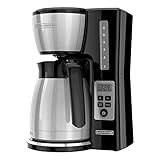
| BLACK+DECKER 12-Cup Digital Coffee Maker | — | $34.99 | 4.4/5 |
| Cuisinart 14-Cup Coffee Maker | Cuisinart | $89.95 | 4.5/5 |
| Cuisinart 14-Cup Coffee Maker | Cuisinart | $89.95 | 4.5/5 |
| Cuisinart 14-Cup Coffee Maker | Cuisinart | $89.95 | 4.5/5 |
Top Picks at a Glance
See also: How to Replace Espresso Machine Water Filter (2026): Step-by-Step • How to Adjust Espresso Machine Brew Temperature (2026): Step-by-Step
What “Programmable” Actually Means in 2026
Entry-level “programmable” means one thing: a 24-hour auto-start timer. That’s it. You set a time, it brews. Useful, but minimal. The real tier split is between machines that only schedule brew time versus machines that also control:
- Brew temperature (195-205°F is the SCAA-certified range)
- Bloom pause (30-45 second pre-infusion that dramatically improves extraction)
- Brew strength (affects contact time, not just coffee amount)
- Carafe warming duration (on/off or time-limited)
- Cup size optimization (adjusts flow rate for small vs. full batches)
If you’re coming from a our pick for espresso machine home and want convenience without sacrificing cup quality, the bloom pause feature alone justifies paying $40-60 more for a mid-range drip machine.
Spec Comparison: What to Look For
| Spec | Minimum Acceptable | Good | Best |
|---|---|---|---|
| Brew temp | 185°F (too low) | 195-200°F | 195-205°F adjustable |
| Carafe type | Glass + hotplate | Glass + auto-off | Double-wall thermal |
| Bloom pre-infusion | None | Fixed 30s pause | Adjustable 15-60s |
| Programming | 24hr timer only | Timer + strength | Full schedule + settings |
| Filter basket | Flat-bottom | Cone (better extraction) | Cone + shower head |
| Wattage | 800W | 1000-1200W | 1200-1500W |
| SCAA certified | No | No | Yes (gold standard) |
| Cleaning cycle | Manual only | Indicator light | Auto-clean program |
Glass Carafe vs. Thermal Carafe: The Real Cost
Glass carafes with hotplates are the most common source of “bad drip coffee.” The hotplate keeps coffee at 160-175°F — hot enough to continue extraction from remaining grounds on the filter, and hot enough to oxidize and flatten flavor within 20-30 minutes. Most people blame their coffee or machine. The culprit is the hotplate.
Thermal carafes hold temperature for 2+ hours with zero heat — the double-wall vacuum does the work. Coffee flavor peaks in the first 30 minutes after brew and degrades slowly at room temp versus rapidly on a hotplate. The thermal carafe adds $20-40 to machine cost and pays back in cup quality immediately.
For anyone also using a precision coffee scale, thermal carafes also make ratio-based brewing more consistent — you know exactly how much coffee you made and it holds without change.
Brew Temperature: The Most Overlooked Spec
Under-temp brewing is the silent killer of drip coffee. Most $30-50 machines reach 175-185°F — 10-20 degrees below the SCAA optimal range. The result: under-extraction, sour/flat flavor, weak body. The fix isn’t more coffee — it’s more heat.
Testing method: use an instant-read thermometer to measure water temperature in the first 30 seconds of brew. If it’s below 190°F, the machine is under-performing regardless of marketing claims. SCAA-certified machines are independently verified to hit the target range consistently.
Bean quality matters here too — if you’re brewing single origin coffee beans with careful sourcing and an under-temp machine is flattening them, you’re wasting money on premium beans.
Grind Settings for Drip: Matching Grind to Machine
Drip machines vary in their flow rate, which affects ideal grind size. Faster-flow machines (cone filters with wide exit holes) need slightly finer medium grind. Slower flat-bottom machines need coarser medium to avoid over-extraction. This is why pre-ground coffee performs inconsistently across drip machines — the universal medium grind is a compromise calibrated for no machine in particular.
Paired with a good see burr coffee grinder best, a programmable drip machine becomes a genuinely high-performance brewer. The grinder investment often matters more than machine upgrades beyond a certain baseline.
Smart Features: Worth It or Gimmick?
Wi-Fi connectivity and app control appear on $100+ machines. Honest assessment: useful for 15% of buyers. If you consistently forget to set a timer or want remote brew start from bed, it earns its price. For everyone else, a simple 24-hour programmable timer does the same job with fewer failure points.
Voice assistant integration (Alexa, Google) works reliably on premium models. The actual use case: asking your assistant to start coffee while still in bed. Niche but genuinely convenient.
Comparison tip: if you’re also weighing a sub-$500 espresso machine against a premium drip, the drip wins for household convenience; the espresso machine wins for flavor ceiling and drink variety.
Maintenance: What Actually Needs Cleaning
Mineral scale is the primary performance killer for drip machines. Calcium deposits reduce heating efficiency — a heavily scaled machine brews 10-15°F cooler than spec. Descale every 2-3 months with white vinegar or a descaling solution. Machines with auto-clean programs prompt you when scale builds up, which is genuinely useful for daily users who lose track.
Filter basket cleaning matters more than most realize. Oils from previous brews accumulate and go rancid, creating off-flavors that no amount of fresh coffee will fix. Weekly scrub with dish soap, not just rinse.
Frequently Asked Questions
How does a programmable drip coffee maker differ from a standard drip machine?
At minimum, a programmable machine adds a 24-hour auto-start timer so coffee is ready when you wake up. Better models add strength control, bloom pre-infusion, and temperature settings. The core brewing mechanism is the same — the programming adds convenience and, in better machines, meaningful quality improvements via pre-infusion.
What is SCAA certification and does it matter?
The Specialty Coffee Association certifies machines that brew within 195-205°F and complete a full carafe in 4-8 minutes. It matters — it’s an independent verification that the machine performs as spec’d. Brands can’t self-certify. The list is short: Technivorm Moccamaster, Breville Precision Brewer, OXO Brew, and a handful of others. If temperature consistency is your priority, SCAA certification is the fastest filter to apply.
Is a programmable drip maker better than a pod machine?
For cup quality: decisively yes. Pod machines under-extract at lower temperatures with pre-ground coffee of unknown freshness. Per-cup cost is also 3-5x higher for pods versus whole bean. Programmable drip wins on flavor, cost, and sustainability. Pod machines win only on speed and variety — relevant if your household has wildly different drink preferences.
How many cups can a programmable drip machine make at once?
Most home machines are 8-12 cup capacity (40-60 oz). Single-serve attachments on combo machines brew 6-14 oz. For households of 1-2, a 12-cup machine used at half-capacity slightly under-performs — the water-to-coffee ratio optimization is designed for full batches. A dedicated 4-6 cup machine or single-serve brewer often outperforms a large machine running small.
What grind size is best for programmable drip coffee makers?
Medium grind is the starting point — similar to table salt in particle size. Cone filter machines can handle medium-fine; flat-bottom basket machines need true medium to medium-coarse. If your drip coffee tastes bitter, go coarser. If it tastes weak and sour, go finer. See the full grind size guide for the complete spectrum and how drip sits relative to other brew methods.
Bottom line: Spend on thermal carafe and verified brew temperature before smart features. A $100 machine that hits 200°F into a thermal carafe outperforms a $250 Wi-Fi machine that tops out at 183°F on a hotplate every time.
Ready to decide? Our #1 pick for 2026 is the Hamilton Beach 2-Way Programmable Coffee Maker.
Live price & availability on Amazon.