- Top Pick: Maestri House S2 Espresso Coffee Scale with Timer 0.1g Precision Shot Scale
- Best Value: Greater Goods Coffee Scale with Timer, 0.1g Precision for Espresso & Matcha
- Premium Choice: KitchenTour Coffee Scale with Timer 3kg/0.1g High Precision Pour Over Drip Espresso Scale with Back-Lit LCD Display (Batteries Included)
As an Amazon Associate we earn from qualifying purchases at no extra cost to you. Product prices and availability are accurate as of the date shown and are subject to change.


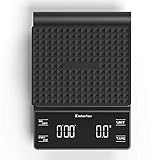
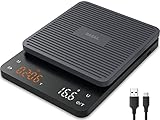

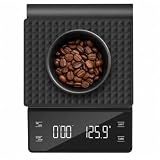


TL;DR: A coffee scale is the single cheapest upgrade that most improves brew consistency. You need 0.1g resolution, a tare function, and ideally a built-in timer. This guide covers what to look for, what to ignore, and how precision weighing changes your espresso and pour-over game.
Coffee Scale Precision Buyer’s Guide: What Matters, What Doesn’t, What to Buy
Every variable in coffee — dose, yield, brew ratio — is a number. If you’re estimating those numbers by eye or by scoop, you’re brewing with a random variable built into every cup. A coffee scale with precision to 0.1g eliminates that variable entirely. This buyer’s guide covers the specs that matter for coffee scale precision, the features worth paying for, and how a scale integrates into espresso, pour-over, and cold brew workflows.
Quick Comparison
| Product | Brand | Price | Rating |
|---|---|---|---|
| MAXUS Digital Pocket Gram Scale 500g x 0.01g High Preci… | Maxusprecisionscale | $8.98 | 4.6/5 |
| Escali Primo Digital Food Scale Multi-Functional Kitche… | — | $25 | 4.7/5 |
| KitchenTour Mini Gram Scale for Coffee | KKitchenTour | $13.49 | 4.3/5 |
| Greater Goods Digital Espresso and Coffee Scale – 750 x… | GreaterGoods | $16.99 | 4.6/5 |
| GDEALER Food Scale | GDEALER | $11.72 | 4.5/5 |
Top Picks at a Glance
See also: How to Season a New Coffee Grinder (2026): Step-by-Step • How to Clean a Moka Pot Safely (2026): Step-by-Step
Why Coffee Scale Precision Matters
A standard tablespoon of coffee varies between 5g and 9g depending on grind size, density, and how tightly it’s packed. Dial in an espresso recipe at 18g in, 36g out, and that “tablespoon” becomes a completely useless measurement — you could be off by 2–4g with every shot, producing dramatically different results despite pulling on the same machine.
Precision weighing solves three problems simultaneously:
- Dose consistency — same coffee mass every shot means the only variable is your grind setting
- Yield tracking — weighing espresso output tells you your brew ratio (typically 1:2 for espresso, 1:15 for pour-over)
- Recipe repeatability — when you nail a great cup, you can reproduce it exactly
Scale investment multiplies the value of every other upgrade. A great grinder used with scoops is less consistent than a decent grinder used with a scale. See our espresso grind size guide to understand how dose and grind size interact.
Key Specs for Coffee Scale Precision
| Spec | Minimum for Coffee | Better | Why It Matters |
|---|---|---|---|
| Resolution | 0.1g | 0.1g | 1g resolution is too coarse for espresso dosing |
| Capacity | 500g | 2000g | Needs to handle portafilter + coffee |
| Response time | <1 second | 0.3–0.5 sec | Fast response = real-time yield tracking during extraction |
| Timer | Built-in preferred | Auto-start timer | Shot timing without a separate device |
| Platform size | Large enough for drip tray | Wide platform | Needs to fit under grouphead with cup on scale |
| Water resistance | Splash-proof minimum | IPX5 or better | Espresso drips; scale must survive occasional contact |
| Auto-off | Adjustable or off-able | Disable option | Auto-off mid-pour is infuriating |
Features Worth Paying For
Auto-Start Timer
Some coffee scales (Acaia Pearl, Timemore Black Mirror) detect the weight increase when espresso begins flowing and automatically start the timer. This eliminates the need to hit a button at the exact moment the shot begins — one less variable, one more precise pull.
Flow Rate Display
High-end scales display live flow rate (g/second) during espresso extraction. This tells you how fast coffee is flowing — too fast means under-extracted, too slow means channeling or over-packed puck. It’s real-time diagnostic data without a refractometer.
Bluetooth App Integration
Acaia and Timemore both offer Bluetooth-connected apps that log shot data over time — dose, yield, time, flow rate. Over weeks of use, patterns emerge. If your espresso on a best espresso machine home or learn about rancilio silvia vs gaggia classic pro keeps running long or short, the app reveals whether it’s a dose or grind issue.
Pour-Over Mode
Some scales display “coffee strength” estimates or guide pour-over bloom timing. Less essential than timer and resolution, but useful if pour-over is your primary brew method. Our Gooseneck Electric Kettle Pour Over Guide covers the other side of pour-over precision — water temperature and flow control.
Coffee Scale Price Tiers Explained
| Price Range | What You Get | Best For |
|---|---|---|
| $15–$30 | 0.1g resolution, basic tare/timer, no Bluetooth | Pour-over, cold brew, AeroPress beginners |
| $30–$60 | Fast response, water resistance, built-in timer | Serious home brewers, espresso users |
| $60–$120 | Auto-start timer, flow rate, Bluetooth logging | Espresso dialing, repeatability-focused users |
| $150+ | Acaia/Timemore premium — lab-level consistency, app ecosystem | Obsessive baristas, competition prep |
For most home espresso users, the $30–$60 tier represents the best value — you get everything that actually improves brewing without paying for features you’ll rarely use. The jump to $100+ is justified only if you’re dialing multiple machines or tracking shot data long-term.
Using a Scale With Your Espresso Machine
On a home espresso machine, scale use is straightforward:
- Place portafilter on scale, tare to zero
- Dose coffee (e.g. 18g) — watch the scale, not a scoop
- Distribute and tamp, lock into machine
- Place scale + cup under grouphead
- Tare to zero, start extraction
- Stop when output weight hits target (e.g. 36g for 1:2 ratio)
- Note time: target 25–30 seconds for standard espresso
The scale eliminates volume measurement guesswork. A 36g output in 22 seconds vs 36g in 38 seconds are completely different extractions — the timer is as important as the weight. See our grinder vs pre-ground test for data on how consistent dosing interacts with grind quality.
Scales and Grinders: The Precision Pair
A scale is only as useful as the grinder it’s paired with. If your grinder produces inconsistent particle sizes, precise dosing will not produce consistent extraction — you’re weighing inconsistency precisely. A quality burr grinder like the TIMEMORE Sculptor 078S produces uniform grind distributions that make weighed doses actually predictable. See our Burr Coffee Grinder Best for recommendations across price points.
Frequently Asked Questions
What resolution do I need in a coffee scale for espresso precision?
0.1g is the minimum and also sufficient for virtually all home espresso. The difference between 17.9g and 18.1g matters — 1g resolution (which rounds to the nearest gram) is too imprecise for consistent espresso dosing. Professional competition scales use 0.01g resolution, but the additional precision has diminishing returns for home brewing.
Do I need a coffee scale for pour-over if I’m not doing espresso?
Yes — arguably more than for espresso. Pour-over recipes are highly sensitive to brew ratio (typically 1:15 to 1:17 coffee to water). A 5g deviation in water weight shifts your ratio significantly. A scale with a tare function lets you weigh your kettle water directly into the brewer, which is faster and more accurate than measuring in a separate container.
What is the difference between a kitchen scale and a coffee scale?
Response time. A kitchen scale updates every 1–2 seconds — fine for baking, terrible for tracking espresso yield in real time (a shot runs 25–35 seconds total). Coffee scales update every 0.3–0.5 seconds, which lets you watch yield accumulate and stop extraction precisely. Size is also a factor: coffee scales are designed to fit under groupheads with cup clearance.
Does a coffee scale need to be waterproof?
Splash-proof at minimum. Working under an espresso grouphead means occasional drips and spills. Fully waterproof (IPX5 or higher) is better — allows cleaning with a damp cloth without fear. Fully submerging a coffee scale is never necessary; IPX5 splash resistance handles all realistic brewing scenarios.
Can I use any scale for pour-over coffee or do I need a specialty coffee scale?
Any scale with 0.1g resolution and a fast response time works for pour-over. The specialty coffee scales earn their premium through response speed, integrated timers, and aesthetic design — not through fundamentally different accuracy. A $25 kitchen scale with 0.1g resolution and a separate timer produces equivalent results for pour-over compared to a $150 Acaia Pearl. For espresso, the faster response time of purpose-built scales is more meaningful.
Precision goes beyond the scale — read our Chemex review for how scale use transforms pour-over consistency, and our moka pot brewing guide to see how ratio control applies even to stovetop brewing.
Ready to decide? Our #1 pick for 2026 is the MAXUS Digital Pocket Gram Scale 500g x 0.01g High Preci….
Live price & availability on Amazon.