Last updated: September 7, 2026
KitchenAid built its reputation on the stand mixer that outlives its owner, so when the brand entered the espresso world, the question wrote itself: is a KitchenAid espresso machine a serious coffee tool, or just a pretty appliance trading on an iconic name? Having looked hard at the lineup — the entry KES6403, the metal-bodied KES6503, the frother-equipped KES6404, and the grinder-integrated KES6551 — the honest answer is that KitchenAid has done its homework. These are semi-automatic machines with dual smart temperature sensors that hold water in the proper 195 to 205 degree Fahrenheit brewing window, fast-heating thermocoils ready in under 45 seconds, 15-bar Italian pumps, and low-pressure pre-infusion that wets the puck gently before full extraction — the same feature set you would shop for in any respected prosumer brand. And yes, they come in the colors. In this review we walk through each model, explain who it suits, and weigh whether style and substance really do meet in the middle.
As an Amazon Associate we earn from qualifying purchases at no extra cost to you. Product prices and availability are accurate as of the date shown and are subject to change.


Top Picks: KitchenAid Espresso Machines Reviewed
1. KitchenAid KES6403 Semi-Automatic (Charcoal Grey)
The KES6403 is the entry point and arguably the best value in the line. You get the dual temperature sensors, sub-45-second thermocoil heat-up, 15-bar pump with low-pressure pre-infusion, a proper 58mm-style metal portafilter feel, and a full accessory kit — four filter baskets, tamper, milk pitcher, and cleaning brush — in the box. The matte Charcoal Grey finish is understated by KitchenAid standards, and the compact body fits under standard cabinets. For a first manual machine, it is a complete, confidence-inspiring package.
2. KitchenAid KES6503 Metal Semi-Automatic (Obsidian Black)
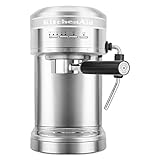
The KES6503 takes the same brewing platform and wraps it in full die-cast metal, which transforms how the machine feels: heavier, steadier under portafilter torque, and finished like the stand mixers that made the brand famous. Brewing performance mirrors the KES6403, so you are paying for build and presence — and in Obsidian Black it has plenty of both. If the machine will live in view and you value the heft of metal construction, this is the one.
3. KitchenAid KES6551 with Burr Grinder (Cast Iron Black)
The KES6551 is KitchenAid’s answer to the Breville Barista Express: a semi-automatic with an integrated burr grinder that doses fresh grounds straight into the portafilter. Freshly ground beans are the single biggest upgrade most home espresso drinkers can make, and having grinder and machine share one footprint and one power cord genuinely simplifies a coffee corner. The Cast Iron Black finish with a 2.5-liter tank makes this the flagship for serious daily use.
4. KitchenAid KES6551 with Burr Grinder (Brushed Stainless)
Identical machinery to the Cast Iron Black flagship, the Brushed Stainless KES6551 deserves its own mention because the finish reads classic espresso-bar rather than colorful KitchenAid, and it pairs naturally with stainless appliances. Same integrated grinder, same dual sensors and pre-infusion, same large tank — choose between the two purely on the kitchen it is going home to.
5. KitchenAid KES6404 with Automatic Milk Frother Attachment
The KES6404 bolts an automatic milk frothing attachment onto the proven KES6403 platform, steaming and texturing milk to your selected level while you pull the shot. For households that want lattes and cappuccinos without learning wand technique — or for the partner who just wants to press a button — it is the most accessible milk-drink machine KitchenAid makes, while still leaving manual steaming available as your skills grow.
How KitchenAid Compares to Breville and De’Longhi
See also: Best Us Washing Machines in 2026: What to Know Before You Buy • Best Scanning Fax Machines in 2026: Top Picks Compared
The natural cross-shop is Breville’s Barista line and De’Longhi’s La Specialista family, and KitchenAid holds its ground better than skeptics expect. On brewing fundamentals — temperature stability, pre-infusion, pump quality — the KES machines are competitive, and their accessory kits are unusually complete. Where Breville still leads is grinder maturity and the breadth of its ecosystem; where KitchenAid leads is build materials at the mid-tier (the die-cast KES6503 feels more substantial than similarly priced rivals) and, frankly, design range — no other espresso brand offers finishes that coordinate with the rest of your countertop appliances. Resale and longevity favor KitchenAid’s parts-and-service network, a quiet advantage in a category where many machines are effectively disposable. If you are still mapping the landscape, our roundups of the best espresso machines under $1000 and best espresso machines under $300 show exactly where each KitchenAid model sits against the field, and our guide to the best espresso machines with built-in grinders puts the KES6551 head-to-head with the Barista Express.
Which KitchenAid Espresso Machine Should You Buy?
Match the machine to your morning. If you already own a quality burr grinder or plan to buy one separately, the KES6403 delivers the full brewing experience for the least money — spend the savings on beans. If the machine doubles as kitchen jewelry and you want metal construction, step up to the KES6503. If you are starting from zero, the KES6551’s integrated grinder is the smart play: one purchase, one footprint, fresh grounds every shot, and dose control that teaches you the grind-extraction relationship espresso is built on. And if milk drinks dominate your order history but nobody wants to learn steaming, the KES6404’s automatic frother removes the barrier entirely. Whichever you choose, plan to learn the basics of dialing in: aim for the classic 1:2 ratio — roughly 18 grams of grounds yielding 36 grams of espresso in 25 to 30 seconds — and adjust grind finer or coarser to hit that window. A scale makes this dramatically easier; see our picks for the best espresso scales with timers and the best calibrated tampers for consistent pucks.
Living With a KitchenAid: Maintenance and Accessories
Semi-automatic machines reward small habits. Flush the group head before and after shots, knock and rinse the portafilter promptly, and wipe the steam wand the second you finish texturing milk. Descale on the machine’s schedule — more often with hard water — using our guide on how to descale an espresso machine, and consider an in-tank filter from our roundup of the best espresso machine water filters, since scale is the number one killer of thermocoil machines and water chemistry quietly shapes taste, as our water quality guide explains. A tamping mat protects both counter and portafilter spouts, and if you steam milk daily, a frothing thermometer keeps you in the 140 to 150 degree sweet spot until your hand learns the feel. Treat the machine like the stand mixer — clean it, feed it decent inputs — and there is no reason it should not serve for many years.
Frequently Asked Questions
Are KitchenAid espresso machines any good?
Yes — genuinely. They are semi-automatic machines with dual smart temperature sensors, fast thermocoil heating, 15-bar Italian pumps, and low-pressure pre-infusion, which are the same core specs found on well-regarded competitors. They are not rebadged drip machines; they pull real espresso and steam real microfoam.
What is the difference between the KitchenAid KES6403 and KES6503?
The brewing internals are essentially the same; the KES6503 upgrades the body to full die-cast metal construction with premium finishes, while the KES6403 uses a lighter build at a lower price. Buy the 6503 for build quality and looks, the 6403 for value.
Does the KitchenAid KES6551 grinder work well?
The integrated conical burr grinder doses freshly ground coffee directly into the portafilter with adjustable settings, and fresh grinding is the largest single quality upgrade in home espresso. A high-end standalone grinder can outperform it, but as an all-in-one it is competitive with the category benchmark machines.
Can KitchenAid espresso machines make lattes and cappuccinos?
All models have steam capability: the KES6403, KES6503, and KES6551 use a manual steam wand for microfoam, while the KES6404 adds an automatic milk frother attachment that textures milk to a chosen level at the press of a button — ideal for households that want one-touch milk drinks.
How long do KitchenAid espresso machines last?
With regular descaling and basic cleaning, owners should expect many years of service, and KitchenAid’s established parts and service network — a rarity among espresso newcomers — means repairs are realistic rather than theoretical. Hard-water households should use filtered water to protect the thermocoil.