As an Amazon Associate we earn from qualifying purchases at no extra cost to you. Product prices and availability are accurate as of the date shown and are subject to change.

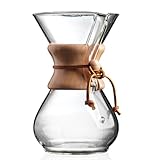


TL;DR: The Chemex coffeemaker rewards patience. After 18 months of daily use, it remains one of the cleanest, most chemically transparent brewers on the market — but it demands precision in grind, water temp, and pour rate. Best for: filter-coffee obsessives who want full control. Not for: anyone in a rush.
Chemex Coffeemaker Review 2026: 18 Months of Daily Brewing — Honest Long-Term Take
Most Chemex reviews are written after a week of testing. This one isn’t. I’ve been pulling a 40g dose through the 6-cup Chemex every single morning since early 2024, and the picture that emerges over 500+ brews is different from the honeymoon take you get in short-term writeups. Let me give you the full picture.
- Quick Comparison
- Top Picks at a Glance
- What Makes Chemex Chemically Different
- Long-Term Build Quality: What Holds Up, What Doesn’t
- Grind Size: The Make-or-Break Variable
- The Pour Technique That Changed My Results
- Chemex vs. Drip Machine: Real-World Comparison
- When Chemex Pairs with Espresso
- Spec Sheet
- Who Should Buy the Chemex in 2026
- Frequently Asked Questions
- About the Author
Quick Comparison
| Product | Brand | Price | Rating |
|---|---|---|---|
| Bodum 34oz Chambord French Press Coffee Maker | Bodum | $39.95 | 4.6/5 |
| Veken French Press Coffee Maker 34oz | Veken | $24.99 | 4.7/5 |
| Chemex Bonded Filter – Natural Square – 100 ct – Exclus… | CHEMEX®Coffeemakers | $18.94 | 4.8/5 |
| Bodum 34oz Pour Over Coffee Maker | Bodum | $19.99 | 4.5/5 |
| Bodum 17oz Pour Over Coffee Maker | Bodum | $17.99 | 4.5/5 |
Top Picks at a Glance
See also: How to Replace Espresso Machine Water Filter (2026): Step-by-Step • How to Adjust Espresso Machine Brew Temperature (2026): Step-by-Step
What Makes Chemex Chemically Different
The Chemex isn’t just a pretty hourglass. The thick, bonded paper filter (20-30% heavier than standard filters) strips nearly all cafestol and kahweol — the diterpene oils responsible for raising LDL cholesterol and, notably, the heavier mouthfeel associated with French press. The result: a cup that’s measurably cleaner in both health chemistry and flavor profile.
What you’re trading away is body. Chemex coffee sits between drip and paper-filtered V60 in terms of texture — light, bright, amplifying high-frequency flavor notes like citrus, florals, and stone fruit. If your beans lean toward chocolatey/nutty profiles, you may find Chemex makes them taste thin.
Long-Term Build Quality: What Holds Up, What Doesn’t
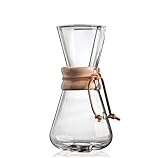
After 18 months: the borosilicate glass is flawless. No scratching, no cloudiness, no mineral staining that won’t come off with a quick citric acid rinse. The wooden collar — secured by a leather tie — has dried out once. I re-conditioned it with a light coat of beeswax. Takes five minutes. Now it’s fine.
The one legitimate gripe: the glass handle (on the handblown version) gets uncomfortably hot if you pour slowly with a full brew. I’ve switched to holding the collar. Non-issue once you adjust, but worth knowing.
Grind Size: The Make-or-Break Variable
Chemex requires coarser grind than V60 — roughly medium-coarse, 800-900 microns on most burr grinders. Too fine and the thick filter chokes: your 4-minute target brew stretches to 8+ minutes, and the cup tastes bitter, over-extracted. Too coarse and you’re pouring weak, sour tea.
The TIMEMORE Sculptor 078S hits the dial-in sweet spot fast. Its flat burr geometry produces a consistent particle distribution that Chemex’s slow draw-down rewards. For deeper context on grind variables, see our guide: top-ranked burr coffee grinder best.
The Pour Technique That Changed My Results
Standard advice: 45g bloom pour, 45-second wait, then continuous pours. After 500 brews I’ve moved to pulse pouring — five 80g additions with 20-second rests. Why? It maintains a consistent slurry depth that prevents channeling through the thick paper. Channeling is the enemy of Chemex extraction. Even one thin channel doubles extraction variance.
For this, the Cocinare Gooseneck Kettle is genuinely worth the $70. Gooseneck spouts aren’t marketing — the laminar flow they produce is physically different from a standard kettle pour. You need flow control, not just temperature control. See our full breakdown: our gooseneck electric kettle pour over guide.
Chemex vs. Drip Machine: Real-World Comparison
| Factor | Chemex | Auto Drip |
|---|---|---|
| Active brew time | 4–6 min | 1 min hands-on |
| Temperature control | Full (you control) | Machine-fixed |
| Cup clarity | Exceptional | Medium |
| Oils in cup | Minimal | Some |
| Cleanup | 30 sec (rinse + filter) | 5 min |
| Scalability | Up to 10 cups | Up to 12 cups |
When Chemex Pairs with Espresso
Many home baristas run Chemex for morning filter and an espresso machine for afternoons. The flavor contrast is striking — Chemex clarity vs. espresso intensity. If you’re building that dual setup, the see best espresso machine home and the Gaggia Classic Pro vs Rancilio Silvia comparison are essential reads before committing to a machine.
Spec Sheet
| Spec | Detail |
|---|---|
| Material | Borosilicate glass, wooden collar, leather tie |
| Sizes | 3, 6, 8, 10 cup |
| Filter type | Proprietary bonded paper (square or circle) |
| Brew time (6-cup) | 4–6 minutes |
| Ideal grind | Medium-coarse (~850 microns) |
| Ideal water temp | 93–96°C (199–205°F) |
| Ratio | 1:15 to 1:17 (coffee:water) |
| Dishwasher safe | Glass only (remove collar) |
| Country of origin | USA |
Who Should Buy the Chemex in 2026
Buy it if: you value cup clarity over body, you enjoy the ritual, you have quality single-origin beans worth tasting at their cleanest. Skip it if: you want automation, prefer espresso-style intensity, or consistently run 5+ minutes late in the morning.
Frequently Asked Questions
How often should I replace Chemex filters?
Every brew. Chemex filters are single-use. Attempting to reuse them introduces old coffee oils and dramatically reduces flow rate. Buy in bulk — the 100-pack is the most cost-efficient option and reduces per-brew cost to under $0.15.
Can I use generic filters in a Chemex?
Technically yes, but results vary. Generic filters are thinner, allowing more oils through — closer to V60 output. If that’s your preference, it works. But the Chemex’s distinctive clarity comes specifically from the bonded paper weight. For true Chemex character, use Chemex filters.
Why is my Chemex brewing too slowly?
Almost always a grind-size issue. Your grind is too fine. Coarsen it two to three notches and retest. Secondary cause: incorrect filter folding — the fold should create four layers on the spout side for structural support, three layers opposite. If the filter collapses, it slows everything.
What’s the ideal Chemex ratio?
Start at 1:16 — 60g coffee to 960g water for the 6-cup. Adjust from there. If the cup tastes thin, drop to 1:15. If too intense, stretch to 1:17. Chemex’s clean extraction means small ratio changes have noticeable impact, so adjust in small increments.
Does the Chemex work with light roasts?
It excels with light roasts. Light roast compounds are volatile and delicate — the thick filter preserves them while blocking the heavier oil-bound compounds that can muddy the cup. Ethiopian naturals and Kenyan washed coffees are transformative in a Chemex. Medium roasts also work well. Dark roasts can taste hollow due to the oil stripping — that’s not a flaw, just a preference mismatch.
Ready to decide? Our #1 pick for 2026 is the Bodum 34oz Chambord French Press Coffee Maker.
Live price & availability on Amazon.