Last updated: September 4, 2026
As an Amazon Associate we earn from qualifying purchases at no extra cost to you.



Disclosure: As an Amazon Associate we earn from qualifying purchases. This page contains affiliate links and we may earn a commission at no extra cost to you.
Every espresso upgrade you make — better machine, better grinder, better technique — gets filtered through one brutal gatekeeper: the freshness of your beans. Roasted coffee is a perishable food with three enemies, and your kitchen contains all of them. Oxygen oxidizes the aromatic oils, light accelerates the staling reactions, and ambient humidity dulls the bean’s surface. A rolled-down retail bag on the counter loses the fight within a week or two of opening. A proper storage vault — an opaque, airtight canister built for coffee — stretches peak flavor across the whole bag.
The storage vault category splits into two philosophies. One camp seals against the outside world with a gasketed lid and, often, a one-way valve to let the beans’ own CO2 escape. The other camp, led by the Airscape design, goes further and pushes the air out: a plunger-style inner lid that sinks down to sit directly on the beans, expelling the headspace air entirely. Both beat the bag by a mile; which one you choose depends on how fast you drink and how much you fuss.
We compared six of the most popular storage vaults home baristas actually buy — two Veken models, two Airscape variants, a windowed budget option, and the Coffee Gator that has anchored this category for years. Here is how they differ and which fits your counter.
Quick Comparison
| Product | Price | Rating |
|---|---|---|
| Veken Coffee Canister with Window | $21.99 | 4.8/5 |
| AirScape Stainless Steel Canister | $44.00 | 4.8/5 |
| Veken Coffee Canister (Stainless) | $21.99 | 4.8/5 |
| Planetary Design Airscape Canister | $44.00 | 4.8/5 |
| Canister with Window, Scoop & Airtight Lid | $15.99 | 4.8/5 |
| Coffee Gator 11oz Canister | $16.99 | 4.7/5 |
Why Trust This Guide
See also: 6 Best Knock Box Mats (October 2026) Reviews & Picks • 6 Best Profitec Accessories (October 2026) Complete Guide
We evaluate storage gear against the actual chemistry of coffee staling — oxygen, light, moisture, and CO2 behavior — and judge each design by how well its mechanism addresses those factors at its price. We distinguish between genuine engineering differences and cosmetic ones, and we note plainly when two products in a roundup are close relatives.
Veken Coffee Canister with Window
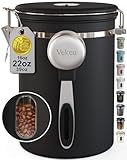
Veken’s windowed canister is built around a practical bet: that you will tolerate a small viewing window in exchange for never being surprised by an empty canister. The body is airtight stainless steel with a sealing lid, and the window lets you gauge remaining beans at a glance — genuinely handy in a busy household where two people both assume the other bought coffee. For beans consumed within a couple of weeks, the small light exposure through the window is a minor trade.
Purists will note, correctly, that any window admits light and light is an enemy. The mitigation is placement: keep the canister in a cupboard or a shaded corner of the bench and the window costs you almost nothing. If your beans routinely last three weeks or more, consider the fully opaque options below — or split your supply, with the week’s working beans in the windowed canister and the rest sealed away, a strategy we expand on in our freezer storage guide.
AirScape Stainless Steel Canister
The Airscape’s patented inner lid is the cleverest mechanism in coffee storage: a plunger you press down into the canister until it rests on the beans themselves, forcing the air out through a one-way valve as it descends. Instead of sealing a jar half-full of oxygen, you remove the oxygen. As the bean level drops, the lid follows it down, so the headspace stays minimal for the life of the batch. It is the design that takes the chemistry most seriously, and it has earned its cult following.
At forty-four dollars it costs twice what the simple canisters do, and the plunger adds a step to every refill. Whether that is worth it depends on your pace: a household that finishes a bag in ten days will barely taste the difference, while a one-espresso-a-day brewer working through the same bag over a month absolutely will. Slow drinkers, decaf-on-the-side households, and anyone storing premium beans — say, a rotating selection like an espresso sampler pack — get the most from the design.
Veken Coffee Canister (Stainless)
This is Veken’s windowless stainless canister: the same airtight construction as its windowed sibling at the same price, minus the glass. Choosing between the two is refreshingly simple — do you want to see your beans or protect them from every photon? The opaque body makes this version the more conservative choice for anyone who stores coffee on an open counter near a sunny window, where the viewing panel would work against you several hours a day.
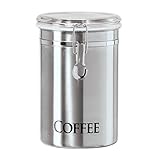
Like most canisters in this tier it seals with a gasketed lid, which protects well against oxygen ingress but does not remove the air already inside. The practical workaround costs nothing: keep the canister matched to your consumption so it is usually fairly full, and decant big bags into a second container. For the price of one Airscape you can run two Vekens — one for espresso beans, one for the cold brew blend — which is honestly how many households end up organized.
Planetary Design Airscape Canister
This is the Airscape again in a separate listing — same Planetary Design engineering, same patented air-expelling inner lid, same price point. We include it because both listings circulate widely and shoppers understandably wonder whether they differ; functionally, you are buying the same mechanism, and your choice can come down to the size and finish on offer in each listing at the moment you order. The stainless body and bail-style outer lid are shared across the line.
One practical note that applies to any Airscape: the plunger lid needs a few inches of free height above the canister to remove and reseat, so measure your shelf clearance if it will live in a cupboard. And because the inner lid touches the beans, give it the occasional wash — oily dark roasts in particular will film it over time, the same slow rancidity that afflicts neglected grinder hoppers and group screens.
Canister with Window, Scoop & Airtight Lid
The budget pick bundles the windowed-canister concept with a scoop and an airtight stainless body for under sixteen dollars. The included scoop matters more than it seems: dipping a dedicated scoop is gentler on beans than pouring from a heavy canister, which tumbles and chips brittle roasts, and it keeps your hands — and their moisture — off the beans entirely. For a first canister, or for outfitting the office coffee corner, the value here is excellent.
The compromises are the predictable ones at this price: the gasket and hinge are the parts to watch over years of daily use, and the window carries the usual light caveat. But the gap between this canister and the retail bag it replaces is enormous, while the gap between it and the premium options is real but modest. If a tight budget has you choosing between storage and other gear, take this and put the savings toward fresher beans — the combination outperforms an expensive canister full of supermarket coffee, a logic that also runs through our guide to coffee alternatives for the caffeine-curious.
Coffee Gator 11oz Canister
The Coffee Gator is the canister that mainstreamed the one-way valve: a small vent in the lid that lets the CO2 escaping from fresh-roasted beans flow out without letting oxygen flow in. That solves a genuine problem the plain-sealed canisters ignore — really fresh beans gas off vigorously for days after roasting, and in a hard-sealed container that pressure has nowhere to go. The 11-ounce size suits a typical retail bag, and the steel body is fully opaque.
The 11oz capacity is also the main limitation for bulk buyers; households that order by the kilo will want this as the daily-use vessel fed from larger sealed storage. The valve itself is a wear part in the loosest sense — it simply works until it does not, years out — and the brand’s long run at the top of this category means replacement lids are easy to find. For drip-bag drinkers branching into espresso, or anyone making whipped coffee from a jar of instant who is ready to graduate to beans, it remains the default starter vault.
What to Look For in a Coffee Storage Vault
Stripped of branding, every coffee canister is a set of answers to the same four chemistry questions. Here is how to read a product page like a coffee scientist.
- True airtight seal — A gasketed, latching lid is the minimum. If the lid just rests or twists loosely, it is a cookie jar, not a coffee vault.
- Light protection — Fully opaque bodies protect best. Windows trade a little protection for convenience; if you choose one, store it away from direct sun.
- Headspace management — Plunger designs like the Airscape expel air as beans deplete; standard canisters protect best when kept reasonably full. Match canister size to your real consumption.
- CO2 handling — Fresh beans release gas for days after roasting. A one-way valve vents that pressure without admitting oxygen — valuable if you buy within a week of roast date.
- Capacity versus buying habits — A canister that holds exactly one bag, refilled often, beats a half-empty giant. Bulk buyers should run a small daily canister plus sealed reserve storage.
- Cleanability — Coffee oils accumulate on interior walls and lids and eventually go rancid. Wide mouths, simple gaskets, and removable seals make the monthly wash painless.
Tips for Getting the Most Out of Your Coffee Storage Vault
Date everything. The single highest-value habit in coffee storage costs nothing: write the roast date (or failing that, the opening date) on a piece of tape on the canister every time you refill it. Staling is too gradual to taste day by day, and without a date you will happily drink six-week-old beans while blaming your grinder for dull shots. With a date, you know to size your buying so beans are finished within two to four weeks of roast — the realistic peak window for espresso.
Match the vault to a two-tier system if you buy in bulk. Keep a small working canister on the bench holding a week of beans, and store the remainder in larger sealed containers somewhere cool and dark — or frozen in portions if you have stocked up months ahead. Opening the big reserve once a week instead of twice a day cuts its oxygen exposure dramatically. The working canister takes the daily abuse; the reserve stays pristine. This also keeps your bench tidy — valuable once your setup grows to include syrup bottles and the rest of the flavored-latte arsenal.
And keep the vault away from the espresso machine. It is tempting to park the canister beside the machine for workflow, but that spot bathes it in heat from the boiler and steam from the wand — two accelerants you bought the canister to avoid. Give it a shelf or a cool corner one step away. Your future self, tasting a bright, sweet shot from the last third of the bag instead of a flat one, will consider the extra arm’s reach a bargain.
Frequently Asked Questions
How long do coffee beans stay fresh in a storage vault?
A good airtight, opaque canister keeps espresso-grade beans near their peak for roughly two to four weeks past roast, versus a week or so in a rolled-down bag. Plunger-style designs that expel headspace air stretch the tail end of that window further. Whole beans always; ground coffee fades in days regardless of container.
Is an Airscape-style plunger really better than a normal airtight canister?
Mechanically, yes — removing the air beats sealing it in, and the advantage grows as the canister empties. Practically, the difference matters most for slow drinkers who take three weeks or more to finish a batch. Fast-drinking households empty the canister before the standard design’s headspace oxygen does real damage.
Should I store coffee beans in the fridge?
No — the fridge is the worst of both worlds: not cold enough to halt staling, full of odors coffee absorbs, and prone to condensation every time the container comes out. Use an airtight canister at room temperature for working beans, and a properly sealed freezer stash only for long-term reserves.
Do I need a canister with a CO2 valve?
Only if you buy very fresh coffee. Beans roasted within the past week gas off enough CO2 to pressurize a hard-sealed container, and a one-way valve vents it safely. If your beans are typically two weeks or more past roast when opened, degassing has largely finished and a plain airtight seal serves you equally well.