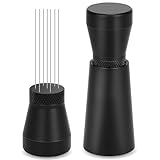
- Top Pick: WDT Espresso Distribution Tool Espresso Stirrer Tools for Barista, 0.35mm 7 Needles Espresso Coffee Stirrer with Extra 7 Replaceable Needles, Aluminum Alloy Handle with Stand (Black)
- Best Value: Zolunu Espresso Coffee Stirrer 5 Needles 0.4mm Espresso Distribution Tools, Natural Wood Handle and Stand (Walnut)
- Premium Choice: Nessus WDT Espresso Distribution Tool, Espresso Accessories with Built-in Cleaning Brush, 0.35mm 10 Needle Distributor and Extra 10 Needles for Espresso Stirrer, Aluminum Handle with Stand for Barista
Last updated: October 20, 2026
Disclosure: As an Amazon Associate we earn from qualifying purchases. This page contains affiliate links and we may earn a commission at no extra cost to you.
Ask any home barista what finally fixed their spritzing, channeling, sour-and-bitter-at-the-same-time shots, and the answer is almost never a new machine. It is nearly always puck prep. A distribution tool — the spinning, wedge-bottomed gadget you twist over freshly dosed grounds — levels the coffee bed before tamping so water flows through the puck evenly instead of punching escape routes through the loose spots. For the price of a bag of specialty beans, it removes one of the biggest variables in espresso.
As an Amazon Associate we earn from qualifying purchases at no extra cost to you.




The catch is that distribution tools are sold in a confusing spread of sizes: 51mm, 53mm, 54mm, 58mm, and the slightly oversized 58.5mm or 58.35mm variants that hug the basket wall more closely. Buy the wrong diameter and the tool either jams in the basket or leaves an untouched ring of grounds around the edge, which defeats the entire purpose. If your shots taste harsh no matter what you do, it is worth reading our breakdown of why espresso turns bitter and how to fix it alongside this guide, because distribution problems and grind problems often masquerade as each other.
Below are six distribution tools we recommend across every common portafilter size, from budget levelers for De’Longhi and Breville machines to a gravity-adaptive tool for 58mm prosumer setups. Each pick gets a short honest review, followed by buying criteria, technique tips, and answers to the questions we hear most often.
🛒 Best Price Today on Amazon
Prime members get fast, free shipping on everything above, plus member-only deals. New members get a 30-day free trial — cancel anytime.
Quick Comparison
| Product | Price | Rating |
|---|---|---|
| 53mm Coffee Distributor & Leveler | $12.88 | 5.0/5 |
| 58mm Coffee Distributor | $17.99 | 4.7/5 |
| MATOW 53mm Coffee Distributor | $19.99 | 4.7/5 |
| 51mm Coffee Distributor & Leveler | $16.99 | 4.7/5 |
| Normcore 58.5mm Gravity Distributor | $39.99 | 4.7/5 |
| 54mm Walnut Distribution Tool | $39.99 | 4.7/5 |
Why Trust This Guide
See also: 6 Best Knock Box Mats (October 2026) Reviews & Picks • 6 Best Profitec Accessories (October 2026) Complete Guide
We pull shots daily on home machines across the common portafilter sizes and evaluate accessories on fit, build quality, adjustability, and whether they actually change what ends up in the cup. Recommendations here are based on hands-on use and careful comparison of published product information — we do not quote specifications we cannot verify, and we never let price alone decide a ranking.
53mm Coffee Distributor & Leveler
This is the cheapest sensible entry point for owners of 54mm Breville machines, whose baskets accept a 53mm tool with the right amount of clearance. The adjustable depth collar threads smoothly, and the angled fins do exactly what a leveler should: a few light twists and the bed of grounds sits flat and uniform instead of mounded in the middle.
At this price you accept some compromises. The finish is more workmanlike than luxurious, and the depth markings are a guide rather than a precision scale, so you will want to dial in your preferred setting by feel and then leave it alone. For a first distribution tool on a Bambino or Barista Express, though, it is an easy recommendation — the improvement in shot consistency far outweighs the modest cost.
58mm Coffee Distributor
Owners of 58mm machines — Gaggia Classic, Rancilio Silvia, and most prosumer setups — should start here. The 58mm size is the commercial standard, and this distributor’s weight does much of the work for you: rest it on the basket, spin two or three times, and the grounds settle into a level, lightly compacted bed that takes a tamp beautifully.
The adjustable depth mechanism holds its position once locked, which matters more than it sounds; cheaper tools can drift a quarter-turn over a week of daily use and quietly change your prep. The one caveat is that a flat 58mm tool leaves a small gap at the basket wall, so finish with a confident, level tamp rather than treating the leveler as a tamper substitute.
MATOW 53mm Coffee Distributor
MATOW has built a quiet reputation among Breville owners, and this 53mm distributor shows why. Machining is a clear step up from generic alternatives — threads feel tight, the fins are cleanly polished, and the heft gives the tool a planted, deliberate spin. It pairs especially well with stock Breville baskets, which are shallower than commercial ones and punish uneven prep.
Compared with the budget 53mm option above, you are paying a few dollars more for nicer tolerances and a more confident adjustment collar. If you make milk drinks daily and your espresso workflow already includes a good frother — see our full guide to the best milk frothers for home espresso — this is the kind of small upgrade that keeps the coffee side of the drink as polished as the milk side.
51mm Coffee Distributor & Leveler
The 51mm crowd — De’Longhi Dedica owners, many entry-level and portable machines — is chronically underserved by accessory makers, which makes a properly sized 51mm leveler genuinely valuable. This one fits snugly in Dedica baskets and transforms prep on a machine that ships with a flimsy plastic tamper and no distribution help at all.
Small baskets are unforgiving: the same clump that would barely matter in a 58mm basket can channel an entire 51mm shot. A few twists of this tool, then a firm tamp, and Dedica shots run noticeably slower and sweeter. It is the single best sub-$20 upgrade for compact machines, and a sensible companion purchase if you are still deciding between brew methods — our French press vs pour over comparison explains why espresso demands this level of fuss while other methods forgive it.
Normcore 58.5mm Gravity Distributor
Normcore’s gravity-adaptive distributor is the enthusiast pick of this list. The 58.5mm diameter closes the gap at the basket wall that standard 58mm tools leave, and the self-leveling gravity design lets the head float so it follows the coffee bed rather than your wrist angle. In practice this makes good prep less dependent on technique — exactly what a tool should do.
It costs roughly twice as much as a basic leveler, and on a budget machine with pressurized baskets you will not taste the difference. But on a 58mm machine with non-pressurized baskets and a capable grinder — if you are still shopping for one, start with our espresso grinder guide — it is the distribution tool we would buy with our own money.
54mm Walnut Distribution Tool
This walnut-and-stainless 54mm tool is for Breville owners who want a true 54mm fit rather than the 53mm workaround, plus something that looks at home on a nicely arranged coffee bar. The wood collar is comfortable to grip and twist, the stainless base adds useful weight, and the adjustable depth mechanism is smooth and repeatable.
You pay for the materials — it is the same price as the Normcore — so this is partly an aesthetic decision. Functionally it earns its keep with the closer fit in Breville baskets, leaving less untouched coffee at the rim than a 53mm tool. If your counter setup already leans warm and woody, it is a lovely match; if you only care about the shot, the MATOW does ninety percent of the job for half the cost.
What to Look For in a Coffee Distribution Tool
Distribution tools look interchangeable in photos, but a handful of details separate the ones that improve your espresso from the ones that just flatten the top layer for show.
- Exact diameter match — Measure your basket, not your portafilter spouts. Breville machines typically take 53–54mm tools, De’Longhi compacts 51mm, and prosumer machines 58mm or the snugger 58.35–58.5mm variants.
- Adjustable depth that locks — The fins should reach the lower portion of the coffee bed, not just graze the surface. A collar that locks firmly and stays put preserves your settings shot after shot.
- Meaningful weight — A heavier tool settles the grounds under its own mass with light spins, which is more repeatable than pressing down a featherweight tool by hand.
- Fin geometry — Gentle, sloped wedges redistribute grounds outward smoothly; aggressive or sharp fins can compact unevenly and create their own density pockets.
- Machining quality — Clean threads, no rattle, and a smooth spin matter for a tool you will use multiple times daily for years.
- Grip and comfort — Knurled metal or a wood collar gives controlled rotation; glossy smooth tops get slippery the moment espresso prep gets a little dusty.
Tips for Getting the Most Out of Your Distribution Tool
A leveler works best on grounds that are already loosely declumped. Give the portafilter a gentle side-to-side shake or a few taps after dosing, or stir with a fine needle tool first if your grinder clumps badly. Then rest the distributor on the basket, spin it two or three full rotations with almost no downward pressure, and let the weight of the tool do the settling. Finish with a level tamp — the distributor prepares the bed, but it does not replace compaction.
Set the depth so the fins just reach into the body of the dose without bottoming out against the basket. Too shallow and you are polishing the surface while leaving voids underneath; too deep and the tool plows the bed around instead of leveling it. Once dialed, resist fiddling: consistency is the entire point. The reward shows up most clearly in milk drinks, where a sweeter, more even shot needs less syrup to taste balanced — though if you enjoy flavored lattes anyway, our tour of the best coffee syrup flavors pairs well with properly pulled shots.
Finally, remember that distribution cannot rescue a bad grind or stale beans. If shots still gush or choke after your prep is consistent, adjust grind size first. Even espresso destined for dessert drinks deserves this care — a clean, balanced shot is what makes an affogato taste intentional rather than accidental, and it is the right base for cold foam coffee as well.
Frequently Asked Questions
Do I really need a distribution tool if I already tamp well?
Tamping compacts the bed but cannot fix uneven density underneath — it just locks the unevenness in place. A distributor levels and settles the grounds before the tamp, so the two tools solve different problems. Most home baristas notice fewer fast, spritzy shots within the first week of using one.
What size distribution tool fits a Breville Barista Express or Bambino?
Breville’s portafilters are nominally 54mm, and both 53mm and true 54mm tools are sold for them. A 53mm tool offers easy clearance with a small untouched ring at the rim; a 54mm tool fits closer but must be well made to avoid binding. Either works — just avoid 51mm and 58mm tools entirely.
Is a gravity or self-leveling distributor worth the extra money?
On a non-pressurized 58mm setup with a decent grinder, yes — the floating head removes wrist angle from the equation and makes prep more repeatable. On entry-level machines with pressurized baskets, the basket itself masks most prep differences, so a basic leveler is the smarter spend.
Should I use a WDT needle tool, a distributor, or both?
They complement each other. A needle tool breaks up clumps through the full depth of the dose, while a spinning distributor levels and settles the surface. If you only buy one, clumpy grinders benefit more from needles, while decent grinders gain more from a leveler — but the combination, plus a steady tamp, is the gold standard of home puck prep.