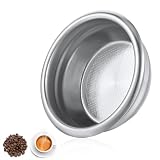
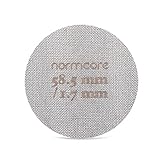
- Top Pick: Normcore 53.3mm Puck Screen – Lower Shower Screen – Metal Contact Screen for Espresso 54mm Portafilter Filter Basket – 1.7mm Thickness 150μm – 316 Stainless Steel
- Best Value: 2 Pack 53.3mm Espresso Puck Screen, Reusable 1.7mm Thickness 150μm Coffee Filter Mesh Plate for Espresso Portafilter Filter Basket (53.3mm,150μm)
- Premium Choice: 2 Pack 51mm Espresso Puck Screen, Reusable 1.7mm Thickness 150μm Coffee Filter Mesh Plate for Espresso Portafilter Filter Basket (51mm,150μm)
Last updated: September 4, 2026
As an Amazon Associate we earn from qualifying purchases at no extra cost to you.





Disclosure: As an Amazon Associate we earn from qualifying purchases. This page contains affiliate links and we may earn a commission at no extra cost to you.
A puck screen is a thin perforated disc that sits on top of your tamped coffee, between the puck and the machine’s shower screen. For an object the size of a cookie and the weight of a coin, it earns its bench space twice over. First, it spreads the incoming water across the puck face instead of letting the shower screen’s spray pattern dig at specific spots — a gentler, more uniform start to extraction, especially on machines whose water distribution is more enthusiastic than even. Second, it keeps wet coffee from blasting up into the group head, which means a dramatically cleaner shower screen and gasket, and pucks that knock out dry and intact.
The honest framing matters here, because puck screens attract both hype and backlash: the flavor improvement is real but situational — biggest on machines with crude water dispersion and during long pre-infusions — while the cleanliness benefit is universal and immediate. If you’ve ever wiped brown sludge off your group head two days running, that alone justifies the ten dollars. The deeper mechanics of gentle puck wetting are worth understanding too; our pre-infusion guide covers why slow, even saturation makes shots sweeter and more forgiving.
The market has split into two design philosophies — substantial mesh screens around 0.8mm thick that hold shape for years, and ultra-thin 0.2mm foils that minimize water retention and temperature impact — plus bundles that pair screens with dosing funnels or full prep kits. The six picks below span all of it, from an eight-dollar two-pack to a complete bench setup. Whichever you choose, the goal is the same: an extraction even enough that the only thing deciding your shot’s flavor is the coffee, not the plumbing. When shots still misbehave, our rundown of bitter espresso fixes is the companion read.
Quick Comparison
| Product | Price | Rating |
|---|---|---|
| 58mm Full Accessories Kit | $168.25 | 5.0/5 |
| Funnel + Puck Screen Set | $39.97 | 5.0/5 |
| Magnetic Funnel & Screen Set | $29.99 | 4.8/5 |
| 58.5mm 4-Piece Screen Set | $15.49 | 4.7/5 |
| 316 Ultra-Thin Screens (3-Pack) | $9.98 | 4.7/5 |
| 58.3mm Dual-Layer Screens (2-Pack) | $8.19 | 4.7/5 |
Why Trust This Guide
See also: 6 Best Knock Box Mats (October 2026) Reviews & Picks • 6 Best Profitec Accessories (October 2026) Complete Guide
We use puck screens daily across home machines and judge them on verifiable traits — material grade, thickness, diameter fit, and what’s actually in the box — informed by long experience with what survives months of twice-a-day espresso. We’re candid that this is a marginal-gains accessory: we’ll tell you what a screen genuinely does, what it doesn’t, and which one fits how you brew.
58mm Full Accessories Kit
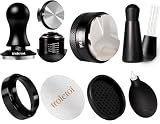
This is the everything-at-once option: a complete 58mm puck-prep station that bundles the screen together with a tamper, distribution tool, tamping base, and the supporting cast of a serious espresso bench. At $168 it’s obviously not a puck screen purchase — it’s an outfitting decision for someone setting up a new 58mm machine who would rather buy a coherent kit than research six accessories separately.
The economics can work if you genuinely need most of the pieces; matching tools also share sizing and finish, which is more practical than it sounds when everything seats correctly on the same baskets. The caution is the usual one with kits: you inherit the bundle’s choices instead of picking each tool, and enthusiasts usually end up replacing one or two pieces with favorites. Buy it as a strong, tidy starting point — not as the last word on any single tool in the box.
Funnel + Puck Screen Set
This stainless pairing — a 58mm dosing funnel plus a matching puck screen — bookends your puck prep: the funnel keeps grounds in the basket while you dose and stir, and the screen evens the water’s arrival once the shot starts. They’re natural partners because they fix the two messes of espresso making, the one before the shot and the one after.
The funnel earns its keep the first time you WDT-stir without redecorating the counter in coffee dust, and the screen’s contribution shows up that evening when the shower screen wipes clean instead of needing a scrub. At about forty dollars it’s priced as a premium set, and the build justifies it — solid stainless with proper fit on standard 58mm baskets. For a methodical barista without a funnel yet, this is two permanent workflow upgrades in one box.
Magnetic Funnel & Screen Set
The clever twist here is magnetic attachment: the dosing funnel snaps onto the portafilter rim and holds itself in place, leaving both hands free for grinding, stirring, and tamping prep. Anyone who has chased a loose funnel across the bench mid-stir understands immediately. The included 58mm puck screen completes the set, and the combined price undercuts buying comparable pieces separately.
Hands-free positioning sounds like a luxury until single-dosing workflows make it routine — grind into the portafilter under the chute, stir with the funnel still attached, lift it away cleanly, tamp. The magnetic ring needs an occasional wipe to keep grounds from clinging to it, which is the design’s only real tax. For 58mm machine owners building a fast, tidy morning routine, this is the most workflow-per-dollar in the roundup.
58.5mm 4-Piece Screen Set
Four substantial screens — 0.8mm-thick 304 stainless at 58.5mm — plus a stand to dry and store them on. The thicker mesh construction is the durable school of puck screen design: these hold their flatness through years of tamping pressure, daily rinsing, and the occasional drop, and the slightly oversized 58.5mm diameter suits precision baskets that run large, sitting flush to the wall with minimal gap.
Why four? Because screens in rotation are screens that get used — one in the basket, one drying, spares for the inevitable day a screen wanders off inside a knock-box. The stand is a small touch that solves the real annoyance of screens drip-drying on a towel. Tradeoffs: thick screens hold a bit more water and heat than foil-thin ones, and you should verify your baskets accept 58.5mm. For most 58mm setups, this is the practical, set-for-years choice.
316 Ultra-Thin Screens (3-Pack)
The minimalist school: 0.2mm foil-thin screens in 316 stainless, three to a pack, at about ten dollars. The ultra-thin profile is the point — almost no thermal mass to steal heat from the brew water, almost no water retained on top of the puck after the shot, and negligible headspace consumed in tight baskets where a thick screen can crowd the shower screen.
The 316 alloy is the more corrosion-resistant grade of stainless, a nice touch for an object that lives wet and acidic. The tradeoff for thinness is delicacy: these can crease if pried carelessly off a sticky puck, which is exactly why they sell in multipacks. Handle them by the edge, rinse immediately, and they last fine. For brewers sensitive to temperature stability — or anyone whose machine has minimal clearance above the basket — thin is the right school.
58.3mm Dual-Layer Screens (2-Pack)
The budget pick with a thoughtful spec: two 58.3mm screens in a dual-layer design that pairs a fine mesh with a supporting structure, aiming for even flow distribution while keeping the disc flat under pressure. The 58.3mm diameter is a smart middle path — closer-fitting than a standard 58mm screen in precision baskets, without the snugness of a full 58.5mm.
At eight dollars for two, this is the lowest-risk way to find out what a puck screen does for your particular machine — and that experiment is genuinely worth running, because the benefit varies between machines more than any other accessory we know. If the screens prove their place in your routine, you’re set; if not, you’ve spent less than two café lattes learning something about your group head’s water dispersion. That’s a fair bargain either way.
What to Look For in an Espresso Puck Screen
Puck screens are simple discs, so the differences hide in millimeters and metallurgy. Check these before buying.
- Diameter match — screens come in 58, 58.3, and 58.5mm (and smaller for compact machines). The closer the screen sits to your basket’s true wall, the less coffee creeps around its edge; precision baskets usually want the larger sizes.
- Thickness philosophy — ~0.8mm mesh screens are durable and stay flat for years; ~0.2mm foils minimize heat theft and retained water but demand gentler handling. Pick the school that matches your patience.
- Material grade — 304 stainless is the solid standard; 316 adds corrosion resistance for a part that lives in hot, acidic liquid. Avoid anything that doesn’t state its alloy.
- Layer construction — dual-layer and mesh-sandwich designs aim for finer water dispersion than simple drilled plates; they also trap more coffee oils, so weigh flow quality against cleaning effort.
- Headspace clearance — a screen adds height on top of your dose. If you run full baskets, confirm there’s still room below the shower screen, or downsize the dose slightly.
- Sensible bundling — multipacks and funnel pairings are real value; full kits are only worth it if you need most of the contents. Never pay kit prices for one disc you wanted.
Tips for Getting the Most Out of Your Puck Screen
Placement is the whole technique: tamp first, then lay the screen flat on the compacted puck — never tamp on top of the screen on machines where it can bind, and never let it sit tilted against the basket wall. After the shot, the screen usually clings to the group’s shower screen or rides the puck into the knock box; retrieve it promptly, rinse it hot, and let it dry where air reaches both faces. A screen left in the drip tray sludge grows into a science project by Thursday.
Re-check your recipe the week you adopt one. A screen subtly changes flow resistance and headspace, so shots may run a second or two differently than your established baseline — treat it like any variable change and confirm your numbers instead of assuming. Deep-clean weekly with espresso machine cleaner to strip the oils that fine mesh loves to hoard; a blinded screen quietly becomes a flow restrictor, which is the opposite of its job.
Then enjoy the dividends where they actually appear: in the cup and on the schedule. Cleaner extractions mean a sweeter base for an oat milk latte or a weekend affogato, less scrubbing means more time to play with cold foam or the syrup collection, and dry pucks mean a knock box that empties in one clean thwack. Pair the tidier shots with properly textured milk — our milk frother guide has that side handled — and the whole routine levels up together.
Frequently Asked Questions
Do puck screens actually improve espresso taste?
Sometimes, and honestly it depends on your machine. Screens help most where the shower screen’s water distribution is uneven or pre-infusion is long — they spread the initial flow so the puck wets uniformly. On machines with already-excellent dispersion the taste change is small; the cleanliness benefit, though, applies to every machine.
Does a puck screen go on before or after tamping?
After. Prepare and tamp the puck normally, then rest the screen flat on the compressed surface before locking in the portafilter. Tamping with the screen in place can press it into the coffee unevenly, and in some baskets it shifts position during the tamp.
Thick or ultra-thin — which puck screen is better?
Different tradeoffs. Thicker (~0.8mm) mesh screens are nearly indestructible and stay flat for years, but hold slightly more water and heat. Ultra-thin (~0.2mm) screens minimize thermal impact and retained liquid but crease if mishandled. Daily-driver durability favors thick; temperature-obsessed brewing favors thin.
How do I clean a puck screen?
Rinse hot immediately after each shot, and soak weekly in espresso machine cleaner to dissolve trapped oils — fine mesh clogs invisibly, and a blinded screen restricts flow. Hold it to the light: if water doesn’t pass evenly everywhere, it’s due for a soak. Dry fully before storing to keep any alloy happy.