Last updated: October 20, 2026
The Breville Bambino BES450 is the best compact espresso machine in this group for most small kitchens: it heats in about 3 seconds, uses a 54 mm portafilter and brews at about 9 bar. If you want to spend less and like a pressure gauge, the CASABREWS CM5418 or 3700 Essential are the practical alternatives. Two compact drip makers and one steam-driven unit are included as clearly labeled runner-ups for readers who want brewed or espresso-style coffee, not true espresso. Every pump machine here needs a separate grinder.
Quick List
- Breville Bambino BES450 – best for fast heat-up and a proper 9 bar shot
- CASABREWS CM5418 – best for beginners who want a pressure gauge and steam wand
- CASABREWS 3700 Essential – best for a larger tank and one-touch shot presets
- XIXUBX 20 Bar PID (White) – best for a narrow body with temperature control
- BYESHOP 20 Bar Touchscreen – best for touch controls and dual gauges
- XIXUBX 3.5 Bar Steam Machine – best for the lightest, smallest espresso-style option
- KRUPS Simply Brew Compact – best compact drip runner-up for one or two cups
- HousesAid 5 Cup Compact – best simple, small drip runner-up
Which One Is Right for You?
See also: How to Descale an Espresso Machine: Citric Acid vs Vinegar • Best Electric Kettles: Ten Glass, Steel and Gooseneck Picks Compared
| If you… | Choose |
|---|---|
| Want the most authentic shot and fast warm-up | Breville Bambino BES450 |
| Are new to espresso and want a gauge to learn from | CASABREWS CM5418 |
| Want a bigger tank and preset single/double buttons | CASABREWS 3700 Essential |
| Care about PID temperature control in a narrow body | XIXUBX 20 Bar PID |
| Prefer a touchscreen and readouts for pressure and temperature | BYESHOP 20 Bar |
| Want the smallest, lightest milky-coffee machine and accept it is not true espresso | XIXUBX 3.5 Bar |
| Drink one or two mugs of drip with pause-and-pour | KRUPS Simply Brew Compact |
| Want the simplest on/off small drip maker | HousesAid 5 Cup |
The key question is whether you want real espresso. Only machines whose pump holds about 9 bar at the coffee can deliver it. Next, check your counter, because listed footprints vary by source.
All 8 Picks in Detail
1. Breville Bambino BES450 – Best for Overall Compact Espresso
As an Amazon Associate we earn from qualifying purchases at no extra cost to you.

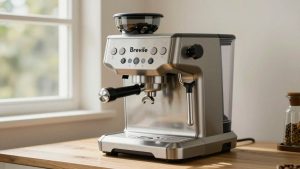
The Bambino suits anyone who wants a real shot in a small body and is willing to buy a separate grinder. Breville’s ThermoJet system reaches extraction temperature in about 3 seconds, so there is no long warm-up.
- 54 mm portafilter built around an 18 g dose
- 15 bar Italian pump with about 9 bar at extraction, after low-pressure pre-infusion
- Single and dual-wall baskets, milk jug, tamper and cleaning tools included
- Water tank of about 47 fl oz and 1560 W heating, per most listings
- Manual steam wand for microfoam
Setup is straightforward. The baskets are designed around an 18 g dose, and Breville says the dual-wall baskets help regulate pressure regardless of grind, dose, tamp or coffee freshness, which makes the first weeks more forgiving. The instruction book also describes low water pressure at the start of the shot to expand the grounds gently before full extraction. Plan on roughly 7.7 inches of width and 12.6 inches of depth, which is the figure most retailers quote, and leave a couple of extra inches at the front for the portafilter handle.
Pros: very fast heat-up; proper 9 bar extraction; bundled jug and tools.
Cons: no built-in grinder; the manual steam wand needs practice; listed dimensions differ by source (widths from about 6.3 to 7.7 inches), so verify against the product page.
Compared with the CASABREWS CM5418, it drops the pressure gauge but gains a larger portafilter and a faster heater.
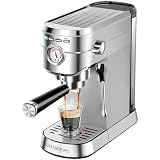
2. CASABREWS CM5418 – Best for Beginners Who Want a Gauge

The CM5418 is a compact, semi-automatic machine with a built-in pressure gauge, which gives newcomers a visual cue while they learn grind size and tamp pressure.
- 20 bar pump rating, 1350 W
- 34 oz removable tank
- 51 mm portafilter with dual-wall baskets
- Manual steam wand and about 1 minute heat-up
- Roughly 5.5 to 5.9 in wide, 12.3 in deep and 12 in tall, per listings
Beginners benefit from the gauge, which gives a visual cue when you adjust grind size or tamp. One written review notes that the dial has no bar markings and that an over-pressure valve appears to limit pressure, so use it as a relative guide, not a calibrated reading. The dual-wall baskets are forgiving, and non-pressurized aftermarket 51 mm baskets can be swapped in later if you want to progress. Another reviewer found the basket does not sit perfectly in the portafilter and can fall out when removing a used puck, so handle it carefully.
Pros: narrow footprint; helpful gauge; forgiving baskets for beginners.
Cons: the steam wand is slow, with one reviewer reporting 85 to 95 seconds for 6 oz of milk; one thermoblock means waiting between brewing and steaming; plastic parts and a cast aluminum portafilter.
Next to the 3700 Essential it has a smaller tank but a built-in gauge.
3. CASABREWS 3700 Essential – Best for Bigger Tank and Presets

The 3700 Essential suits people who make several drinks per day and prefer pressing a button for a single or double shot over timing it.
- 20 bar pump rating and 1350 W thermoblock heating
- 43.9 oz removable water tank
- Preset volumes of 30 ml (single) and 60 ml (double)
- 51 mm portafilter with one- and two-cup filters, tamper and spoon
- About 5.7 in wide, 12.6 in deep and 12.5 in tall, with a weight near 8.1 lb
The box includes 51 mm one-cup and two-cup filters, a portafilter, and a tamper with a coffee spoon, plus a manual and recipes. The 30 ml and 60 ml presets are volume-based, so the shot length stays the same even if your grind drifts, which means you still need to adjust the grinder to get a good taste. Listings disagree on dimensions: most give about 12.6 inches deep and 12.5 inches tall, while one retailer shows much larger numbers that look like shipping-box size. Treat the first set as the machine and confirm before you measure your shelf.
Pros: the largest tank in the 51 mm group; simple presets; steel steam wand.
Cons: the 20 bar figure is a pump rating, not the pressure at the puck; steam performance is not documented in the sources checked; confirm whether your listing includes a gauge, since the gauge-equipped CASABREWS models are separate products.
It is the pick over the CM5418 when tank size and presets matter more than a gauge.
4. XIXUBX 20 Bar PID (White) – Best for a Narrow Body With Temperature Control

This white XIXUBX is aimed at small kitchens where looks and footprint matter. Its listing highlights PID temperature control, low vibration, and gentle pre-infusion.
- 20 bar rating with PID temperature control
- 34 fl oz removable tank
- Listed at about 11.4 in deep, 6.7 in wide and 11.8 in tall
- Built-in milk frother and auto shut-off
- Related XIXUBX listings use a 51 mm portafilter; confirm on this one
The listing highlights PID temperature control, low-pressure pre-infusion, auto shut-off and a removable tank. One review site says the PID stabilizes brewing temperature and prevents fluctuations. Because PID claims on budget machines are hard to check, look in the manual for a stated target temperature or an adjustable setting before relying on the feature. At about 11.4 inches deep, it is among the shallowest pump-driven machines in this group, which is why it works on shallow counters.
Pros: shallower depth than most in this group; PID aims at steadier brew temperature.
Cons: wattage and heat-up time were not published in the sources checked; the 20 bar figure is a pump rating; fewer long-form reviews than the Breville.
Against the BYESHOP it trades touchscreen features for a narrower, simpler design.
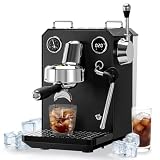
5. BYESHOP 20 Bar Touchscreen – Best for Touch Controls and Dual Gauges

The BYESHOP appeals to readers who like data on the front panel. It shows pressure and temperature readouts and offers one-cup and two-cup presets, with a long press to adjust shot volume and extraction time.
- 20 bar rating, semi-automatic, ground coffee
- 1.1 L (about 37 oz) water tank
- LED touchscreen with dual pressure and temperature displays
- Milk frother with steam wand, filter and manual included
- Dimensions are inconsistent between listings, so confirm before buying
The listing markets a dual-display upgrade, and the touchscreen offers 1-cup and 2-cup presets that you can adjust with a long press for shot volume and extraction time. Footprint is the main uncertainty: one listing shows an implausibly small 8 by 2.5 by 2.9 inches, while another shows roughly 12 inches deep, 5 inches wide and 11 inches tall. Use the larger figure for planning, and confirm before you buy. The package lists the machine, a filter, a milk frother and a manual.
Pros: adjustable presets; generous tank; at-a-glance gauges.
Cons: wattage, portafilter size and heat-up time were not published in the sources checked; the brand has a thinner track record; electronics add one more thing that can fail.
It is the most feature-heavy alternative to the XIXUBX PID model.
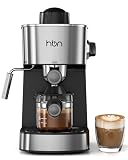
6. XIXUBX 3.5 Bar Steam Machine – Best for the Smallest Espresso-Style Footprint

This is a different category. At 3.5 bar it relies on steam pressure, far below the roughly 9 bar needed for true espresso, so expect a strong, espresso-style coffee, not crema-topped shots.
- 800 W heating, about 2 minutes to brew
- 240 ml capacity with a one-touch four-cup design
- About 8.3 in deep, 6 in wide, 11.8 in tall, and 3.3 lb
- Single knob for brew, steam and off
- Safety lock, Tritan cups and a steam wand
Steam-driven designs like this one work very differently from pump machines, and at 3.5 bar the brewing pressure is far below the roughly 9 bar used for real espresso. Read it as a compact way to make strong coffee and steamed milk for lattes and cappuccinos. It ships with a pin for clearing the steam wand, and a single knob switches between brew, steam and off, which keeps operation simple for a first-time user or a shared office. One third-party listing claims capsule compatibility, but the maker describes a permanent filter and ground coffee, so go with the maker’s description.
Pros: lightest and smallest here; easy to store and carry.
Cons: not true espresso; small capacity; plastic construction.
Choose it over the KRUPS only if you want steamed milk and a stronger cup.
7. KRUPS Simply Brew Compact 5 Cup – Best Compact Drip Runner-Up

This is a drip coffee maker, listed here as a runner-up for readers who actually want brewed coffee in a small footprint.
- 5 cups, about 25 to 26 oz of brew capacity
- Approximately 5.7 in deep, 8.1 in wide and 10.1 in tall, 2.8 lb
- Pause-and-brew: return the carafe within 20 seconds to resume
- Reusable filter and keep-warm function
- No programming
Capacity figures vary by source: one measured about 26 oz, while another lists a 27.1 fl oz reservoir with 25 fl oz of brew. In coffee-maker terms that is five 5 oz cups, or about two large mugs. The unit has no programming, so you start and stop it by hand, and the carafe must go back within 20 seconds after a mid-brew pour or coffee may overflow. The reusable filter saves on paper, but you will still need to wash it, and the lack of a timer means it will not have coffee ready when you wake up.
Pros: tiny footprint; pause-and-pour; reusable filter.
Cons: no espresso, milk frother or timer.
Its pause-and-brew feature is the main difference from the HousesAid. It also suits people who want a small appliance that is easy to store, since it weighs only 2.8 lb.
8. HousesAid 5 Cup Compact – Best Simple Drip Runner-Up

This 0.75 L, 650 W drip machine is sold for one or two people and uses a simple on/off switch with an indicator light.
- 0.75 L glass carafe with level markings
- 650 W heating
- Nonstick warming plate keeps coffee warm for about an hour
- Removable, dishwasher-safe filter basket
- One variant lists about 9.5 in deep, 10.6 in wide and 7.9 in tall
The 0.75 L carafe holds about 25 fl oz, which is enough for one or two generous mugs. The nonstick plate keeps coffee warm for about an hour, and the filter basket is removable and dishwasher safe. Several HousesAid models exist, including a version with a 2-hour auto shut-off and a separate programmable model with a digital timer, so compare listing details closely. It is a drip machine and cannot make espresso, so buy it only if that is what you need. Its small body suits a dorm shelf or an office desk, where a full-size machine would be overkill.
Pros: simple operation; small size.
Cons: several similar HousesAid models exist, with timers or auto shut-off on some, so verify the exact version; no espresso capability.
The KRUPS adds pause-and-brew, while this one wins on simplicity. Check the listing carefully for the exact version, since the pictures and features can differ between variants.
Specs Compared
| Model | Type | Pressure or power | Portafilter | Tank or capacity | Approx. footprint (W x D x H) |
|---|---|---|---|---|---|
| Breville Bambino BES450 | Semi-auto espresso | 15 bar pump, about 9 bar extraction, 1560 W | 54 mm | About 47 fl oz | Sources vary: about 6.3 to 7.7 x 12.6 to 13.7 x 12 in |
| CASABREWS CM5418 | Semi-auto espresso | 20 bar rating, 1350 W | 51 mm | 34 oz | About 5.5 to 5.9 x 12.3 x 12 in |
| CASABREWS 3700 Essential | Semi-auto espresso | 20 bar rating, 1350 W | 51 mm | 43.9 oz | About 5.7 x 12.6 x 12.5 in |
| XIXUBX 20 Bar PID (White) | Semi-auto espresso, PID | 20 bar rating | Confirm on listing | 34 fl oz | About 6.7 x 11.4 x 11.8 in |
| BYESHOP 20 Bar | Semi-auto espresso, touchscreen | 20 bar rating | Confirm on listing | About 37 oz (1.1 L) | Confirm on listing |
| XIXUBX 3.5 Bar | Steam-driven espresso-style | 3.5 bar, 800 W | Not applicable | 240 ml | About 6 x 8.3 x 11.8 in |
| KRUPS Simply Brew Compact | 5-cup drip | Drip, pause-and-brew | Not applicable | About 25 to 26 oz | About 8.1 x 5.7 x 10.1 in |
| HousesAid 5 Cup Compact | 5-cup drip | 650 W | Not applicable | 0.75 L | Confirm on listing |
How We Chose These
This guide is based on desk research of published material. We compared manufacturer pages, retailer specification tables, instruction books and independent written reviews, giving the most weight to figures that several sources agreed on. Where listings disagreed, as with the Bambino and BYESHOP footprints, we gave a range or said to confirm. We ranked espresso machines by extraction pressure, heat-up time, footprint and tank size, and placed the steam-driven unit and the two drip makers as labeled runner-ups. We did not rely on popularity badges, and we skipped any claim we could not trace to a written source. Each pick below lists its caveats.
What to Look For
Pressure: what the numbers mean
The 20 bar figure on many listings is the pump’s maximum rated output, not the pressure at the coffee. Espresso is brewed at about 9 bar, and an over-pressure valve limits what actually reaches the puck, so a 20 bar pump and a 15 bar pump deliver the same working pressure. Breville states the Bambino’s design plainly: a 15 bar pump with about 9 bar at extraction. By contrast, a 3.5 bar steam machine cannot reach espresso pressure at all. When a listing quotes a bar figure, ask whether it describes the pump or the extraction. Reviewers of the CASABREWS CM5418 note that its gauge has no bar markings, so you cannot confirm the working pressure yourself and should treat the dial as a relative cue.
Footprint and clearance
Most of the pump machines here are 5.5 to 7.7 inches wide and 11 to 14 inches deep, so a narrow counter slot is often enough. Measure depth first, including the water tank if it sticks out and the space needed to pull the portafilter forward. Height matters under cabinets, since several machines stand 12 inches or taller. Dimensions in listings often disagree, so compare at least two sources.
Here is a worked example. Suppose your nook is 8 inches wide, 14 inches deep and 13 inches tall under a cabinet. The CASABREWS CM5418 at about 5.5 to 5.9 x 12.3 x 12 inches fits with roughly 1.7 inches of spare depth and 1 inch of spare height. The Bambino at the commonly cited 7.7 x 12.6 x 12.2 inches fits with only about 0.3 inch of spare width, so you could not slide it in with items on either side.
Tank size and a worked example
A double shot uses roughly 60 ml of water. A 34 oz tank holds about 1,000 ml, so in theory it covers around 16 double shots if you did not steam or flush. In practice steaming, purging and rinsing use more water, so a 34 oz tank means refilling every few days for one or two drinkers, while 43.9 oz or 47 oz stretches that interval. The tanks run from 34 oz on the CASABREWS CM5418 and the XIXUBX PID to about 47 oz on the Bambino, and all are removable.
Baskets, grinder and steam
Pressurized dual-wall baskets use a small exit hole to build pressure and still produce crema from imperfect grinds or pre-ground coffee, which suits beginners. Non-pressurized baskets need a burr grinder and good puck prep, but reward you with better extraction. For milk drinks, check steam: a single thermoblock cannot brew and steam at once, and weaker wands take longer to heat milk. Whatever you choose, plan for a separate burr grinder.
Basket size also matters. The 51 mm CASABREWS portafilters have a smaller accessory market than the 58 mm commercial standard, and the Bambino’s 54 mm basket is designed around an 18 g dose.
Heating and warm-up
How a machine heats changes your morning. The Bambino’s ThermoJet reaches brewing temperature in about 3 seconds, the CASABREWS CM5418 lists about 1 minute, and the 3.5 bar XIXUBX takes around 2 minutes to brew. A single heating system also means you cannot brew and steam at the same moment, so plan to pull the shot first and steam the milk second.
Questions
Can a compact machine make real espresso?
Yes, if it has a pump that holds about 9 bar at the coffee. The Bambino is explicitly built around that figure, while the 3.5 bar steam machine and the drip makers cannot produce true espresso.
Does 20 bar mean better espresso than 15 bar?
No. Both figures are pump ratings, and an over-pressure valve limits pressure at the puck to a similar level. Temperature stability, baskets and your grinder matter more.
Do I need a grinder?
For the best results, yes. Pre-ground coffee works with pressurized baskets but tastes flatter. A burr grinder with fine adjustment unlocks the better baskets.
Which is best for lattes?
Breville positions the Bambino’s manual wand for microfoam and latte art, which makes it the strongest milk option here on paper. The CASABREWS machines can steam milk but more slowly, and you wait between brewing and steaming.
Are the drip makers a good substitute?
Only if you want brewed coffee. For small kitchens that mainly serve one or two mugs, the KRUPS and HousesAid use less space than an espresso setup.
Update History
- October 20, 2026 – Updated with specification checks and a revised product comparison.
- Check the product page for current specifications and availability before buying.
Sources
- Breville product page and instruction book for the Bambino BES450
- Manufacturer and retailer specification pages for CASABREWS, XIXUBX, BYESHOP, KRUPS and HousesAid
- Independent written reviews of the CASABREWS CM5418 covering steam power, baskets and gauge accuracy
- Coffee reference guides explaining 9 bar versus 20 bar pump ratings
- Espresso dose and yield guides from home-barista sites
- KRUPS instruction manual for pause-and-brew behavior