- Top Pick: KT THERMO Instand Read 2-Inch Dial Thermometer,Best for The Coffee Drinks,Chocolate Milk Foam
- Best Value: CDN ProAccurate® Instant Read Beverage Frothing Thermometer with Clip for Precise Temperature Measurement, 5" Stainless Steel Stem, Black Case (IRT220-F)
- Premium Choice: KT THERMO Instand Read 2-Inch Dial Thermometer(2 Pack),Best for The Coffee Drinks,Chocolate Milk Foam
Last updated: September 4, 2026
As an Amazon Associate we earn from qualifying purchases at no extra cost to you.




Disclosure: As an Amazon Associate we earn from qualifying purchases. This page contains affiliate links and we may earn a commission at no extra cost to you.
Milk is the half of a latte that home baristas ruin most often, and temperature is usually the murder weapon. Steam it too cool and the foam is thin and the drink lukewarm; push past the scalding point and the sweetness literally cooks away, leaving that flat, faintly eggy taste of overheated milk. The window for sweet, glossy microfoam is narrow — roughly the range where the pitcher becomes just too hot to hold comfortably — and until your hand learns that signal, a frothing thermometer is the honest referee.
These are simple instruments: an analog dial on a stainless probe, usually with a clip that holds it on the pitcher wall so you can watch the needle climb while you steam. The differences that matter are dial readability mid-froth, how securely the clip grips, response speed, and whether the marked zones match real steaming practice. None of them cost much, which makes the thermometer one of the highest-value purchases in all of home espresso.
We have picked six worth owning, including a two-pack for shared kitchens and a pitcher with a built-in thermometer for anyone starting from zero. If you are still choosing the frothing hardware itself, start with our guide to the best milk frothers and come back — the thermometer serves whichever path you pick.
🛒 Best Price Today on Amazon
Prime members get fast, free shipping on everything above, plus member-only deals. New members get a 30-day free trial — cancel anytime.
Quick Comparison
| Product | Price | Rating |
|---|---|---|
| KT Thermo 2-Inch Dial Thermometer | $10.99 | 4.6/5 |
| Stainless Milk Frothing Thermometer | $8.99 | 4.6/5 |
| Norpro 5981 Espresso Thermometer | $13.37 | 4.6/5 |
| 2-Pack Instant Read Pocket Thermometer | $13.50 | 4.6/5 |
| KT Thermo 1-Inch Dial Thermometer | $7.99 | 4.6/5 |
| Dailyart Milk Pitcher with Thermometer | $12.98 | 4.6/5 |
Why Trust This Guide
See also: 6 Best Knock Box Mats (October 2026) Reviews & Picks • 6 Best Profitec Accessories (October 2026) Complete Guide
We steam milk daily and have used thermometers from every tier of this market, comparing readability, clip security, and how quickly each needle tracks a fast-heating pitcher. Recommendations rest on hands-on use and verified product details — no invented accuracy claims, no specifications we have not seen supported.
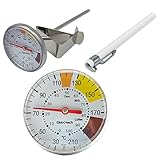
KT Thermo 2-Inch Dial Thermometer
KT Thermo’s 2-inch dial is the pick for anyone who has squinted at a tiny gauge through steam wand fog. The large face reads at a glance from above the pitcher — exactly the viewing angle you actually have mid-froth — and the needle moves promptly enough to act on, not just observe. The clip holds the probe at a consistent depth, which keeps readings honest between sessions.
It costs a few dollars more than the smallest dials, and the bigger face is marginally less pocketable, which matters to nobody steaming milk at home. As a primary thermometer for latte and cappuccino duty, this is the one we would hand a beginner: the readability removes the last excuse for scorched milk.
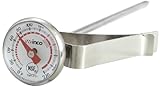
Stainless Milk Frothing Thermometer
This straightforward stainless dial-and-clip model is the value workhorse of the category. It does the three essential things — clips to the pitcher, reads the milk zone clearly, survives daily rinsing — for under nine dollars. The frothing range is marked legibly, so even on the first morning you know where “stop steaming” lives without memorizing numbers.
At this price the construction is functional rather than refined: the clip is serviceable but worth checking for grip on thick-walled pitchers, and the dial glass is plastic. None of that affects the milk. If you want the cheapest single thermometer that does the job properly, this is it — and the savings buy a bag of beans for the oat milk drinks it will help you perfect.
Norpro 5981 Espresso Thermometer
Norpro is the established kitchenware name in this lineup, and the 5981 reflects that pedigree: consistent build quality, a clearly marked dial, and a clip that has clearly met a milk pitcher before. It is the thermometer most often spotted in home espresso setups for good reason — it simply keeps working, year after year, through daily clip-on, steam, rinse cycles.
You pay a small brand premium over the generic options for essentially equivalent function. What that premium buys is consistency and longevity — Norpro has made this exact tool for a long time, and replacement-buying the same model a decade later is a real possibility. The steady, sensible choice of the list.
2-Pack Instant Read Pocket Thermometer
The two-pack solves problems the single dials cannot. Busy households keep one thermometer on the steaming pitcher and one for everything else — pour-over water checks, hot chocolate duty, the occasional custard. The 1-inch dials with 5-inch probes and pitcher clips are standard frothing format, and the instant-read response keeps pace with fast home steam wands.
Per unit this is among the cheapest routes into the category, with the trade-off that smaller dials demand a closer look than the 2-inch KT Thermo. For shared kitchens, teaching a partner to steam, or anyone who loses small tools (no judgment), redundancy is genuinely worth more than refinement. The spare also conveniently serves the precise water temperatures that alternative brews want — see our French press vs pour over comparison for where that matters.
KT Thermo 1-Inch Dial Thermometer
The 1-inch KT Thermo is the minimalist’s version of our top pick: same maker, same clip-and-probe format, smaller face, smaller price. At eight dollars it is the cheapest single unit here, and it gives up nothing in actual measurement — only in at-a-glance readability, which experienced steamers need less anyway since they are tracking by feel and sound and using the dial for confirmation.
That makes this the right model for the improving barista rather than the day-one beginner: once your hand knows roughly when the pitcher is approaching done, a small confirming dial is all you need. Beginners who will stare at the needle through the whole steam should spend the extra three dollars on the 2-inch face.
Dailyart Milk Pitcher with Thermometer
Dailyart’s pitcher bundles the thermometer into the steaming vessel itself — an integrated gauge so the temperature is always in view exactly where you are looking anyway. For beginners building a kit from nothing, getting a proper stainless frothing pitcher and temperature feedback in one thirteen-dollar purchase is plainly efficient, and one less loose tool survives the kitchen drawer.
The integrated design has limits: you cannot use the gauge with a different pitcher, and if either component disappoints, both are tied together. Pour control from the spout matters enormously for latte art, so dedicated artists eventually want a specialized pitcher. As a starter combination for cappuccino and flat white mornings, though, it is an easy, tidy recommendation.
What to Look For in a Milk Frothing Thermometer
Frothing thermometers are inexpensive, but a few details separate the ones that improve your milk from the ones that fog up and frustrate.
- Dial readability under steam — You will read this thing from above, through wisps of steam, while your other hand works the wand. Bigger faces and high-contrast markings earn their space.
- A secure pitcher clip — The clip should grip your pitcher wall firmly and hold the probe tip in the milk’s body, not scraping the bottom. A drifting probe lies to you.
- Response speed — Milk under a capable steam wand heats fast. A needle that lags by several seconds reports where your milk was, which is how overshoots happen.
- Marked frothing zone — Clear ideal-range markings beat bare numbers when your attention is split. You want a glance to answer “keep going or stop?”
- Stainless, washable build — Milk residue is relentless. Probes and clips should rinse clean under hot water daily without rusting or trapping film.
- Probe length matched to your pitcher — A standard 5-inch probe suits common 12–20oz pitchers; very small or very tall pitchers may position the tip poorly with clip-on designs.
Tips for Getting the Most Out of Your Milk Frothing Thermometer
Use the thermometer as a teacher, not a crutch. Each session, rest your free hand on the pitcher wall and consciously note what the metal feels like as the needle passes through the frothing zone — within a few weeks your palm will know the stopping point before the dial does, which is exactly how professionals work. The needle also lags the true temperature slightly and milk keeps heating for a moment after the steam stops, so make a habit of cutting the wand just before the needle reaches your target rather than exactly on it.
Different drinks and different milks want different targets. Lattes and flat whites sit at the cooler end of the sweet range where milk tastes sweetest; cappuccino foam tolerates slightly more heat. Plant milks are generally less forgiving — oat and almond turn thin or split when pushed hot, so stop earlier than you would with dairy. Run the experiment once with the thermometer and you will have personal numbers for every milk in your fridge, which transforms drinks like the ones in our frother and steamer guide from approximate to repeatable.
Keep the instrument honest. Rinse the probe immediately after each session so milk film never bakes on, check the clip’s grip now and then, and test the calibration occasionally in ice water — a quality dial thermometer should read at or very near freezing, and many have an adjustment nut behind the dial if it drifts. Thirty seconds of upkeep keeps a ten-dollar tool accurate for years of cold foam sessions and morning cappuccinos alike.
Frequently Asked Questions
What temperature should I froth milk to for a latte?
The widely used target zone for steamed dairy sits around 140–150°F (60–65°C) — hot enough to feel properly warm and develop sweetness, below the range where milk scalds and turns flat. Frothing thermometers mark this zone on the dial. Plant milks generally prefer the cooler end of that window.
Why does my milk taste burnt even though it never boiled?
Milk proteins and sugars degrade well below boiling. Push steamed milk much past about 160°F (70°C) and sweetness fades while a cooked, slightly sulfurous note creeps in. If your drinks taste flat or scorched, you are almost certainly overshooting — stop steaming earlier and let the thermometer confirm the new habit.
Are analog dial thermometers accurate enough for milk frothing?
Yes — frothing is a zone game, not a decimal game. A quality dial thermometer tracks closely enough to keep you inside a ten-degree window, which is all steamed milk requires. Verify in ice water occasionally and recalibrate if your model allows; replace any unit that reads wildly off, since they cost less than two lattes.
Can I just use the bottom of the pitcher to judge temperature by hand?
Eventually, yes — the too-hot-to-hold-comfortably signal lands close to ideal latte temperature, and experienced baristas steam by feel and sound. But hands calibrate slowly and dishonestly, especially when the pitcher is thick-walled or your fingers are cold. The thermometer is how you train the hand quickly; most people can retire it within a season.