- Top Pick: Belly Moka Coffee Maker Stovetop Espresso Maker 2 Cup Aluminum Moka Pot Percolator 3.3oz 100ml Easy Brewing for Electric Ceramic Stoves Home Camping Italian Cuban Café Classic Silver
- Best Value: CDKM Electric Moka Pot, Stainless Steel, Auto-Shut-Off (2/4 cup)
- Premium Choice: Alessi MDL02/6 B "Pulcina" Stove Top Espresso 6 Cup Coffee Maker in Aluminum Casting Handle And Knob in Pa, Black
Last updated: September 18, 2026
A moka pot is small, inexpensive, and deceptively easy to buy badly. The most common mistake is treating the printed “cup” count like a standard coffee measurement. In moka-pot sizing, one cup usually means about 1.5 to 2 fluid ounces of strong coffee—not an 8-ounce mug. A six-cup pot may produce roughly 9 to 12 fluid ounces, while a two-cup model may yield only 3 to 4 ounces.
Shoppers also buy the wrong material for their cooktop, choose a capacity that does not match their routine, or assume a higher price guarantees better coffee. A $15 aluminum pot can brew well when it fits your stove and is used correctly; a $100 design can still be frustrating if it is too large for one person or incompatible with induction.
As an Amazon Associate we earn from qualifying purchases at no extra cost to you. Product prices and availability are accurate as of the date shown and are subject to change.


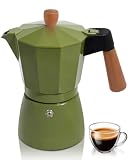
This moka pot buying guide by capacity focuses on the specifications that affect everyday use: output, heat compatibility, construction, handling, price, support, and delivery. The goal is not to find the most expensive pot, but to find the right size and build for how you actually drink coffee.
Decide These 3 Things First
- How much coffee do you need per brewing cycle? Estimate finished moka coffee at 1.5 to 2 fluid ounces per labeled cup. Choose a two-cup pot for one small serving, a three- or four-cup pot for one larger drink or two smaller drinks, and a six-cup pot for two to four servings.
- What type of cooktop do you have? Traditional aluminum pots generally work on gas, electric coil, and many ceramic or glass cooktops, but not induction. Induction requires a magnetic stainless-steel base or an induction-compatible design. Electric models need a nearby outlet and counter space.
- Will you prioritize price, durability, or convenience? Basic aluminum pots often cost $12 to $30. Better-finished stainless-steel or electric models commonly run $35 to $80. Design-led premium models can cost $90 to $150 or more. Set a limit before comparing colors and shapes.
Size and Capacity
See also: How to Season a New Coffee Grinder (2026): Step-by-Step • How to Clean a Moka Pot Safely (2026): Step-by-Step
Capacity is the most important decision because moka pots are intended to be filled with water and coffee according to their design. You should not routinely half-fill a six-cup pot to make a two-cup serving; doing so can produce inconsistent extraction and leaves the filter basket underfilled.
| Label | Approximate output | Best for |
|---|---|---|
| 1 cup | 1.5–2 fl oz | One concentrated serving |
| 2 cups | 3–4 fl oz | One person who drinks a small portion |
| 3–4 cups | 4.5–8 fl oz | One larger drink or two small servings |
| 6 cups | 9–12 fl oz | Two to four small servings |
Manufacturers do not always use identical cup definitions, so check the stated milliliter capacity before ordering. A listed 100 ml, or about 3.4 fl oz, model is generally a two-cup-size pot even if the product title uses different wording. Remember that the brewed volume is not the same as the water reservoir’s advertised capacity; some coffee and water remain in the grounds and lower chamber.
Material and Cooktop Compatibility
Aluminum is the traditional choice. It is lightweight, heats quickly, and is usually the least expensive option. A small aluminum pot may weigh under 1 pound, while a larger model often weighs about 1 to 1.5 pounds before adding water. Aluminum moka pots are commonly suitable for gas, electric coil, and ceramic cooktops, but they are usually not suitable for induction.
Stainless steel is heavier and often easier to maintain. Many stainless models weigh roughly 1.5 to 3 pounds depending on size and base thickness. Stainless steel is the safer choice for induction only when the manufacturer specifically states induction compatibility. A stainless body alone does not guarantee that the base will trigger an induction burner.
Electric moka pots add a heating element, a power cord, and controls. Typical household versions are rated around 300 to 500 watts, although the exact figure varies. They can be useful in offices, dorms, or kitchens without a compatible stovetop. They also take more counter space and create more parts that may eventually need replacement.
For ceramic and glass cooktops, look for a flat, stable base and lift the pot rather than sliding it across the surface. Aluminum can scratch some surfaces if dragged.
Construction and Seal Quality
Look for a lower chamber with even threading, a filter plate that sits flat, and a gasket that fits cleanly without bulging. The gasket is commonly silicone or rubber, and replacement rings are often available in several sizes. Confirm that replacements can be purchased before committing to an unusual or obscure model.
The safety valve should be clearly visible on the lower chamber and should not appear blocked by packaging residue or manufacturing debris. The valve is not a decoration: it releases pressure if the filter becomes obstructed. Do not modify, cover, or remove it.
A well-designed pot should close smoothly without cross-threading. The handle and knob should be firmly attached, with no sharp flashing around molded plastic or wood. A wood handle can look attractive and stay comfortable, but it may require more care around prolonged moisture and dishwasher cleaning. Plastic handles are common and practical; heat-resistant construction matters more than the finish.
For larger six-cup pots, check the assembled height and width. A typical model may be about 8 to 10 inches tall and 5 to 6 inches wide, while a compact two-cup model may be approximately 5 to 7 inches tall and 3 to 4 inches wide. Measure cabinet clearance and burner space if your kitchen is tight.
Comfort, Handling, and Brewing Performance
Capacity affects handling as much as output. A full six-cup pot can contain more than 12 ounces of hot water before brewing, so a secure handle and balanced base are important. A narrow two-cup pot is easier to store but may feel less stable on a large burner.
Choose a handle with at least about 3 inches of clearance from the pot body when possible. That spacing helps reduce accidental contact with hot metal, though you should still use the handle only after checking that it remains cool enough to touch. A heat-resistant knob makes it easier to lift the top chamber when checking the brew.
Do not select a pot based on “espresso” language alone. Moka coffee is concentrated and rich, but it is not technically espresso because it is brewed at lower pressure. For better results, use medium-fine coffee rather than true espresso-fine grounds, fill the basket level without tamping, and stop heating when the flow becomes pale or sputtering. These practices matter more than decorative styling.
Price Tiers
Budget: $12–$30. This tier is dominated by aluminum stovetop models. A basic two-cup pot may cost about $14 to $20, while a six-cup version may be $18 to $30. These are sensible choices for occasional use, provided the gasket, valve, and replacement parts are available. A low price may also mean thinner walls, a less refined hinge, or a handle that feels less substantial.
Mid-range: $35–$80. Expect more stainless steel, induction-compatible bases, electric controls, or improved finishing. An electric two- or four-cup model may sit near the upper end of this range. Pay attention to whether automatic shutoff is included and whether the water reservoir can be removed for cleaning.
Premium: $90–$150 or more. Premium pricing often reflects distinctive industrial design, heavier casting, brand reputation, or a more polished finish. A six-cup design such as a sculptural aluminum model may cost around $100. It can be worthwhile when appearance and long-term ownership matter, but it does not automatically provide more capacity or better coffee than a well-made $25 pot.
Warranty and Replacement Parts
For a manual moka pot, a one-year limited warranty is a useful baseline. Some brands offer two years, while inexpensive unbranded products may offer little practical support beyond the retailer’s return window. Electric models should ideally include at least a one-year warranty because the heating base and controls add failure points.
Ask whether the manufacturer sells gaskets, filter screens, funnels, and replacement handles. A gasket commonly needs replacement after roughly one to two years of regular use, but heat, cleaning methods, and frequency can shorten that period. Keep the original manual because gasket dimensions and cleaning instructions vary by model.
Delivery, Packaging, and Assembly
Most stovetop moka pots require no assembly beyond washing the parts and inserting the filter and gasket. “Assembly” should not mean attaching a handle, safety valve, or pressure component yourself. If those parts arrive loose, inspect the instructions and contact the seller rather than improvising.
Check the packed and assembled dimensions, especially for six-cup models. A box around 10 by 7 by 6 inches is common for a larger pot, but packaging varies. Inspect the rim, threads, handle, valve, and base within the return period. Dents in the lower chamber, a lid that does not close squarely, or a basket that does not sit flat are reasons to request an exchange.
Spec Checklist
| Spec | Budget | Mid | Premium |
|---|---|---|---|
| Typical price | $12–$30 | $35–$80 | $90–$150+ |
| Common sizes | 2–6 cups | 2–6 cups | 3–12 cups |
| Body material | Aluminum | Stainless steel or improved aluminum | Cast aluminum or premium stainless steel |
| Induction | Usually no | Often available | Model-specific; verify |
| Electric option | Rare | Common, about 300–500 watts | Available on selected models |
| Warranty target | Return window to 1 year | 1–2 years | 1–2 years |
| Replacement parts | May be limited | Usually available | Usually available through the brand |
Red Flags
- The listing gives a cup count but no milliliter or fluid-ounce capacity.
- It claims induction compatibility without identifying a magnetic base.
- The safety valve is missing, unclear, or described as decorative.
- The product has no gasket size, replacement-part information, or usable manual.
- The handle is positioned directly above the pot body or appears loosely attached.
- Reviews mention leaking around the threads, a lid that will not seal, or a basket that does not fit.
- An electric model does not state wattage, voltage, automatic shutoff, or warranty coverage.
- The seller uses “espresso” to imply pump-level pressure or crema.
FAQ
What size moka pot should one person buy?
A two-cup model is a good starting point for one person who wants about 3 to 4 fluid ounces of concentrated coffee. Choose a three- or four-cup model if you usually add milk, ice, or hot water and want a larger finished drink. Buy a six-cup pot only if you regularly need approximately 9 to 12 fluid ounces in one brew.
Is aluminum or stainless steel better?
Neither is universally better. Aluminum is lighter, quicker to heat, and less expensive. Stainless steel is heavier, often easier to maintain, and more likely to be offered with an induction-ready base. Choose based on your cooktop, cleaning preferences, and expected frequency of use.
Can a moka pot be used on induction?
Only if the product specifically says it is induction-compatible or has a suitable magnetic base. A conventional aluminum pot will not work directly on most induction burners. An induction adapter plate may work, but it can reduce efficiency and add another hot surface.
How long should a moka pot last?
The metal body can last for many years when it is not dropped, overheated, or aggressively scrubbed. Gaskets and filter screens are consumable parts and may need replacement every one to two years, sometimes sooner. Regularly inspect the safety valve, seal, threads, and handle rather than judging the pot only by its appearance.
Ready to decide? Our #1 pick for 2026 is the 1 cup.
Live price & availability on Amazon.