- Top Pick: IAOSEN Knock Box Large Capacity Design Espresso Knock Box Shock-absorbent Knock Box Espresso with Removable Knock Bar and Non-Slip Base Espresso Accessories for Home/Office
- Best Value: DIBTSA Espresso Knock Box, Stainless Steel Coffee Grounds Knock Box, With Removable Knock Bar and Non-Slip Rubber Base (Silver)
- Premium Choice: CAFEMASY Rubber Knock Box Bar Sleeve – Knock Box Bar for Square Espresso Knock Box Chute Replacement Knock Box Bar Cover for Knock Chute
Last updated: September 18, 2026
The Short Answer
For most home coffee bars, choose a knock box about 5 to 7 inches wide, 5 to 7 inches deep, and 5 to 6 inches tall (13 to 18 by 13 to 18 by 13 to 15 cm). This medium size holds roughly 10 to 15 espresso pucks and fits comfortably beside a home espresso machine.
A small 4- to 4.5-inch knock box is suitable when counter space is limited or you make only one or two drinks at a time. A large model, usually about 8 to 10 inches wide and 6 to 8 inches deep, is better for entertaining, offices, or households that empty the box once per day rather than after every few drinks.
As an Amazon Associate we earn from qualifying purchases at no extra cost to you. Product prices and availability are accurate as of the date shown and are subject to change.

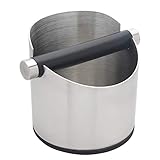

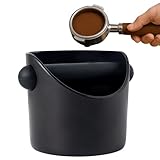
The best size is not simply the largest box that fits. Leave enough room to grip the portafilter, swing it over the knock bar, remove the container for cleaning, and open nearby cabinets. For most home bars, capacity and access matter more than maximum volume.
Standard Sizes
See also: How to Season a New Coffee Grinder (2026): Step-by-Step • How to Clean a Moka Pot Safely (2026): Step-by-Step
Knock boxes do not follow one universal sizing standard, so advertised dimensions can vary by brand and may include the rubber bar or outer rim. Use the measurements below as practical buying categories. Internal capacity is approximate because curved corners, the bar, and the bin’s shape reduce usable space.
| Size | Typical outside dimensions | Approximate capacity | Best for |
|---|---|---|---|
| Compact | 4.3–5 in W × 4.3–5 in D × 4–5 in H (11–13 × 11–13 × 10–13 cm) |
5–8 espresso pucks | Small counters, occasional coffee, dorms and apartments |
| Medium | 5.5–7 in W × 5.5–7 in D × 5–6 in H (14–18 × 14–18 × 13–15 cm) |
10–15 espresso pucks | Most home espresso setups |
| Large | 8–10 in W × 6–8 in D × 5.5–7 in H (20–25 × 15–20 × 14–18 cm) |
20–30 espresso pucks | Families, entertaining and office coffee stations |
| Drawer or built-in | 10–15 in W × 12–18 in D × 3–6 in H (25–38 × 30–46 × 8–15 cm) |
25–50 or more pucks | Dedicated cabinets, café-style counters and high volume |
A medium knock box is the safest starting point if you are unsure. A compact box can fill quickly, causing grounds to pile above the bar and making each knock messier. Oversizing can also be inconvenient: a large box takes up valuable prep space and may be awkward to lift when it contains wet coffee grounds.
Consider the box’s empty weight as well as its capacity. Lightweight plastic models may weigh about 0.5 to 1.5 pounds (0.2 to 0.7 kg), while stainless-steel or heavily based models commonly weigh about 1 to 3 pounds (0.45 to 1.4 kg). A heavier base generally feels more stable, but it is less convenient to move for cleaning.
How to Measure Your Space
- Measure the available width. Use a tape measure from the espresso machine to the nearest wall, appliance or cabinet. Subtract at least 1 inch (2.5 cm) so the knock box does not rub against neighboring items.
- Measure front-to-back depth. Include the space needed to place the portafilter over the bar. A box that fits at the back of a counter may still be awkward if there is no room to bring the handle forward.
- Check the height above the box. Look for upper cabinets, shelves and appliance doors. Leave at least 3 inches (7.5 cm) above the knock box for lifting out the inner bin or removing the bar.
- Measure the portafilter handle. A standard home portafilter handle may extend about 7 to 9 inches (18 to 23 cm). Make sure you can hold it level and knock straight down without hitting a wall or cabinet.
- Account for cleanup access. If the box sits under a cabinet, confirm that the container can slide forward or lift vertically. A removable inner bin is useful, but it needs clearance to come out.
- Mark the footprint. Use painter’s tape to outline the proposed width and depth on the counter. Test whether you can operate the espresso machine, grinder and milk pitcher without crossing into that area.
Measure the product’s external footprint, not just its stated capacity. For a rectangular box, width and depth determine counter use. For a round box, measure the full diameter, including any lip or protruding base. A non-slip base may add a small amount to the overall footprint.
By Room or Use Case
Small apartment or compact kitchen
Choose a compact model around 4.3 to 5 inches wide and deep. These boxes work well beside a narrow espresso machine and are easy to store in a cabinet. The tradeoff is limited capacity, so plan to empty it after roughly five to eight shots. A small espresso knock box priced around $7 to $12 can be a sensible choice when minimizing both cost and counter space is the priority.
Typical home espresso bar
A medium box measuring about 6 by 6 inches is the most versatile option. It provides enough room for a morning routine without dominating the work surface. Look for a removable knock bar, a rubber or silicone sleeve, and a non-slip base. Many basic stainless-steel or plastic models fall in the approximate $15 to $25 range, including products similar in price to the $14.99 IAOSEN and $19.99 DIBTSA examples.
Family kitchen or frequent entertaining
Move up to a large box measuring at least 8 inches wide if several people use the machine throughout the day. The extra capacity reduces emptying and avoids a mound of grounds around the bar. Choose a stable base and a padded bar sleeve to reduce noise. A large box is worthwhile only if you have at least 8 to 10 inches of usable counter width and enough forward clearance to remove it comfortably.
Home office or shared coffee station
For a shared machine, prioritize durability and easy cleaning over the smallest footprint. A large box with a removable container can hold 20 or more pucks and reduce interruptions. If the counter is narrow, a medium box may be easier to keep sanitary than an oversized model that is difficult to empty. Expect roughly $20 to $40 for sturdier, larger or better-finished designs.
Drawer, cabinet or built-in bar
A drawer-style knock box can be 10 to 15 inches wide and may hold 25 to 50 pucks. Confirm the cabinet’s internal width, depth and height, plus the drawer’s weight rating. Wet grounds become heavy; a full box can add several pounds. Built-in options look tidy but require more precise measuring than a countertop model.
Common Sizing Mistakes
- Buying by diameter alone: A stated 5-inch diameter does not tell you the box’s height, base width or usable capacity.
- Ignoring the knock bar position: The bar should let the portafilter hit near the center rather than forcing you to strike against an edge.
- Choosing the biggest box available: Extra capacity is not useful if the box blocks the grinder, sink or cabinet door.
- Forgetting portafilter clearance: A deep box can fit on paper but leave too little room to swing and empty the portafilter.
- Overlooking cleaning: Grounds retain moisture. Choose a model with a removable bar or bin and enough clearance to rinse it thoroughly.
- Assuming a replacement sleeve changes the box size: A rubber bar sleeve, such as a replacement accessory priced around $10 to $15, improves cushioning but does not increase capacity or footprint.
- Using a fragile container: Glass or thin ceramic may chip when a portafilter is knocked repeatedly. A purpose-built box with a shock-absorbing bar is safer.
FAQ
What size knock box is best for a home espresso machine?
A medium box about 5.5 to 7 inches wide and deep is best for most homes. It balances 10 to 15 pucks of capacity with a manageable counter footprint. Choose compact if space is tight, or large if several people make espresso daily.
How many espresso pucks should a knock box hold?
For a home bar, aim for at least 10 pucks. That usually covers a day of moderate use without overflow. A compact box holds about five to eight, while a large box can hold roughly 20 to 30, depending on puck size and how loosely the grounds are deposited.
Can a knock box be too big?
Yes. A box that is too large can waste counter space, obstruct equipment and become heavy when full. It can also be harder to wash in a small sink. Select the smallest size that holds your normal daily volume with a little extra room.
How often should I empty a home knock box?
Empty it at least daily, even if it is not full. Wet coffee grounds can develop odors and mold when left in a warm box. Rinse the container and let it dry fully before replacing it. With that routine, a correctly sized box should remain cleaner and more pleasant through 2026 and beyond.
Ready to decide? Our #1 pick for 2026 is the Compact.
Live price & availability on Amazon.