- Top Pick: Maestri House S2 Espresso Coffee Scale with Timer 0.1g Precision Shot Scale
- Best Value: WISHSOM Coffee Scale with Timer, 3kg/0.1g High Precision Espresso Scale, Digital Kitchen Scale for Espresso and Pour-Over Coffee (Batteries Included)
- Premium Choice: Mini Coffee Scale with Timer Automatic, 0.1g/2000g Rechargeable Precision Espresso Scale
Last updated: September 18, 2026
If you are shopping for an espresso scale, the best size is usually compact enough to sit on your drip tray while still leaving room for a cup and a readable display. For most home espresso machines, look for a scale measuring approximately 4.5 to 5.5 inches wide, 5 to 6.5 inches deep, and less than 1 inch tall. A capacity of at least 2,000 grams is useful for espresso, while a 3,000-gram model offers more flexibility for pour-over brewing and kitchen tasks.
Size is not only about the scale’s outer dimensions. You also need to account for the machine’s drip tray, the cup or portafilter, the display position, and clearance under the group head. This guide explains the practical measurements to compare before buying in 2026.
As an Amazon Associate we earn from qualifying purchases at no extra cost to you. Product prices and availability are accurate as of the date shown and are subject to change.



The Short Answer
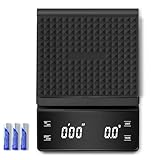
The ideal espresso scale is typically about 5 x 5 inches (12.7 x 12.7 cm) and no more than 0.75 to 1 inch (1.9 to 2.5 cm) tall. That footprint fits most home espresso drip trays and provides enough surface area for a demitasse, cappuccino cup, or shot glass.
- Best all-around size: 4.5–5.5 inches wide by 5–6 inches deep
- Smallest practical size: about 4 x 4 inches for narrow machines and shot glasses
- Large or multipurpose size: 6–7 inches wide by 6–8 inches deep
- Preferred thickness: under 1 inch, especially for low-clearance machines
- Useful precision: 0.1 gram resolution
- Useful capacity: 2,000–3,000 grams
A scale that is too small can let a cup overhang the weighing platform or hide the display. One that is too large may not fit on the drip tray, may interfere with the portafilter, or may need to sit beside the machine instead of under the cup.
Standard Sizes
See also: How to Season a New Coffee Grinder (2026): Step-by-Step • How to Clean a Moka Pot Safely (2026): Step-by-Step
Espresso scales do not follow one universal standard, but most products fall into a few practical size categories. The dimensions below refer to the scale body, not the retail box or charging cable.
| Scale type | Typical dimensions | Typical capacity | Best use |
|---|---|---|---|
| Extra-compact espresso scale | 4.0–4.5 W x 4.0–4.5 D x 0.6–0.9 H in (10.2–11.4 x 10.2–11.4 x 1.5–2.3 cm) |
1,000–2,000 g | Small drip trays, espresso shots, travel |
| Standard espresso scale | 4.5–5.5 W x 5.0–6.0 D x 0.7–1.0 H in (11.4–14.0 x 12.7–15.2 x 1.8–2.5 cm) |
2,000–3,000 g | Most home espresso machines |
| Low-profile premium scale | 4.5–5.5 W x 5.0–6.0 D x 0.4–0.7 H in (11.4–14.0 x 12.7–15.2 x 1.0–1.8 cm) |
2,000–3,000 g | Machines with limited cup clearance |
| Large coffee and kitchen scale | 6.0–7.0 W x 6.0–8.0 D x 0.8–1.3 H in (15.2–17.8 x 15.2–20.3 x 2.0–3.3 cm) |
3,000–5,000 g | Pour-over, baking, and general kitchen use |
For espresso, the standard and low-profile categories are usually the safest choices. Many inexpensive models cost approximately $10 to $22, while more feature-rich espresso scales commonly fall between $25 and $60. The example products provided range from about $9.99 to $30.39, showing that a compact footprint and 0.1-gram resolution do not necessarily require a premium price.
Capacity is different from physical size. A 3,000-gram scale may not be much larger than a 2,000-gram model, but capacity helps if you use a heavy French press, mixing bowl, or pour-over server. For espresso alone, 2,000 grams is generally sufficient because the cup, coffee, and brewed espresso usually weigh far less than that.
How to Measure Your Space
- Measure the drip tray width. Use a tape measure across the flat area where the scale will sit. Record the narrowest usable width, not the widest part of the tray.
- Measure the drip tray depth. Measure from the front edge to the back wall or the point where the group head begins. Subtract about 0.25 inch (0.6 cm) for comfortable placement.
- Check vertical clearance. Place your usual cup beneath the group head and measure the remaining space. Subtract the scale’s height from that clearance. The result should leave enough room to position the cup without forcing it against the group head.
- Measure the cup base. A standard espresso cup may have a base around 2.5–3 inches wide, while a cappuccino cup or small latte glass can be 3.5–4.5 inches wide. Make sure the scale platform is wider than the cup base.
- Look for raised edges. A silicone mat or raised rim can reduce the usable platform area. A scale listed as 5 inches deep may provide only 4.5 inches of flat weighing surface.
- Check the display location. A front-facing display is easier to read when the scale sits under a portafilter or cup. If the display is on the rear, the cup may block it.
- Account for cables and controls. Leave space for a USB charging cable and make sure the power or tare button is reachable. Many rechargeable scales charge through a 5-volt USB connection; the exact input requirement varies by model.
If your drip tray is less than 5 inches deep, prioritize a compact or low-profile model. If you cannot fit a scale under the group head, you can place it on the counter beneath the portafilter before brewing, but this is less convenient and may make it harder to capture the complete shot weight.
By Room or Use Case
Small home espresso station
For a compact kitchen counter or apartment coffee bar, choose a scale around 4.5 x 5 inches. This size fits most espresso setups without taking over the counter. A 2,000-gram capacity and 0.1-gram resolution are enough for weighing coffee doses and monitoring espresso yield. A rechargeable battery is helpful when outlets are limited.
Large semi-automatic espresso machine
Machines with deep drip trays can accommodate a standard scale measuring up to 5.5 x 6 inches. This gives you more room for a larger cappuccino cup or small espresso server. Confirm that the scale remains below the group head and that its buttons are not covered by the cup.
Travel or office coffee setup
A mini scale measuring approximately 4 x 4 inches is easier to pack and store. Look for a protective cover, automatic shutoff, and a weight under roughly 1 pound. Compact scales may have less surface area and lower capacity, so they are best for espresso shots and small brewers rather than large carafes.
Pour-over and espresso combination
If one scale must handle both brewing methods, choose a platform about 5.5–7 inches wide and 6–8 inches deep, with a capacity of at least 3,000 grams. The additional surface area helps support a dripper and server. Make sure the scale includes a timer if you want to track bloom and total brew time without using a separate device.
Shared kitchen or multipurpose use
A larger kitchen scale can weigh coffee, ingredients, and brewing equipment, but it may be too tall or wide for espresso. Choose this type only if you have counter space beside the machine or a removable drip tray that provides generous clearance. Protect the scale from water and coffee grounds, particularly around the display and charging port.
Common Sizing Mistakes
- Buying by capacity alone: A 3,000-gram rating does not tell you whether the scale will fit your machine.
- Ignoring height: A scale that is only 0.25 inch too tall can prevent a cup from fitting beneath the group head.
- Measuring the machine instead of the tray: The outside width of an espresso machine is not the usable weighing area.
- Choosing a platform smaller than the cup: The cup should sit fully on the weighing surface for stable readings.
- Forgetting the display: A scale can fit physically but still be frustrating if the cup blocks the numbers.
- Using a kitchen scale with slow updates: Espresso output changes quickly. Look for 0.1-gram resolution and a responsive timer or auto-timing function.
- Assuming every USB charger is identical: Check the manufacturer’s charging instructions rather than assuming any adapter is suitable.
FAQ
What is the best size coffee scale for espresso?
A scale around 5 x 5 inches with a height below 1 inch is the best general choice. It fits most home espresso machines while providing enough room for a cup and a readable display.
Will a 6-inch coffee scale fit on an espresso machine?
It may fit on a large drip tray, but not on every machine. Measure the tray’s usable depth and compare it with the scale’s actual dimensions. Leave clearance for the group head, cup, and buttons.
Is 2,000 grams enough for espresso?
Yes. A 2,000-gram capacity is more than enough for a portafilter, coffee dose, cup, and espresso yield. Choose 3,000 grams or more if you also want to weigh pour-over servers, French presses, or kitchen ingredients.
Does a larger espresso scale work better?
Not necessarily. A larger platform can be more versatile, but the most useful espresso scale is the one that fits securely under your group head. Prioritize a low profile, 0.1-gram resolution, responsive readings, and a platform that matches your machine’s drip tray.
Ready to decide? Our #1 pick for 2026 is the Extra-compact espresso scale.
Live price & availability on Amazon.