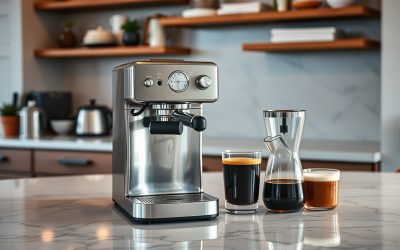
TL;DR: The Hario Buono kettle is the gold standard gooseneck for pour-over coffee. Its curved spout gives precise, turbulence-free flow control that no standard kettle can match. If you brew V60, Chemex, or any pour-over method, the Buono is the tool that makes technique repeatable.
Hario Buono Kettle: The Gooseneck That Defines Pour-Over Precision
Pour-over coffee lives or dies by water control. Bloom timing, spiral pours, center pours — every technique assumes you can put water exactly where you want it, at the flow rate you choose, without wrist fatigue. The Hario Buono kettle has been the reference-point gooseneck for baristas and home brewers for over a decade, and the reasons are mechanical, not aesthetic.
As an Amazon Associate we earn from qualifying purchases at no extra cost to you. Product prices and availability are accurate as of the date shown and are subject to change.




- Quick Comparison
- What Makes the Hario Buono Kettle Special
- Hario Buono Kettle Models to Consider
- Hario Buono Specs Comparison
- Stovetop vs. Electric Buono: Which Should You Buy?
- Pour Techniques That Unlock the Buono’s Potential
- Cleaning and Maintaining Your Hario Buono Kettle
- FAQ: Hario Buono Kettle
- About the Author
- Frequently Asked Questions
Quick Comparison
| Product | Brand | Price | Rating |
|---|---|---|---|
| TIMEMORE Sculptor 078S Flat Burr Coffee Bean Grinder | TIMEMORE | $799 | 4.3/5 |
| Gaggia RI9380/49 Classic Evo Pro Espresso Machine | — | $499 | 4.4/5 |
| Rancilio Silvia Espresso Machine | Rancilio | $995 | 4.2/5 |
What Makes the Hario Buono Kettle Special
See also: Best Espresso Accessories for New Owners in 2026: Tested and Ranked • 6 Best Blind Filters for Backflushing
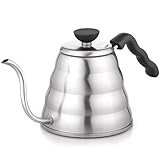
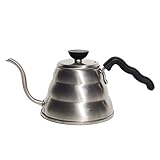
The Buono’s signature is its swan-neck spout geometry. The spout exits the body low, curves upward in a long arc, then bends down toward the tip. This shape creates a natural restriction that smooths turbulent flow from the kettle body into a laminar stream at the tip. You get a steady ribbon of water regardless of how you tilt the handle — the physics does the work.
The handle is positioned above the center of gravity, which means the kettle balances almost by itself mid-pour. Heavy-handed baristas and beginners alike find they can sustain a consistent pour angle for a full 2–3 minute brew without the hand fatigue that plagues straight-spout pours.
Hario Buono Kettle Models to Consider

TIMEMORE Sculptor 078S Flat Burr Coffee Bean Grinder, Electric Espresso Grinder with Stepless Coarseness Adjustment, Suitable for Espresso, Pour over, French Press, Cold Brew - Black






As an Amazon Associate we earn from qualifying purchases. Product prices and availability are accurate as of the date/time indicated.

Gaggia RI9380/49 Classic Evo Pro Espresso Machine, Thunder Black, Small

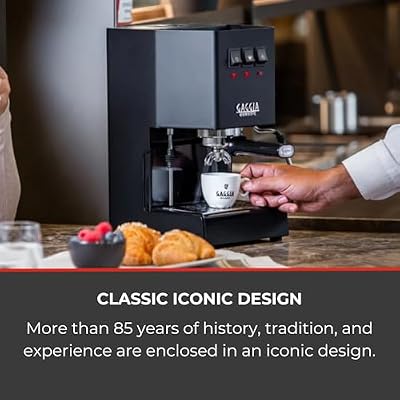


As an Amazon Associate we earn from qualifying purchases. Product prices and availability are accurate as of the date/time indicated.

Rancilio Silvia Espresso Machine, Stainless Steel


As an Amazon Associate we earn from qualifying purchases. Product prices and availability are accurate as of the date/time indicated.
Hario Buono Specs Comparison
| Spec | Buono Stovetop (600ml) | Buono Stovetop (1.2L) | Buono Electric (800ml) |
|---|---|---|---|
| Capacity | 600ml | 1.2L | 800ml |
| Material | Stainless steel | Stainless steel | Stainless steel |
| Heat source | Gas / electric coil / halogen | Gas / electric coil / halogen | Built-in 1000W element |
| Temperature control | External thermometer needed | External thermometer needed | Variable 60–100°C |
| Induction compatible | No (standard) / Yes (Buono IH) | No (standard) / Yes (Buono IH) | N/A |
| Weight (empty) | ~330g | ~450g | ~600g |
Stovetop vs. Electric Buono: Which Should You Buy?
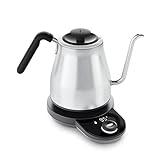
The stovetop Buono is lighter, cheaper, and more durable over a decade of use. Its weakness is temperature management — you need a clip thermometer or separate probe to know when water hits your target. The electric Buono (also called the Buono EVC) adds a variable temperature dial and keep-warm function, which is genuinely useful for multiple back-to-back brews where water cools between pours.
For a pure single-cup pour-over setup, the stovetop 600ml is the classic choice. For a cafe-at-home workflow where you brew for two or three people in sequence, the 1.2L stovetop or electric variant makes more sense. The pour quality is identical across all three — the spout geometry is the same regardless of version.
Pour Techniques That Unlock the Buono’s Potential
The Buono rewards technique investment. Start with the bloom pour: 2x the coffee weight in water (30ml for 15g of coffee), pour in slow circles from center outward, and wait 30–45 seconds. The gooseneck lets you hit every part of the bed without flooding the edges — something impossible with a standard kettle’s powerful stream.
For the main pour, try the Rao Spin method: a single continuous spiral pour from the center out and back, maintaining a steady height of 3–5cm above the bed. The Buono’s controlled flow rate (roughly 5–8ml per second at a comfortable tilt) makes this technique approachable even for beginners. Review the complete pour-over brewing guide for step-by-step technique across V60, Chemex, and Kalita Wave.
Cleaning and Maintaining Your Hario Buono Kettle
The interior of the Buono is 18-8 stainless steel — minimal limescale adhesion and easy to rinse. For hard water areas, descale monthly with a 1:10 citric acid solution (5g per 500ml water), fill and let sit 30 minutes, then rinse three times thoroughly. Avoid abrasive pads on the exterior finish.
The spout tip is the area most prone to mineral deposit buildup. If you notice the stream becoming turbulent or splitting, soak the spout opening in citric acid solution overnight. A pipe cleaner or thin brush can clear stubborn deposits without scratching the interior taper. For context on how kettle quality affects your overall setup, see the espresso and milk drinks guide on building a complete home coffee station.
FAQ: Hario Buono Kettle
Is the Hario Buono kettle worth the price for home use?
Yes, definitively. The Buono stovetop costs $40–$55 and lasts 10+ years with basic care. The precision it adds to pour-over brewing is not marginal — it is the difference between guessing at flow rate and controlling it. If you brew even two pour-overs per week, the investment pays off in better coffee within the first month.
What is the difference between the Hario Buono and other gooseneck kettles?
The Buono’s specific spout curve creates a more laminar flow than most competitors at similar price points. Cheaper goosenecks often have a shorter, less curved spout that allows turbulence to persist through the tip. Higher-end alternatives (Fellow Stagg, Brewista) match or exceed Buono flow quality but cost significantly more. The Buono sits at a rare intersection of quality and value that has kept it relevant for over a decade.
Can the Hario Buono be used on an induction cooktop?
The standard Buono is not induction compatible. Hario makes a dedicated IH (Induction Heating) version with a magnetic stainless base — look for “Buono IH” when buying. The electric version plugs directly into any 100–240V outlet and is compatible with all setups. Confirm compatibility before buying if induction is your only heat source.
What temperature should I use with the Hario Buono for pour-over?
Target 92–96°C (197–205°F) depending on roast level. Light roasts: 94–96°C to extract floral and fruit notes fully. Medium roasts: 92–94°C for balance. Dark roasts: 88–92°C to soften bitterness. If using the stovetop Buono, bring water to a boil and let it rest 30–60 seconds to drop from 100°C — a cheap digital thermometer confirms when you hit target.
How much water does the Hario Buono 600ml hold for brewing?
The 600ml capacity comfortably serves a single V60 02 or Chemex 3-cup recipe (typically 300–400ml of brew water plus bloom). For a 15g dose producing 250ml of coffee, the 600ml Buono handles the full recipe in one fill. For larger brews (20–25g dose, 350–420ml water) the 1.2L version is more practical — fewer refill interruptions mid-brew.
Frequently Asked Questions
Does the Hario Buono have temperature control?
No. The Buono is a plain stovetop gooseneck kettle with no thermometer, PID or hold function. You either use a separate probe thermometer, boil and rest the water for 30 to 60 seconds, or buy one of the electric variable-temperature kettles if precision matters to you.
Is it induction compatible?
The stainless steel Buono works on gas, electric and induction, though the smaller 1.0 litre version’s base sometimes falls below the minimum diameter that large induction rings can detect. The copper Buono is not induction compatible at all. Check your hob’s minimum pan size first.
Should I buy the 1.0 or 1.2 litre?
The 1.2 litre handles two or three pour-over servings or a Chemex batch, while the 1.0 litre is easier to control when nearly full and fine for one or two cups. Neither should be filled to the brim, because a full gooseneck pours heavier and less predictably.
Why does a gooseneck spout matter?
The narrow curved spout produces a slow, straight, predictable stream, letting you wet the bed evenly and control agitation. A standard kettle dumps water in an uncontrolled surge that digs channels through the coffee bed and produces uneven extraction no matter how good your grind is.
Does the handle get hot on the stove?
The Buono’s handle is designed to stay cool over a stovetop flame, but leaving the kettle on a large burner where flames lick up the sides will heat it. Center it on a burner no wider than the base and it stays comfortable to hold throughout.
Ready to decide? Our #1 pick for 2026 is the TIMEMORE Sculptor 078S Flat Burr Coffee Bean Grinder.
Live price & availability on Amazon.