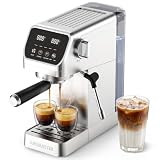
- Top Pick: Flair UPDATED 49 PRO (Black) – All manual 49mm lever espresso maker with handled portafilter, pressure gauge and no plastics in brew path
- Best Value: La Pavoni EPC-8 Europiccola Lever Style Espresso Machine – Chrome & Silver – Manual Espresso Maker – 0.8 L Water Capacity, Authentic Italian Craftsmanship for Home Use
- Premium Choice: Manual Espresso Maker Set – Hand Press Espresso Machine – 12Bar Pressure Profiling, Dual-Lever Manual Coffee Maker with Pre-Infusion, Portable for Custom Espresso Shots, Stainless Steel (Green)

Manual Lever Espresso Machine: ROK and the Case for Hand-Pulled Espresso
TL;DR — Quick Answer
A manual lever espresso machine uses human arm force — not an electric pump — to generate 6–9 bar extraction pressure. The ROK EspressoGC (~$199) is the best entry-level lever machine: no electricity required, surprisingly capable espresso, and a tactile connection to extraction that pump machines can’t replicate. Trade-off: real skill required, pressure consistency demands practice, and no steam wand.
Every pump-driven espresso machine abstracts the extraction away from you. Press a button, a ULKA vibration pump or rotary motor generates 9 bar, water moves through the puck at a fixed rate. You’re an observer. A manual lever espresso machine inverts that relationship entirely — your arms generate the pressure, your hands feel the resistance, and your control over the pressure curve is direct and immediate. For a certain kind of home barista, nothing else comes close.
As an Amazon Associate we earn from qualifying purchases at no extra cost to you. Product prices and availability are accurate as of the date shown and are subject to change.


This guide covers the ROK EspressoGC and the broader manual lever category — who it’s for, what the learning curve actually looks like, and how it compares to pump machines at equivalent price points.
Quick Comparison
| Product | Brand | Price | Rating |
|---|---|---|---|
| Rancilio Silvia Espresso Machine | Rancilio | $995 | 4.2/5 |
| Gaggia RI9380/49 Classic Evo Pro Espresso Machine | — | $499 | 4.4/5 |
| TIMEMORE Sculptor 078S Flat Burr Coffee Bean Grinder | TIMEMORE | $799 | 4.3/5 |
Manual Lever Machines at a Glance
See also: How to Replace Espresso Machine Water Filter (2026): Step-by-Step • How to Adjust Espresso Machine Brew Temperature (2026): Step-by-Step
BEST LEVER ENTRY
ROK EspressoGC
~$199

Rancilio Silvia Espresso Machine, Stainless Steel


As an Amazon Associate we earn from qualifying purchases. Product prices and availability are accurate as of the date/time indicated.
PUMP ALTERNATIVE
Gaggia Classic Evo Pro
~$499

Gaggia RI9380/49 Classic Evo Pro Espresso Machine, Thunder Black, Small




As an Amazon Associate we earn from qualifying purchases. Product prices and availability are accurate as of the date/time indicated.
PROSUMER PUMP
Rancilio Silvia
~$995

TIMEMORE Sculptor 078S Flat Burr Coffee Bean Grinder, Electric Espresso Grinder with Stepless Coarseness Adjustment, Suitable for Espresso, Pour over, French Press, Cold Brew - Black





As an Amazon Associate we earn from qualifying purchases. Product prices and availability are accurate as of the date/time indicated.
How a Manual Lever Espresso Machine Works
Two lever designs dominate the manual espresso category:
Direct lever (ROK-style): You pull down handles directly connected to a piston above the portafilter. Water is heated separately (kettle or dedicated tank) and poured into the chamber above the piston. Pulling the levers down drives the piston through the water and into the puck. Pressure generated is entirely dependent on your arm force and lever geometry. The ROK uses a dual-arm design that amplifies force — a 20 lb downward pull at the handle generates approximately 7–9 bar at the puck.
Spring-loaded lever: Found in classic Italian machines (Pavoni, Cremina). You raise the lever against a spring, which loads tension. Releasing the lever lets the spring drive the piston — generating a declining pressure profile (9 bar initial, tapering to 4–5 bar). This natural pressure decline is considered by many lever enthusiasts to produce uniquely textured, sweet espresso that pump machines can’t replicate at fixed 9 bar.
The ROK is a direct lever — pressure profile is entirely manual. Spring-loaded machines like the Flair 58 or Pavoni Europiccola add a mechanical assist. Both require more involvement than any pump machine.
ROK EspressoGC: Full Review
Rancilio Silvia Espresso Machine, Stainless Steel
As an Amazon Associate we earn from qualifying purchases. Product prices and availability are accurate as of the date/time indicated.
The ROK EspressoGC (GC = Grinder Compatible, indicating 58mm portafilter compatibility) is a cast aluminum and stainless steel manual lever machine that requires no electricity. Water is heated in a separate kettle (or the included temperature chamber) to 93–96°C and poured directly into the piston chamber. You apply pressure via two arms, pulling down in a smooth, controlled motion.
Shot quality ceiling is genuinely high. With a quality grinder and proper technique, the ROK produces espresso with a thick, complex texture that surprises pump machine users. The manual pressure application allows intuitive mid-shot adjustments — if you feel sudden resistance (channeling), you can ease off pressure momentarily to let the puck redistribute. No pump machine allows this mid-shot feedback loop.
| Spec | ROK EspressoGC |
|---|---|
| Type | Direct manual lever |
| Portafilter | 58mm (GC version) |
| Max pressure | ~9 bar (user-dependent) |
| Water capacity | ~80ml per shot |
| Electricity | None required |
| Steam wand | No |
| Weight | 2.7 kg |
| Dimensions | 20 x 15 x 30 cm |
| Warranty | 10 years (UK-based) |
Who the ROK Is (and Isn’t) For
The ROK is for: baristas who want total tactile control, travelers who want quality espresso without power access (camping, off-grid, travel), anyone who finds pump machines unsatisfying, or home baristas on a tight budget who refuse to compromise on extraction quality. It’s also the logical choice if you value craftsmanship over convenience — the ROK is a tool, not an appliance.
The ROK is not for: anyone who wants milk-based drinks (no steam wand — you need a separate frother), people who want consistent shots with minimal skill investment, or households making more than 2 espresso drinks per session (the manual workflow is inherently slower). If you primarily drink flat whites or lattes, a pump machine with a steam wand is the practical choice.
Manual Lever vs. Pump Machine: Honest Comparison
Pressure consistency: Pump machines win. A vibratory pump at 9 bar is mechanically consistent; your arms are not. Beginners pulling their first 20 ROK shots will produce variable pressure profiles. With 50–100 shots of practice, consistency improves dramatically — but it never reaches the mechanical repeatability of a pump. For black espresso obsessives who want to isolate variables, this matters. For everyone else, the taste difference is less significant than technique.
Pressure profiling: Lever machines win. Intentional pressure variation — light pre-infusion pressure, building to 8–9 bar, tapering off — is natural on a lever and requires expensive hardware (flow control paddle, pressure kit) on pump machines. The lever’s pressure curve freedom is a genuine creative advantage for experienced baristas. Some of the most complex, layered espresso shots come from skilled lever users who’ve learned to shape their pressure over the full extraction.
Workflow speed: Pump machines win significantly. A Gaggia Classic Evo Pro shot: preheat 5 minutes, grind, dose, tamp, extract. The ROK requires additionally: boil and temperature-measure water, pre-warm the piston chamber, manage water fill, apply manual pressure with both arms. Add 3–5 minutes per shot. For a single morning espresso, manageable. For a morning cappuccino rush for two people, frustrating.
Grinder requirement: Same for both. The ROK is not forgiving of a poor grinder — if anything, it demands more grinder precision because pressure variability amplifies grind inconsistency. You need a proper burr grinder regardless. Pairing the ROK with a good hand grinder (like the 1Zpresso JX or Commandante C40) creates an entirely manual, electricity-free espresso setup — a coherent and satisfying choice for a specific type of coffee enthusiast.
Temperature Management on the ROK
Without a boiler, temperature control is your responsibility. Target brew water at 93–96°C (199–205°F). Heat water to 98–100°C (just off boil), then allow 30–45 seconds cooling before use — or measure with a thermometer probe. Pre-warming the ROK’s piston chamber with a blank pull of hot water (no coffee) reduces heat loss to the metal mass by 5–8°C — skip this step and your first shot runs cooler than intended.
This temperature management workflow is exactly what pour-over brewers already do. If you’re comfortable with a gooseneck kettle and temperature discipline, the ROK workflow feels natural. If you’ve never thought about brew water temperature, the ROK will teach you to — which is part of its educational appeal.
Frequently Asked Questions
Is a manual lever espresso machine as good as a pump machine?
At equivalent skill levels, yes — and in some respects better. Lever machines allow natural pressure profiling that pump machines replicate only with expensive additions. Peak shot quality from a skilled ROK user rivals a $600 pump machine. The limitation is consistency and workflow speed, not peak quality ceiling. A beginner on a pump machine will produce more consistent shots faster than a beginner on a lever.
How hard is it to pull good espresso with the ROK?
Expect 30–50 shots before you’re consistently hitting good extractions. The learning curve involves: dialing the grind (slightly coarser than pump machines), mastering pre-warm temperature discipline, and developing a smooth, even arm pressure technique. Most new ROK users see a clear quality jump around shot 20–30 as muscle memory kicks in. It’s a steeper curve than pump machines but genuinely rewarding.
Does the ROK espresso machine require electricity?
No — the ROK EspressoGC requires zero electricity. You heat water with any kettle or stovetop pot, pour into the pressure chamber, and apply force with the levers. This makes it uniquely suitable for camping, travel, off-grid use, or anywhere power access is unreliable. It’s the most capable no-electricity espresso option on the market.
What grinder should I use with the ROK?
A quality burr grinder is non-negotiable. For a manual-everything setup, the 1Zpresso JX-Pro or Commandante C40 hand grinders ($100–200) pair perfectly — both grind to espresso fineness consistently. For counter setups, any dedicated espresso burr grinder works. Avoid blade grinders entirely — inconsistent particle size on a manual lever amplifies channeling compared to pump machines.
Can I make milk drinks with the ROK espresso machine?
The ROK has no steam wand. For milk drinks, use a separate handheld frother ($10–20) or electric milk frother to texture milk independently. The workflow: pull your espresso shot, then froth milk separately and combine. It adds 2–3 minutes and one extra tool but is completely workable. If milk drinks are your primary output, a pump machine with an integrated steam wand is more practical.
Related: Best Home Espresso Machines 2026 | Pour Over Kettle Temperature Control | Best Burr Grinder for Espresso 2026
Ready to decide? Our #1 pick for 2026 is the Rancilio Silvia Espresso Machine.
Live price & availability on Amazon.