Last updated: October 20, 2026
The Breville Barista Express is the best overall pick for most people who want to learn real espresso, because it puts a conical burr grinder, a 54 mm portafilter and PID-controlled heating in one footprint. If you already own a capable grinder, the Breville Bambino is the sharper choice thanks to its roughly three-second heat-up. Shoppers who want the lowest barrier to entry should look at the CASABREWS CM5418 or 3700 Essential. This guide sorts eight machines by skill level, counter space and grinder needs so you can match one to your routine.
Quick List
- Breville Barista Express – best for learners who want a built-in grinder and real temperature control
- Breville Bambino – best for fast heat-up and a compact 54 mm setup with a separate grinder
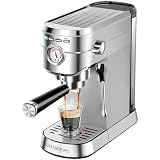
- CASABREWS CM5418 – best for small counters and a visible pressure gauge
- CASABREWS 3700 Essential – best for a larger water tank in a slim body
- AMZCHEF Espresso Machine With Grinder – best for an all-in-one with a wide range of grind settings
- atatix 20 Bar – best for a simple, compact machine without a grinder
- Chefman CraftBrew – best for touch controls and a big removable reservoir
- AERCANA 20 Bar – best for quick preheating on a small footprint
Which One Is Right for You?
See also: How to Descale an Espresso Machine: Citric Acid vs Vinegar • Best Electric Kettles: Ten Glass, Steel and Gooseneck Picks Compared
| If you… | Choose |
|---|---|
| Want to learn dose, grind and tamp with one purchase | Breville Barista Express |
| Already own an espresso-capable grinder and want fast, consistent heat | Breville Bambino |
| Need the narrowest body and like watching a pressure gauge | CASABREWS CM5418 |
| Fill the tank rarely and want a slim machine | CASABREWS 3700 Essential |
| Want a grinder built in but prefer a simpler entry point | AMZCHEF Espresso Machine With Grinder |
| Mostly make milk drinks and want fewer features to learn | atatix 20 Bar |
| Prefer touch controls and a roomy water reservoir | Chefman CraftBrew |
| Want the shortest wait before the first shot | AERCANA 20 Bar |
The two Breville models and the AMZCHEF sit at the serious-learner end, while the other five are closer to plug-in-and-go. None of them is a super-automatic that grinds, doses and tamps without your input. That is worth knowing before you buy, because every one of these needs a few sessions of adjustment before the shots taste balanced.
All 8 Picks in Detail
1. Breville Barista Express – Best for Learners Who Want a Grinder Built In
As an Amazon Associate we earn from qualifying purchases at no extra cost to you.

This is the machine to pick if you want one device that teaches the whole workflow. Beans go into the hopper, the integrated conical burr grinder dispenses into a 54 mm portafilter, and Breville suggests an ideal dose of 18 g. It suits someone ready to adjust grind size shot by shot instead of pressing a single button.
- 54 mm portafilter with single and dual wall baskets
- 15 bar Italian pump with low-pressure pre-infusion, then 9 bar extraction
- Thermocoil heating with PID temperature control, water delivered at 200 F
- Integrated conical burr grinder with 16 grind settings and an 8 oz bean hopper
- 67 fl oz removable water tank
Because the portafilter takes non-pressurized baskets as well as dual wall ones, this is the machine where grind quality shows up most clearly, and the 8 oz hopper plus 16 steps give you room to experiment. Expect a short learning period of several shots before the dose, grind and tamp settle into a pattern you like.
Pros:
- Grinder, portafilter and steam wand in one unit
- PID control helps keep brew temperature steady between shots
- Volumetric 1-cup and 2-cup shot control
Cons:
- Larger footprint than the other machines here
- The built-in grinder limits future upgrades unless you add a separate one
Compared with the Bambino, you gain a grinder and a larger tank but lose compactness and the near-instant warm-up.
2. Breville Bambino – Best for Fast Heat-Up With a Separate Grinder

The Bambino is for someone who values speed and a small footprint and plans to pair it with a standalone grinder. Breville says its ThermoJet system reaches extraction temperature in 3 seconds, which makes a weekday shot practically wait-free.
- 54 mm portafilter with an 18 g dose capacity
- 15 bar Italian pump with low-pressure pre-infusion followed by 9 bar extraction
- ThermoJet heating with PID temperature control
- 47 fl oz removable water tank and 1560 W power
- Manual steam wand and one-touch volumetric shot control
The 54 mm basket takes an 18 g dose, the same figure Breville cites for the Barista Express, so you can follow the same recipes. The compact body suits a shelf or a corner of the counter, yet it still delivers volumetric shot control and a steam wand capable of microfoam once you have practiced.
Pros:
- Heat-up measured in seconds rather than minutes
- Same 54 mm basket size as the Barista Express, so accessories carry across
- Light enough at about 10.4 lb to move on and off a shelf
Cons:
- No built-in grinder, so you must budget for one separately
- Smaller tank means more frequent refills
Pick it over the Barista Express if you already own a grinder; otherwise the all-in-one is easier to start with.
3. CASABREWS CM5418 – Best for Small Counters and a Visible Gauge

The CM5418 is a slim, stainless steel machine for a first purchase. Its pressure gauge gives beginners something to watch during extraction, and the narrow body fits next to a kettle or toaster without crowding the counter.
- 20 bar Italian pump with a built-in pressure gauge
- 51 mm portafilter with 1-cup and 2-cup baskets
- 34 oz removable water tank and 1350 W power
- About 5.9 in wide, 12.3 in deep and 12 in tall, with a 4 in maximum cup height
- Single thermoblock heater and manual steam wand
Its 51 mm portafilter ships with 1-cup and 2-cup baskets, and the maximum cup height under the spout is about 4 inches, which matters if you use tall glasses. Weight is around 8.6 lb, so it is easy to slide out when you need to clean behind it.
Pros:
- Narrow body suits tight spaces
- Gauge makes pressure visible while you learn
- Steam wand produces microfoam for lattes
Cons:
- Some owners report a cool-down wait after steaming before the next shot
- Pressurized baskets limit how much grind changes affect the shot
It is the closest match to the 3700 Essential; the CM5418 has the smaller tank, the 3700 the larger.
4. CASABREWS 3700 Essential – Best for a Larger Tank in a Slim Body

If refilling a small tank would annoy you, the 3700 Essential offers more water in a similar slim shape. It suits households that make several milk drinks in a row and want a simple semi-automatic with preset single and double volumes.
- 20 bar pump and 1350 W heating system
- 43.9 oz detachable water tank
- About 5.7 in wide, 12.6 in deep and 12.5 in tall
- Portafilter reported at 51 mm on the standard model, with single and double baskets
- Manual steam wand and automatic single and double shot volumes
The 12.6 inch depth is the number to check against a shallow shelf, since the width stays slim. Casabrews also sells a 3700GENSE variant with a 58 mm portafilter, so be sure the listing you open is the standard Essential model before ordering baskets or a tamper.
Pros:
- Roughly 10 oz more water than the CM5418
- Tamper with spoon included in the box
Cons:
- Pressurized baskets mask grind and tamp differences
- Reported weight varies between sources, so confirm on listing if shelf load matters
Choose it over the CM5418 for tank size; choose the CM5418 if the gauge matters more.
5. AMZCHEF Espresso Machine With Grinder – Best for an All-in-One With Many Grind Settings

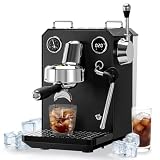
This model targets people who want a grinder in the same body without stepping up to the Breville tier. A touchscreen shows grind time, brew time and temperature, which helps when you are still learning how each variable changes the cup.
- Built-in conical burr grinder with 44 settings and a grind timer
- PID temperature control from 190 to 201 F
- 20 bar pump with low-pressure pre-infusion
- 60 oz removable water tank and an 8 mm stainless steel steam wand
- About 12.5 in deep, 10.8 in wide and 13.4 in tall, near 13.9 lb
The grind timer runs from 1 to 25 seconds in half-second steps, which lets you repeat a dose without weighing every time. One reviewer found that setting 8 worked best for espresso, so expect to start in that neighborhood and move finer or coarser. At about 14 lb it is a substantial machine to shift around.
Pros:
- Grinder and temperature control without a second device
- One-touch cold brew mode adds variety
Cons:
- Wattage differs between listings (1350 W versus 1500 W), so confirm on listing
- Portafilter size was reported by only one source
Against the Barista Express it is an easier entry point but has far less published detail behind it.
6. atatix 20 Bar – Best for a Simple Compact Machine Without a Grinder

The atatix is a straightforward compact semi-automatic for someone who mainly wants lattes and cappuccinos from pre-ground or separately ground coffee. It keeps controls minimal, which suits a first machine.
- 20 bar pump with NTC temperature control rated at 90 to 96 C
- Removable tank listed at 44 oz in the US title and 1.2 L elsewhere
- Single and double filters, a tamper with spoon and a steam wand
- Automatic and manual extraction modes, plus a warming plate on top
- Portafilter size unconfirmed, so check before buying replacement baskets
The listing describes four silicone suction feet that help it stay put while you tamp, a warming plate on top for cups, and a claim that water reaches temperature within about 30 seconds. Because dimensions and tank volume differ between regional listings, measure the exact variant you plan to buy before you commit counter space.
Pros:
- Simple layout with silicone suction feet
- Large tank for the footprint
Cons:
- One reviewer notes no solenoid valve, so the puck comes out wet
- Specifications differ across listings
Compared with the AERCANA, it has the bigger tank but the less certain specification sheet.
7. Chefman CraftBrew – Best for Touch Controls and a Roomy Reservoir

The CraftBrew uses digital touch controls instead of dials, which some beginners find easier to read. A 1.5 L reservoir means fewer refills for a busy morning, and a descale alert appears after 500 brewing cycles.
- 15 bar pump with a thermoblock heater and 1350 W
- 1.5 L removable water reservoir
- About 10.8 in deep, 8.9 in wide and 11.9 in tall
- Single and double shot baskets with a scoop and tamper
- Portafilter size reported inconsistently, between 51 and 59 mm
Digital controls mean no knobs to misread, and the 1.5 L reservoir is the largest in the group outside the two biggest machines. The scoop and tamper in the box get you started. Aftermarket baskets are a harder sell until the portafilter diameter is confirmed in the manual.
Pros:
- Digital controls and a descale reminder
- Reservoir capacity above most machines of this size
Cons:
- Lower pump figure on the box (which matters less than it sounds, since 9 bar is the target)
- Unclear portafilter size makes accessory shopping harder
It is wider than the CASABREWS pair, so it suits a counter with a bit more room.
8. AERCANA 20 Bar – Best for Quick Preheating on a Small Footprint

The AERCANA is aimed at small kitchens and offices that want a pressure gauge and fast warm-up. The listing says it preheats in about 20 seconds, which is the quickest claim among the non-Breville machines here.
- 20 bar pump with a visible pressure gauge
- 1450 W heating system
- 34 oz detachable water tank and drip tray
- About 5.3 in wide, 12.2 in deep and 11.5 in tall
- Detachable steam wand nozzle with a cleaning pin; portafilter size unconfirmed
A pressure gauge and a hot-water function help you learn what extraction pressure looks like, and the quick preheat suits mornings when you have two minutes to spare. The steam wand is described as producing dry, consistent steam, and its removable tip makes cleaning easier than on fixed nozzles.
Pros:
- Narrow footprint, roughly a sheet of paper
- Cup warmer and auto shut-off
Cons:
- Portafilter size not stated in the listings
- Smaller tank than the 3700 Essential
It is the closest rival to the CM5418, trading a bit more wattage for less published detail.
Specs Compared
| Machine | Grinder | Portafilter | Pump spec | Water tank | Heating |
|---|---|---|---|---|---|
| Breville Barista Express | Built in, 16 settings | 54 mm | 15 bar | 67 fl oz | Thermocoil, PID |
| Breville Bambino | None | 54 mm | 15 bar | 47 fl oz | ThermoJet, PID |
| CASABREWS CM5418 | None | 51 mm | 20 bar | 34 oz | Thermoblock |
| CASABREWS 3700 Essential | None | 51 mm reported | 20 bar | 43.9 oz | 1350 W |
| AMZCHEF With Grinder | Built in, 44 settings | 51 mm reported | 20 bar | 60 oz | PID, 190-201 F |
| atatix 20 Bar | None | Confirm on listing | 20 bar | 44 oz listed | NTC control |
| Chefman CraftBrew | None | Confirm on listing | 15 bar | 1.5 L | Thermoblock |
| AERCANA 20 Bar | None | Confirm on listing | 20 bar | 34 oz | 1450 W |
How We Chose These
We built this list from published manufacturer specifications, retailer listings and independent write-ups rather than from anything we claim to have operated ourselves. Each machine had to be a semi-automatic with a steam wand, a removable water tank and a published pump pressure. We favored models where core numbers such as portafilter diameter, tank size and heating type could be confirmed in more than one place, and we flagged every figure that differed between sources. Where a listing was silent, we said so instead of guessing. Brand-new or little-known models received extra scrutiny, because their specification sheets change between listing variants. For the two Breville machines we leaned on the manufacturer pages directly, and for the rest we cross-checked retailer pages against independent write-ups. The result is a shortlist where every number you see has at least one traceable source.
What to Look For
Machine Type and Heating System
Home machines fall into four groups. Manual lever machines have you pull a handle to generate pressure. Semi-automatic models, which include all eight picks here, use a pump but leave grinding, dosing and tamping to you. Automatic machines add programmable shot volumes. Super-automatic machines grind, brew and often froth at the press of a button, which is convenient but limits how much you can tune the cup. If you want to understand espresso, a semi-automatic is the best classroom.
Single boilers, heat exchangers and dual boilers appear on pricier machines. The picks here use faster heaters instead: thermoblock, thermocoil or the Bambino’s ThermoJet. Buying guides put thermoblock warm-up at roughly 30 to 60 seconds and thermocoil at 20 to 40 seconds, while traditional boilers can take 5 to 15 minutes or longer. The trade-off is stability. A larger boiler resists temperature swings during back-to-back shots, whereas smaller heaters rely on PID control to keep up. Treat those ranges as rough, since sources vary.
Pump Pressure, Portafilter Size and Baskets
Espresso is traditionally brewed at about 9 bar. The Italian Espresso National Institute standard cited on Wikipedia lists 9 plus or minus 1 bar, a 25 plus or minus 5 second extraction and water at 88 plus or minus 2 C at the exit. A 15 or 20 bar pump figure is the pump’s peak, and the Breville pages explain that their 15 bar pumps deliver 9 bar extraction after low-pressure pre-infusion. Ignore the biggest number on the box and look for pre-infusion or a gauge instead.
Portafilter diameter decides which baskets and tampers fit. Buying guides describe 58 mm as the commercial standard, 54 mm as the Breville size and 51 mm as the compact budget size. Typical double-basket doses run about 12 to 16 g in 51 mm, 13 to 18 g in 54 mm and 18 to 20 g in 58 mm. Pressurized baskets have an inner wall and a single tiny exit hole, which builds back pressure mechanically and forgives coarse or uneven grounds. Non-pressurized baskets rely on the coffee puck for resistance, so grind quality shows up in the cup right away.
Budget for the Grinder
Several buying guides argue that the grinder matters more than the machine, because a non-pressurized basket needs a fine, consistent grind of roughly 150 to 250 microns. If you buy a machine without a grinder, plan for an espresso-capable burr grinder, since blade grinders produce uneven particles. A common starting recipe is shown below.
| Shot style | Dose in | Liquid out | Time |
|---|---|---|---|
| Ristretto | 18 g | 27 g (1:1.5) | 20-25 seconds |
| Standard double | 18 g | 36 g (1:2) | 25-30 seconds |
| Lungo | 18 g | 45 g (1:2.5) | 30-40 seconds |
Worked example: if your 18 g dose reaches 36 g in 18 seconds, the grind is too coarse. Grind finer in small steps until you land in the 25 to 30 second window, using a scale to track weight rather than volume.
Water Tank Size and Counter Footprint
Tank capacity decides how often you stop to refill, and listings mix ounces and liters, so convert before comparing. One US fluid ounce is about 29.6 mL, which gives the table below for the eight picks.
| Machine | Listed tank | Approximate liters |
|---|---|---|
| CASABREWS CM5418, AERCANA 20 Bar | 34 oz | 1.0 L |
| CASABREWS 3700 Essential | 43.9 oz | 1.3 L |
| atatix 20 Bar | 44 oz (US title) | 1.3 L |
| Breville Bambino | 47 fl oz | 1.4 L |
| Chefman CraftBrew | 1.5 L | about 51 oz |
| AMZCHEF With Grinder | 60 oz | 1.8 L |
| Breville Barista Express | 67 fl oz | 2.0 L |
The narrowest bodies in the group, the two CASABREWS models and the AERCANA, measure roughly 5.3 to 5.9 inches wide. The grinder machines are far wider because the hopper and grinder add bulk. Measure the space under your cabinets and beside the sink before choosing; a machine that fits on paper can still leave no room to lift a tank out.
Steam Wand and Milk Drinks
Every machine here uses a manual steam wand, so milk texture is a skill you practice. Smaller thermoblock and thermocoil heaters can need a short pause between steaming and the next shot, a point some owners of the CASABREWS CM5418 mention. If lattes are your main drink, look for a wand with a clear nozzle, a way to clean it, and enough tank capacity to purge and steam without running dry.
Questions
Do I need a machine with a built-in grinder?
No, but you do need a grinder. Built-in models like the Barista Express and the AMZCHEF save space and money up front. A separate grinder gives more upgrade room later.
Does 20 bar make better espresso than 15 bar?
Not by itself. Espresso extracts at around 9 bar, and the rated number is the pump’s peak. Pre-infusion and temperature control tend to matter more.
Are pressurized baskets bad?
They are a sensible starting point. They forgive coarse or inconsistent grounds, though the crema is partly produced by the single exit hole. Move to non-pressurized baskets once you own a good burr grinder.
Which portafilter size should I prefer?
For these machines, 54 mm (Breville) offers wider accessory choice than 51 mm. If the listing does not state the size, confirm it before buying a tamper or replacement baskets.
How often should I descale?
Follow the manual for your model. Chefman, for example, says its descale alert appears after 500 brewing cycles, but water hardness changes the real interval.
Can I make milk drinks on all of these?
Yes, each has a steam wand. Some owners report a cool-down wait after steaming on single-thermoblock machines before the next shot.
Update History
- October 20, 2026 – Updated with specification checks and a revised product comparison.
- Check the product page for current specifications and availability before buying.
Sources
- Breville product pages for the Barista Express and Bambino
- Manufacturer and retailer listings for the CASABREWS, AMZCHEF, atatix, Chefman and AERCANA machines
- Wikipedia entries on espresso and espresso machines
- Breville guidance on pressurized versus non-pressurized baskets
- Buying guides on thermoblock, thermocoil and boiler heating, portafilter sizes, and grinder importance
- Coffee ratio guides from Clive Coffee and other retailers