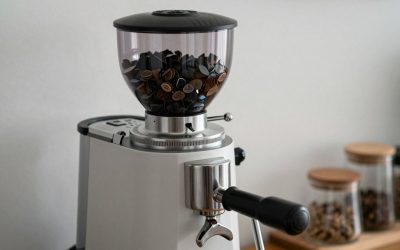
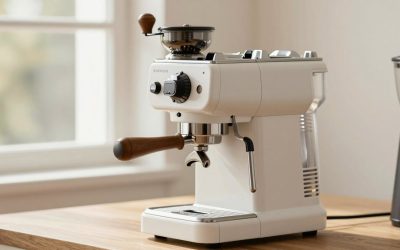
- Top Pick: Ksionka Conical Coffee Bean Grinder, 38 Precise Settings, Anti-Static
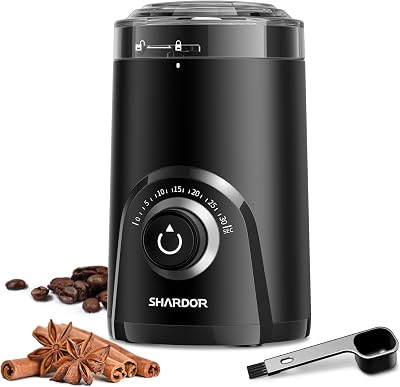
- Best Value: SHARDOR Electric Coffee Grinder, 70g Large Capacity Spice Grinder with Visual Timing Knob for Precise Grind, Quiet Coffee Bean Grinder for Espresso, French Press, Herbs and Grains, Black
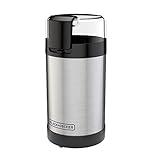
- Premium Choice: BLACK+DECKER One-Touch Coffee & Spice Grinder with Stainless Steel Blades
Last updated: October 21, 2026
Best Seller
Aromaster Conical Coffee Bean Grinder with 48 Gind Settings,Burr Coffee Grinder for Home Use,Stainless Steel,40 Seconds Adjustable Timer,Anti-static,Easy to Clean with Brush,Classic Silver
View on Amazon


Disclosure: As an Amazon Associate we earn from qualifying purchases. This page contains affiliate links and we may earn a commission at no extra cost to you.
As an Amazon Associate we earn from qualifying purchases at no extra cost to you.



If you have ever winced while holding down the grind button at 5:45 in the morning, hoping the rest of the house stays asleep, you already understand why a quiet coffee grinder is worth hunting for. Grinder noise is not just an annoyance. It shapes when you brew, how much you brew, and whether the people you live with associate your coffee habit with a pleasant aroma or a screaming motor. The good news is that grinder design has come a long way, and several current models manage to chew through beans at a volume closer to a conversation than a power tool.
What actually makes a grinder quiet? Mostly it comes down to motor speed, burr geometry, and how well the housing damps vibration. Slow-turning conical burrs tend to produce a lower, less piercing pitch than high-speed blades bouncing beans around a metal chamber. Heavier housings absorb buzz instead of amplifying it across your countertop. Some manufacturers, like KRUPS with its Silent Vortex line, have made noise reduction the headline feature rather than an afterthought.
In this guide we walk through six grinders that keep the racket down while still producing grounds you can be proud of, from a full-featured conical burr machine to compact pulse grinders that cost less than a bag of competition-grade beans. If espresso is your main squeeze, you may also want our deeper roundup of the best coffee grinders for espresso, where grind quality takes priority over decibels.
Quick Comparison
| Product | Price | Rating |
|---|---|---|
| Aromaster Conical Burr Grinder | $89.99 | 5.0/5 |
| Secura One-Touch Quiet Grinder | $25.99 | 4.9/5 |
| Flat Burr Electric Grinder (17 settings) | $59.99 | 4.7/5 |
| Hamilton Beach Custom Grind | $37.95 | 4.6/5 |
| SHARDOR 70g Grinder with Timing Knob | $26.99 | 4.5/5 |
| KRUPS Silent Vortex | $54.99 | 4.5/5 |
Why Trust This Guide
See also: Best Spice Grinders: Ten Electric Models Compared by Capacity, Bowl Design and Cleanup • 4 Best Flat Burr Coffee Grinders for Consistent Grounds (October 2026) Buying Guide
We evaluate grinders on design fundamentals that actually predict performance: burr type, motor approach, adjustment range, build quality, and value at the asking price. We do not repeat marketing claims as fact, we never invent specifications, and we only recommend gear we would be comfortable putting on our own kitchen counters.
Aromaster Conical Burr Grinder
The Aromaster is the most complete package in this lineup. Its conical burr set turns at the slower speeds that keep both noise and heat down, and the 48 grind settings give you genuine room to move between French press, drip, pour-over, and the finer end of the spectrum. For a household that brews more than one way, that adjustment range is the difference between a grinder you tolerate and one you actually enjoy.
Who is it for? Anyone who wants one quiet machine to handle every brew method without fuss. The conical geometry produces a low rumble rather than a shriek, which is exactly what you want before sunrise. If you are still learning how grind size maps to brew method, pair it with our bean-to-cup grind size guide and you will be dialing in confidently within a week.
The tradeoff is price. At $89.99 it costs three times what the pulse grinders here ask, and if you only ever brew drip for one person, that may be more capability than you need. But as a long-term, low-noise daily driver, it is the easiest recommendation on this page.
Secura One-Touch Quiet Grinder
The Secura takes the opposite approach: radical simplicity. One touch, pulse control, stainless steel construction, and a price that barely registers. It is the kind of grinder you buy for a guest room, an office, or a first apartment, and it earns its keep by being fast, compact, and noticeably more polite than the screaming blade grinders of a decade ago.
The compromise is grind uniformity. Pulse-style grinders chop rather than mill, so you get a wider spread of particle sizes than any burr machine produces. For French press and standard drip that spread is forgivable; for espresso it is a dealbreaker. If you want to understand exactly what that uniformity buys you in the cup, our burr grinder versus pre-ground comparison makes the difference plain. Buy the Secura for convenience and quiet, not for competition-level extraction.
Flat Burr Electric Grinder (17 settings)
This mid-priced flat burr machine occupies the sweet spot between the budget pulse grinders and the premium Aromaster. Flat burrs are prized for producing a tighter, more uniform particle distribution, which translates to cleaner, more repeatable brews. Seventeen grind sizes is not an enormous range, but the steps are spaced sensibly across the methods most home brewers actually use.
It suits the brewer who has outgrown a blade grinder and wants a real step up in cup clarity without spending three figures. The flat burr format does tend to run at a slightly higher pitch than a slow conical, though still far from objectionable. Keep the burrs clean and it will reward you; a quick pass with the right tools from our grinder cleaning brush roundup once a week keeps old oils from dulling both flavor and motor efficiency.
Hamilton Beach Custom Grind
Hamilton Beach has been making dependable kitchen workhorses for generations, and the Custom Grind continues that tradition. Its party trick is hands-free operation: press once and it runs the cycle for you, with batch sizes that scale from 4 to 14 cups. That makes it the obvious pick for households that brew a full carafe every morning rather than a single precious cup.
It is not a precision instrument, and it does not pretend to be. You will not dial in espresso on it, and serious pour-over fans will want tighter control. But as a quiet, affordable, set-it-and-forget-it grinder for drip coffee at family scale, it does the job with zero drama. The one-press operation also means the noise, modest as it is, ends on its own without you standing there holding a button.
SHARDOR 70g Grinder with Timing Knob
The SHARDOR’s visual timing knob is a small feature that solves a real problem: repeatability. Instead of guessing how long you held the button yesterday, you set the dial and get the same grind duration every time. Combined with a generous 70 gram capacity, it handles bigger batches than most compact grinders in its class, and it moonlights happily as a spice grinder.
Like the Secura, it is a chop-style machine, so the same uniformity caveats apply. Where it shines is for cold brew and French press drinkers who grind in volume and value consistency of routine over consistency of particle size. At $26.99 it is also one of the cheapest ways to retire a truly loud old grinder and reclaim your quiet mornings.
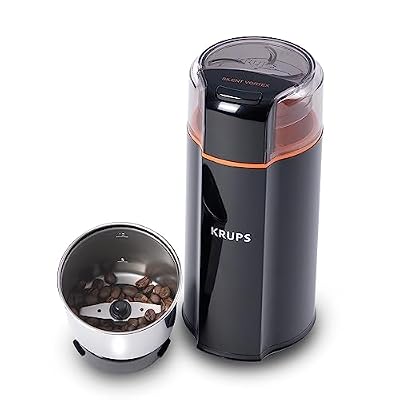
KRUPS Silent Vortex
The Silent Vortex is the only grinder here engineered explicitly around noise reduction, and KRUPS claims a five-fold reduction versus conventional designs. The 175 watt motor drives a vortex grinding action through a 3 ounce chamber, enough for a dozen cups in one go. In practice it produces a muffled whir that you can comfortably talk over, which is the entire point.
It is ideal for thin-walled apartments, early risers, and anyone whose kitchen opens onto a sleeping area. The tradeoffs are the usual ones for this format: no burr-level uniformity and no stepped grind settings, so you control fineness by duration. For drip, press, and cold brew duty it is arguably the most livable grinder on this list. Espresso devotees should instead look at a dedicated machine like the one in our Baratza Encore ESP review, which trades some quiet for genuine espresso-range precision.
What to Look For in a Quiet Coffee Grinder
Noise ratings rarely appear on spec sheets, so you have to read the design instead. These are the factors that actually determine whether a grinder purrs or howls.
- Motor speed — Slow-turning motors produce a lower, less intrusive pitch and generate less heat. High-RPM machines finish faster but tend to whine, and pitch is what wakes people, not duration.
- Burr type and geometry — Conical burrs generally run quieter than flat burrs at comparable quality levels, and any burr set beats blades for both sound character and grind uniformity.
- Housing mass and damping — A heavier body with rubber feet absorbs vibration instead of transmitting it into your countertop, which otherwise acts like a soundboard.
- Capacity matched to your habit — A grinder sized to your daily dose runs once and stops. Running a tiny grinder three times for one carafe triples your noise exposure.
- Adjustment range — More settings mean the grinder grows with you as you explore new brew methods, rather than forcing an upgrade in a year.
- Ease of cleaning — Stale oils and packed fines make motors labor harder and louder over time. Removable parts and brush access keep a quiet grinder quiet.
Tips for Getting the Most Out of a Quiet Coffee Grinder
Placement matters almost as much as the machine itself. A grinder sitting directly on stone or hard laminate transmits vibration into the surface, which amplifies it like a drum head. A simple silicone mat or folded towel underneath can take the perceived volume down a meaningful notch for free. Corners of rooms also reflect sound, so the middle of a counter run is friendlier than a tight nook.
Routine maintenance is the other half of the equation. Coffee oils gum up burrs and chambers, forcing the motor to work harder and sound rougher. A weekly brush-out takes ninety seconds and pays you back in both flavor and acoustics. If you grind for espresso, periodic checks against our advice on why espresso turns bitter will also tell you when grind drift, often a symptom of dirty burrs, is creeping into your shots.
Finally, consider weighing out single doses the night before. Storing tomorrow’s beans in a small sealed jar means your morning grind is one short, predictable burst rather than a hopper-fed marathon, a trick borrowed from the single-dose grinder workflow that quietly improves freshness too.
Frequently Asked Questions
Are burr grinders quieter than blade grinders?
Usually, yes. Burr grinders crush beans between two surfaces at relatively low speed, producing a low rumble. Blade and pulse grinders whip beans around a chamber at high speed, which creates a higher-pitched, more intrusive sound. That said, a well-damped modern pulse grinder like the KRUPS Silent Vortex can undercut a cheaply built burr machine, so design quality matters as much as category.
Does a quiet grinder take longer to grind?
Often slightly, because lower motor speed is one of the main ways manufacturers reduce noise. The difference is typically a matter of seconds per dose. Slower grinding also generates less heat, which is gentler on aromatic compounds in the beans, so the tradeoff generally works in your favor.
Can I use a quiet grinder for espresso?
Only if it is a burr grinder with fine-end adjustment, like the Aromaster in this roundup. Pulse-style grinders cannot produce the uniform fine particles espresso extraction demands, no matter how long you run them. If espresso is your priority, choose a dedicated espresso-capable burr grinder first and treat quietness as a bonus.
How can I make my current grinder quieter?
Three easy moves: put a silicone mat or folded towel underneath to absorb vibration, move it away from walls and corners that reflect sound, and clean the burrs or chamber thoroughly. A grinder choked with old grounds and oils runs louder and rougher than a clean one, so maintenance is the cheapest noise reduction available.