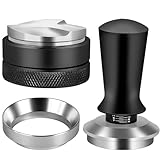
- Top Pick: Apexstone 58mm Coffee Distributor, Espresso Distribution Tool, Espresso Distributor Tool, Coffee Leveler 58mm
- Best Value: MATOW 53mm Coffee Distributor and Tamper, Dual Head Coffee Leveler Compatible with Breville 54mm Portafilter, Adjustable Depth- Professional Espresso Hand Tampers
- Premium Choice: MATOW 53mm Coffee Distributor, Espresso Distribution Tool, Coffee Leveler Compatible with Breville 54mm Portafilter- Professional Espresso Distributor Leveler Tool
As an Amazon Associate we earn from qualifying purchases at no extra cost to you. Product prices and availability are accurate as of the date shown and are subject to change.



TL;DR: A coffee distribution tool (WDT tool or leveler) eliminates clumping and uneven puck density before tamping — the #1 cause of channeling in home espresso. If your shots are inconsistent despite good grind and technique, this $20–$50 tool fixes the problem faster than any other upgrade. Essential for dialing in precision espresso.
Best Coffee Distribution Tool: WDT Tools, Tamper Levelers & Puck Prep Buyers Guide
Ground coffee clumps. That’s just physics — espresso grind is fine enough that static and moisture cause particles to stick together. When you tamp a clumped puck, you’re compressing an uneven surface. Water finds the gaps and channels through, creating sour, unbalanced shots no matter how good your beans or machine are.
A coffee distribution tool — whether a WDT (Weiss Distribution Technique) needle tool or a leveler — breaks up those clumps and creates a uniform puck density before tamping. It’s one of the most impactful $20–$50 investments in home espresso. This guide covers every type, what each does, and which to buy for your setup.
- Quick Comparison
- Types of Coffee Distribution Tools
- Top Coffee Distribution Tools
- Key Specs to Compare
- How to Use a WDT Tool Correctly
- Does Distribution Actually Improve Shot Quality?
- DIY WDT vs Buying One
- Portafilter Basket Size Compatibility
- Distribution Tools in Context: Full Puck Prep Workflow
- Frequently Asked Questions
- Final Verdict
- About the Author
Quick Comparison
| Product | Brand | Price | Rating |
|---|---|---|---|
| MATOW 53mm Coffee Distributor and Tamper | MATOW | $35.99 | 4.7/5 |
| 58mm Coffee Distributor | Apexstone | $17.99 | 4.7/5 |
| 51mm Coffee Distributor | Apexstone | $16.99 | 4.7/5 |
| 53mm Coffee Distributor | Apexstone | $17.99 | 4.7/5 |
| Normcore V4 Coffee Tamper 53.3mm – Spring-Loaded Tamper… | NORMCORECOFFEETOOLS | $42.29 | 4.7/5 |
Types of Coffee Distribution Tools
See also: How to Season a New Coffee Grinder (2026): Step-by-Step • How to Clean a Moka Pot Safely (2026): Step-by-Step
There are three main categories, each addressing distribution differently:
WDT (Weiss Distribution Technique) Tools
WDT tools use thin needles (typically 0.3–0.5mm diameter) to stir the grounds inside the portafilter basket, breaking up clumps and redistributing coffee evenly. Named after John Weiss who popularized the technique, WDT is now standard practice among serious home baristas. The stirring motion disrupts clumps without compressing the grounds — you’re redistributing, not leveling by force. Pair with a good calibrated tamper afterward and your puck prep is solid.
Leveler / Distributor Tools
Levelers rotate across the top of the basket, pushing excess grounds toward low spots and creating a flat surface. They’re faster than WDT but less effective at breaking internal clumps — they level the surface, not the full depth. Many pros use WDT first, then a leveler to finish. The rotation depth is adjustable on quality models to match your basket fill level.
Combination Tools
Some tools combine WDT needles with a leveler head — do the stirring and surface leveling in one pass. More convenient, slightly less precise for each individual function, but a good compromise for home use where workflow speed matters.
Top Coffee Distribution Tools
These are our tested picks across price ranges:
Key Specs to Compare
| Feature | WDT Tool | Leveler | Combination |
|---|---|---|---|
| Clump-breaking | Excellent | Poor | Good |
| Surface leveling | Manual | Excellent | Good |
| Workflow speed | Moderate | Fast | Fast |
| Learning curve | Low | Low | Low |
| Adjustable depth | N/A | Yes (quality models) | Yes |
| Price range | $10–$30 | $20–$60 | $25–$70 |
| Best for | Light roasts, fine grind | Fast daily workflow | All-in-one simplicity |
How to Use a WDT Tool Correctly
Technique matters. Here’s the process that produces the most consistent results:
- Dose your ground coffee into the portafilter basket
- Insert the WDT needles just below the surface of the grounds
- Stir in a circular motion, working from the outside edges toward the center
- Make 3–5 full rotations, lifting slightly to avoid compressing
- Tap the portafilter lightly on a counter to settle (optional — some skip this)
- Tamp with even, level pressure
The goal is uniform density throughout the puck, not just a flat top surface. If you’re using a bottomless portafilter (see our tamper guide), you’ll immediately see the improvement — the extraction flows more evenly across the entire basket rather than channeling to one side.
Does Distribution Actually Improve Shot Quality?
Yes — and it’s measurable. Channeling caused by uneven distribution produces shots where part of the puck over-extracts while another part under-extracts simultaneously. The result: sour AND bitter notes in the same cup, which is confusing to dial in because you’re chasing two problems at once.
Eliminating channeling with proper distribution produces a cleaner extraction where you’re only adjusting one variable at a time. If a shot is too sour, it’s genuinely under-extracted — and the fix is clear. Track your shots with a precision coffee scale alongside distribution technique changes to see the direct impact on your ratio and taste.
Light roasts benefit most from WDT — they’re ground finer and clump more aggressively. Dark roasts are oilier and clump differently, but still benefit from distribution before tamping.
DIY WDT vs Buying One
The original WDT tools were literally wine corks with acupuncture needles stuck through them. Many home baristas still make their own — 0.35mm stainless acupuncture needles from Amazon plus a cork or 3D-printed handle costs under $5. The technique works identically to a $40 commercial tool.
Buy a purpose-built tool if you want: a magnetic stand for the portafilter (prevents tipping during stirring), better ergonomics for daily use, adjustable needle depth, or a cleaner-looking setup. The $20–$50 commercial tools are about workflow convenience and aesthetics, not fundamentally better distribution. Both work. Choose based on how much you value the daily experience.
Portafilter Basket Size Compatibility
Most leveler/distributor tools are sized for specific basket diameters — 58mm (most prosumer machines), 54mm (Breville), or 51mm (DeLonghi Dedica). WDT needle tools are universally compatible — needles fit any basket size. If you’re buying a leveler, verify the basket size first. Our Breville Barista Express review covers the 54mm basket specifics if that’s your machine. For prosumer 58mm setups, see the Rancilio vs Gaggia comparison for basket context.
Distribution Tools in Context: Full Puck Prep Workflow
Distribution is one step in a larger puck prep workflow. The full sequence for consistent shots:
- Grind — consistent particle size from a quality burr grinder
- Dose — weigh on a precision scale
- Distribute — WDT tool to break clumps
- Level — leveler or finger-level to even the surface
- Tamp — calibrated tamper, 20–30 lbs pressure, perfectly level
- Inspect — check for cracks or low spots before locking in
Skip any step and you introduce variance. The distribution step is the most commonly skipped — and the most impactful on channeling prevention. See our full home espresso setup guide for the complete workflow from grinder to cup.
Frequently Asked Questions
Do I need a distribution tool if I have a good grinder?
Yes. Even the best grinders produce some clumping — it’s a function of static and particle physics at fine espresso grind settings, not grinder quality. A high-end grinder reduces clumping vs a budget grinder, but WDT is still beneficial. Professional baristas use distribution tools regardless of grinder price.
What’s the difference between distribution and tamping?
Distribution = arranging the grounds evenly in 3D space before compression. Tamping = applying uniform pressure to create a dense, flat puck. You cannot tamp your way out of a poorly distributed puck — the tamper compresses unevenness, it doesn’t fix it. Distribution must come first.
How deep should WDT needles go into the grounds?
All the way to the basket floor initially, then work in layers. The full-depth pass breaks up bottom clumps; lighter passes near the surface level the top. Avoid grinding the needles into the basket wall — that’s not helping distribution, just making noise.
Should I use a distribution tool with a pressurized basket?
Pressurized baskets (common on entry-level machines) are more forgiving of uneven distribution by design — the pressurized valve compensates. Distribution still helps, but the improvement is less dramatic than with a non-pressurized basket. If you upgrade to a precision basket, distribution becomes essential.
Can I use a coffee distribution tool for other brew methods?
WDT technique is espresso-specific — other methods don’t require the same puck uniformity. For pour-over or AeroPress, a gentle swirl or Rao Spin after adding water distributes grounds more effectively than pre-brew WDT. Levelers and distributor tools are also espresso-only tools.
Final Verdict
If you’re pulling espresso without a distribution tool, you’re leaving shot consistency on the table. A WDT tool is the cheapest, highest-ROI upgrade in espresso. A leveler adds workflow speed. A combination tool simplifies the process.
Our recommendation: start with a simple WDT tool (or make your own for under $5). Once you experience the difference in shot consistency, you’ll understand why professional baristas treat distribution as non-negotiable. If you want the full setup dialed in, check our guide to the best espresso machines under $500 and our grinder vs pre-ground comparison to make sure your whole workflow is optimized.
Ready to decide? Our #1 pick for 2026 is the MATOW 53mm Coffee Distributor and Tamper.
Live price & availability on Amazon.