Last updated: October 2, 2026
Quick answer: Our top pick in 2026 is the Rancilio Classe 5 — our #1 rated choice. See the full ranked comparison, alternatives and buying advice below.
A commercial espresso machine for a serious home setup?
The Rancilio Classe 5 is a commercial espresso machine, not a typical countertop appliance. It is designed for cafés, where a machine may be switched on for long service and used to make drink after drink. At home, that build can be appealing if you make espresso frequently, have room for a substantial machine, and want a traditional portafilter workflow. It can also be an expensive, awkward fit for a household that makes two cappuccinos each morning.
Before buying, check the exact Classe 5 version and configuration. The range has been sold with different group counts and electrical setups, and commercial machines may need installation or plumbing that a home kitchen cannot accommodate. Ask the seller to confirm voltage, water connection, dimensions, included accessories, warranty coverage, and whether the machine is new or refurbished. Those details matter more than a broad claim that it is “café quality.”
What the Classe 5 does well
See also: Breville Bench Saver • Rocket Espresso Coffee Machine
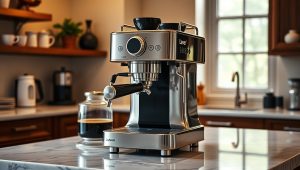
The Classe 5 is built around a commercial espresso workflow: a portafilter, a group head, a steam wand, and controls intended for repeated use. Compared with many home machines, its main appeal is capacity and a more substantial construction. If you regularly serve several people, make milk drinks back-to-back, or run a small coffee bar, that design can be useful.
Its trade-off is that commercial construction does not automatically mean better coffee in a home kitchen. The grinder, coffee, water, and the person using the machine still determine the result. A large machine cannot rescue stale beans or an inconsistent grind. Nor is a commercial group head necessarily simpler to operate: dialing in espresso and steaming milk still take practice.
Some versions may include features intended to help manage temperature or simplify operation, but do not assume every used or retailer-listed Classe 5 has the same controls. Confirm the precise version and consult its manual before comparing specifications. A seller who cannot identify the configuration clearly is a reason to pause.
Check the fit before you buy
Measure the counter and the route into the kitchen, including doorways and stairs. Allow room above the machine to fill or service it, and check whether the drip tray and panels can be removed without moving it. Commercial machines can be heavy; a delivery to the curb is not the same as installation.
Then check the utilities. Depending on the model, the machine may require a dedicated electrical circuit or a direct water connection and drain. Do not rely on a household outlet, adapter, or plumbing arrangement being suitable just because a machine powers on. Have an electrician or installer confirm requirements if anything is unclear.
Water quality and maintenance deserve equal attention. Hard water can cause scale, while unsuitable filtration can affect taste or machine components. Follow Rancilio’s water guidance for the exact unit; do not pour in untreated tap water or use a filter on the assumption that all filters soften water enough. Commercial equipment also needs routine cleaning and periodic service. A neglected used machine can turn a bargain into a repair project.
Classe 5 versus a home espresso machine
| Choice | Best for | Main advantage | Main trade-off |
|---|---|---|---|
| Rancilio Classe 5 | Frequent entertaining, high drink volume, or a small commercial setting | Commercial format and capacity for repeated use | Space, installation, service, and purchase costs can be disproportionate at home |
| Prosumer home machine | Daily espresso and milk drinks in a dedicated home coffee area | More manageable size and home-oriented setup | Less suited to sustained café-level volume |
| Entry-level home machine | Occasional espresso or a tighter budget | Lower cost and usually easier to accommodate | May involve slower recovery or less convenient milk-drink workflow |
| Superautomatic coffee maker | Convenience and minimal hands-on preparation | Grinds and brews with fewer manual steps | Less control over the espresso process and milk texture |
If your use is a few drinks a day, a well-chosen home machine is usually the more sensible purchase. Browse prosumer home espresso machines if you want a portafilter workflow without taking on a full commercial installation. A simpler machine is also fine if espresso is occasional: entry-level espresso machines can make more sense when low cost and a smaller footprint matter more than serving several drinks quickly.
Budget for the whole setup
The machine is only part of the cost. Add a capable espresso grinder, suitable water treatment, a tamper if one is not included, cleaning supplies, and any required installation. A commercial machine paired with a poor grinder is a lopsided setup: the grinder controls how evenly and consistently coffee can be extracted.
For a Classe 5, also budget for maintenance and ask whether local technicians will service that specific configuration. Before buying used, request service records, a demonstration under pressure, and clear photos of the group head, steam wand, case, and interior where accessible. Check for leaks, corrosion, damaged controls, inconsistent heating, and a steam wand that struggles to build pressure. A cosmetic mark is less concerning than unclear service history or an unexplained fault.
Compare the total installed cost—not just the listing price—with a home machine and grinder. If the commercial machine requires plumbing work, a circuit change, or a costly repair, the gap can grow quickly. The cheaper home option is not a compromise if it meets your daily volume and produces the drinks you enjoy.
Who should buy it?
The Classe 5 makes the most sense for someone who has a dedicated coffee area, understands espresso basics, and needs commercial-style capacity. It may also suit a serious hobbyist who values that format and accepts the space and upkeep. For a café or other business, confirm the intended group count and expected service volume with a qualified supplier rather than choosing on appearance alone.
It is a poor fit for a cramped kitchen, a first-time espresso drinker seeking push-button convenience, or a household making only a couple of drinks a day. In those cases, consider a compact manual machine or, if speed matters more than hands-on control, a superautomatic espresso machine. You give up some control, but avoid paying for capacity you will not use.
FAQ
Is the Rancilio Classe 5 suitable for a home kitchen?
It can be, if you have enough space, compatible utilities, and a reason to make drinks at commercial volume. For ordinary daily use, a home-focused machine is often easier and less expensive.
Does it include a grinder?
Do not assume so. Confirm what is included in the specific listing, and plan for a separate espresso-capable grinder if it is not bundled.
Can I use it with a regular household outlet?
That depends on the exact version and your home’s electrical setup. Check the machine’s rating plate and manual, then have an electrician verify the circuit before installation.
Should I buy a used Classe 5?
Only if you can verify its configuration, service history, working condition, and local repair support. A low price is not worthwhile if the machine needs major service or cannot be installed safely.
Ready to decide? Our #1 pick for 2026 is the Rancilio Classe 5.
Live price & availability on Amazon.