Last updated: October 2, 2026
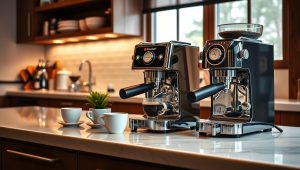
The Lelit dual boiler machines — primarily the Bianca PL162T and the Elizabeth PL92T — occupy an awkward middle ground that many home baristas actually want. They cost more than a heat-exchanger like the Lelit MaraX or Profitec Pro 500, but significantly less than a La Marzocco Linea Micra or ECM Synchronika. For that premium you get independent temperature control for brewing and steaming, which is the single biggest quality-of-life upgrade if you make milk drinks back-to-back or want to dial in light roasts without temperature surfing.
Unlike E61 dual boilers from ECM or Profitec, Lelit’s approach is compact, electronically controlled, and feature-heavy for the price. That makes them compelling, but also means different trade-offs in build, serviceability, and workflow.
What Makes the Lelit Dual Boilers Different
Lelit currently offers two true dual boiler models for home use. They are not just scaled versions of each other — they target different users.
The Bianca PL162T is the flagship. It pairs a 0.8L brew boiler and 1.5L steam boiler with Lelit’s electronic paddle for manual flow profiling, a rotary pump that can run from reservoir or be plumbed in, and the LCC (Lelit Control Center) for PID control. It’s built around a commercial-style E61 group, but adds modern sensors and a low-pressure pre-infusion you can control by paddle position.
The Elizabeth PL92T is smaller, cheaper, and more automated. It uses a 0.3L brew boiler and 0.6L stainless steam boiler, a vibratory pump (reservoir only), and a saturated group derived from Lelit’s 58mm system, not an E61. No paddle, but it has programmable pre-infusion, auto brew timing, and a much faster heat-up — about 10-15 minutes versus 25-35 for the Bianca.
Both give you what a dual boiler is supposed to: set brew temperature to 93C and steam boiler to 135C and they stay there, independently. You can pull a shot and steam milk simultaneously with no recovery time and no flushing ritual.
Brew Performance and Workflow in Practice
See also: Breville Bench Saver • Rocket Espresso Coffee Machine
On the cup, the difference between a well-managed heat-exchanger and a dual boiler is smaller than marketing suggests if you drink medium-dark roasts. Where the Lelits pull ahead is consistency and control, especially for light roasts that need precise, lower or higher brew temps.
The Bianca’s paddle is not a gimmick, but it is manual. Fully left is pump off, center is line-pressure pre-infusion (if plumbed, or ~2-3 bar from the tank), and fully right is full pump pressure. You control flow by feathering it. There is no automatic pressure profiling — you watch the gauge and learn. Paired with the LCC, you can also program temperature, pre-infusion duration, and see shot time. For tinkerers, this is the cheapest way to get true flow control without adding a needle valve kit yourself.
The Elizabeth trades that hands-on control for convenience. You set pre-infusion on/off and duration in the menu, press a button, and it delivers a timed, temperature-stable shot. The vibratory pump is louder than the Bianca’s rotary pump, and you can’t plumb it in, but it takes up far less counter space: roughly 30cm wide versus 29cm wide but much deeper and heavier for the Bianca.
Steaming is strong on both, but different. The Bianca’s larger boiler and rotary pump deliver dry, powerful steam that can texture 200ml of milk in ~20 seconds once fully heated. The Elizabeth is faster to ready but less powerful and will drop pressure if you steam large pitchers back-to-back. Both have no-burn wands that are easy to clean, but the joints and ball valves will eventually need rebuilding — a normal 3-5 year service item.
Lelit vs. Other Dual Boilers at the Same Price
If you are shopping dual boilers under $3,500, you are usually deciding between Lelit and the ECM/Profitec, Rancilio, and Breville/Sage options. Here is how they actually compare for home use.
| Machine | Boilers | Pump / Plumbing | Group Type | Key Strength | Key Weakness |
|---|---|---|---|---|---|
| Lelit Bianca PL162T | 0.8L brew + 1.5L steam (brass) | Rotary, reservoir or plumbed | E61 with paddle flow control | Flow profiling out of the box, quiet | Large footprint, E61 needs maintenance |
| Lelit Elizabeth PL92T | 0.3L brew + 0.6L steam | Vibratory, reservoir only | Lelit 58mm saturated group | Fast heat-up, compact, programmable | Smaller boilers, louder, no plumbing |
| Profitec Pro 600 / ECM Synchronika | 0.75L brew + 2.0L steam | Rotary or vibratory, plumbable | E61 | Build quality, serviceability, hygiene | No flow control stock, heavier, pricier |
| Rancilio Silvia Pro X | 0.3L brew + 1.0L steam | Vibratory, reservoir only | Rancilio saturated group | Compact dual boiler, simple PID | No profiling, smaller water tank |
When you browse current dual boiler espresso machines, you will notice the Bianca often undercuts a Synchronika by $500-$800 while including flow control. The saving comes from lighter stainless panels, more plastic internally (LCC housing, drip tray), and brass boilers instead of stainless on the ECM. Functionally excellent, but long-term corrosion resistance and perceived solidity are a step below German-built machines.
Drawbacks and Failure Modes to Know Before Buying
Lelit builds well for the price, but these are not buy-it-for-life tanks with zero upkeep.
1. LCC and electronics. The LCC is convenient until it isn’t. Moisture ingress from overfilling the reservoir or a leaky fitting can fog or kill the display. Keep the tank below the max line and wipe spills immediately. If the LCC fails out of warranty, replacement is ~$150-$200 and requires opening the machine.
2. E61 maintenance (Bianca). The E61 group needs lubrication every 6-12 months and cam/mushroom gasket replacement every 1-2 years depending on use. If neglected, the lever gets sticky and the group leaks. It is easy DIY work, but it is work. The Elizabeth’s saturated group avoids this.
3. Brass boilers and water. Both Lelits use brass boilers. Brass is great for thermal stability but sensitive to poor water. Use soft, low-mineral water (35-70 ppm TDS) with no chloride. Hard tap water will scale the small brew boiler quickly, and descaling a dual boiler is tedious — you have to isolate each boiler. A good water solution like a BWT or espresso water softener with regular filter changes is cheaper than a service call.
4. Vibratory pump wear (Elizabeth). Vibratory pumps are rated for ~5-7 years of home use. They get louder before they fail. Replacements are cheap ($60-$90) and easy, but plan for it.
5. Temperature offset. Both machines show boiler temperature, not puck temperature. Lelit applies an offset, and it is usually accurate within 1-1.5C, but if you chase exact numbers, verify with a group thermometer or Scace device. For most users, just dial by taste — 92C for dark, 93-94C for medium, 94-96C for light.
Who Should Buy Which Lelit — And When to Save Money
Buy the Bianca if you want to experiment with flow and pressure, make 3+ milk drinks in a row for family/guests, have space to plumb in or value a quiet rotary pump, and don’t mind tinkering. It suits the hobbyist who already has a good grinder — pairing a $2,800 machine with a $200 grinder wastes its potential.
Buy the Elizabeth if you want dual boiler convenience in a small kitchen, value speed over ritual, and mostly drink 1-2 drinks at a time. It is also the better choice if you dislike E61 maintenance. For many apartments, it is the more sensible dual boiler.
Don’t buy either if you primarily drink dark roast milk drinks and make one cappuccino in the morning. A heat-exchanger like the Lelit MaraX or a single-boiler dual-use machine like the Rancilio Silvia Pro X will get you 90% of the result for less money and less complexity. Be honest about that — the cheaper option is fine if you won’t use profiling or simultaneous brew/steam daily.
If you are still deciding, compare the total system cost. You will need a capable grinder, and you will get more taste improvement from upgrading from a $300 to a $600 grinder than from any machine upgrade in this class. Look at 58mm espresso grinder options with stepless or micro-stepped adjustment before you stretch for the Bianca.
For both machines, buy from a dealer who stocks Lelit spare parts in your country. Lelit support is good, but shipping a boiler or control board from Italy takes weeks. A domestic retailer with service stock is worth $100-$200 extra upfront.
FAQ
Is the Lelit Bianca worth the extra cost over the Elizabeth?
Only if you will use flow profiling and need the larger steam boiler and rotary pump. For straight 9-bar shots with PID control, the Elizabeth makes espresso that is just as stable and heats up faster. The Bianca is for hands-on control and entertaining, not inherently better-tasting shots.
How long does each machine take to heat up?
The Elizabeth is ready to brew in about 10-15 minutes, with steam ready shortly after. The Bianca needs 25-35 minutes for full thermal stability due to the mass of the E61 group, even though the boilers themselves heat quickly. Use a smart plug timer to preheat the Bianca in the morning.
Can I use tap water in a Lelit dual boiler?
Only if your tap is soft (below ~100 ppm hardness) and chloride-free. Most municipal water is too hard and will scale the small brew boiler within months. Use filtered, softened water or a proven espresso water recipe and avoid distilled water alone, which can cause sensor errors and corrosion.
Do I need to plumb in the Bianca?
No. It runs fine from its 2.5L reservoir. Plumbing in gives you line-pressure pre-infusion, automatic refill, and less refilling, which is useful if you make many drinks. If you cannot plumb in, you still get manual flow control from the tank, just at vibratory-pump-like pre-infusion pressure.