Last updated: October 2, 2026
- What the DeLonghi Maestro Actually Is
- Who It Suits And Who Should Skip It
- Grinding and Tamping: Where It Saves You
- Brewing and Temperature Control
- Milk Steaming: Automatic and Manual Modes
- Living With It: Cleaning and Failure Modes
- How It Compares to Other DeLonghis and Rivals
- What to Check Before You Buy
- FAQ
What the DeLonghi Maestro Actually Is
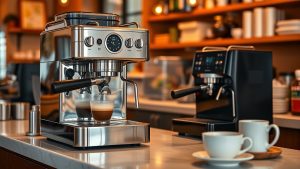
The DeLonghi Maestro most people mean is the La Specialista Maestro — model EC9665M in the US. It sits at the top of DeLonghi’s semi-automatic range, above the La Specialista Arte and Prestigio. Think of it as DeLonghi trying to bridge manual espresso and automatic convenience: it has a built-in grinder, automatic tamping, dual heating system, and a manual steam wand with some automation mixed in.
It’s not a fully automatic bean-to-cup machine like the Magnifica or Dinamica, where you press one button for a latte. And it’s not a stripped-down single-boiler like the Dedica. The Maestro wants to give you control over the shot while removing the two steps beginners mess up most: grinding and tamping.
Who It Suits And Who Should Skip It
See also: Breville Bench Saver • Rocket Espresso Coffee Machine
This machine makes sense if you want to learn to make real espresso without buying a separate grinder, tamper, and spending weeks dialing in. The sensor grinding, automatic tamping, and active temperature control shorten the learning curve a lot. If you drink mostly milk drinks but care about the espresso underneath, the Maestro hits a sweet spot.
Skip it if you fall into one of these camps:
You want true one-touch lattes. The Maestro still requires you to move the portafilter, tamp automatically, brew, then manually steam or use the auto-steam preset. A fully automatic bean to cup espresso machine will be faster and cleaner for a busy household where everyone just wants a button.
You want full manual control. If you already own a good single-dose grinder and enjoy WDT, precision tamping, and pressure profiling, the Maestro’s integrated grinder and auto-tamp will feel limiting. You are paying for automation you don’t need.
You are on a tight budget or tight counter. The Maestro is wide — about 15 inches — and heavy at over 30 pounds. It also needs regular cleaning clearance on top for the bean hopper. A smaller semi-automatic plus a separate grinder can be cheaper and more repairable.
Grinding and Tamping: Where It Saves You
The built-in grinder has 8 stepped settings and uses what DeLonghi calls Sensor Grinding. It doses by time and adjusts slightly based on the previous shot. It’s not as precise as a standalone Eureka or Baratza, but it is consistent enough for medium to dark roasts, which is what most buyers use.
The real differentiator is the automatic tamping. You pull the tamping lever after grinding and a small hydraulic piston tamps at a fixed pressure. This eliminates channeling from uneven tamps, which is the number one reason beginners get sour, fast shots. In practice, puck prep goes from a 90-second ritual to about 10 seconds.
Trade-off: you lose feel. You can’t experiment with lighter tamp pressure for light roasts, and the grinder struggles with very light, dense beans. If you love light-roasted single origins, you will hit the finest grind setting and still get fast shots. The Maestro is tuned for traditional Italian-style beans.
Brewing and Temperature Control
DeLonghi uses a dual heating system: a thermoblock for brewing and a separate thermoblock for steaming. That means no long wait between brewing and steaming, unlike single-boiler machines like the Dedica. Active temperature control lets you pick between three temperature profiles — suited to light, medium, or dark roasts — though even the hottest setting runs a bit cool compared to a PID-controlled E61 or a Breville dual boiler.
The pump delivers the standard 15 bars but brews around 9 bars at the group. There is a low-pressure pre-infusion, which helps with even extraction. Shot quality is solid and repeatable, with decent crema, but not as nuanced as what a well-tuned manual setup can pull. Expect 20-28 second extractions once dialed in. The 58mm portafilter is full-size, which is a plus for aftermarket accessories.
Milk Steaming: Automatic and Manual Modes
You get two systems in one wand. MyLatteArt steam mode is fully manual — you control jug position and texture like any barista wand. It has good power for a thermoblock and can produce tight microfoam if you learn technique. The other mode is Auto Latte: you set the desired temperature and texture level, stick the wand in the jug, and it stops automatically.
Auto Latte is genuinely useful if you make milk drinks half-asleep in the morning. It won’t match a skilled hand for latte art, but it beats the panarello wands found on cheaper DeLonghis that just froth bubbles. The downside is maintenance. The wand has more internal tubing than a simple manual wand and will clog if you don’t purge and wipe after every use. That is the most common failure mode owners report: weak steam after a few months because milk baked inside the wand.
Living With It: Cleaning and Failure Modes
Day-to-day, the Maestro is cleaner than a separate grinder setup because the grinder is contained, but it is not low-maintenance. You need to:
Empty the drip tray often — it fills faster than you expect because it dumps the pre-infusion purge. Brush out the grinder chute weekly or it cakes with oily beans. Backflush with water regularly and run the descaling cycle when prompted; the dual thermoblocks scale quickly in hard water areas.
Common issues after year one: grinder jams from very oily dark roasts, the auto-tamp mechanism getting sluggish if grounds build up in the rails, and the steam thermostat failing if people run steam without purging. None are catastrophic, but they require cleaning discipline. Using filtered water and not using beans that look shiny/oily extends life significantly.
DeLonghi support is patchy in the US. Warranty is one year, and service often means shipping the whole unit. If reliability and local service matter more than automation, a simpler machine with fewer integrated parts is easier to keep running.
How It Compares to Other DeLonghis and Rivals
| Machine | Grinder | Tamping | Heating | Best For |
|---|---|---|---|---|
| DeLonghi La Specialista Maestro EC9665M | Built-in, 8 steps, sensor dosing | Automatic hydraulic | Dual thermoblock | Beginner to intermediate who wants guided espresso + decent milk |
| DeLonghi La Specialista Arte Evo | Built-in, 8 steps | Manual (with included tamper) | Single thermoblock | Tighter budget, willing to learn tamping |
| DeLonghi Dedica + Separate Grinder | None (buy separate) | Manual | Single thermoblock, 15-bar pump | Small kitchen, wants upgrade path |
| Breville Barista Express Impress | Built-in, 25 steps | Assisted lever tamp | Thermocoil with PID | More grind control, better for lighter roasts |
The Maestro costs significantly more than the Arte Evo but the auto-tamp and faster steam recovery are meaningful if you make two or more milk drinks back-to-back. Compared to the Breville Barista Express Impress, the Maestro has better auto-milk but less grind range and slightly less precise temperature control. Breville is often easier to find parts for in North America.
When the cheaper option is fine: if you only make one cappuccino a day and don’t mind learning to tamp, the Arte Evo pulls a very similar shot for several hundred dollars less. Put the savings toward fresh beans and a proper espresso grinder 58mm accessory kit with a scale and WDT tool. If you make three lattes every morning for family, the Maestro’s speed and auto-steam will pay back every day.
What to Check Before You Buy
Check your counter height. With the hopper, the Maestro is over 17 inches tall — it won’t fit under low cabinets. Measure depth too; you need room to pull the portafilter straight out.
Consider your water. If you have hard water, budget for a filter jug or direct filtration. Scale is what kills thermoblocks, and DeLonghi’s descale process uses a full tank cycle that you can’t skip.
Don’t overpay for bundles. Retailers often bundle the Maestro with DeLonghi’s pressurized baskets and cleaning kits you may not need. The standard package already includes single and double non-pressurized baskets, which is what you should be using. If you want to comparison shop, check current listings for the DeLonghi La Specialista Maestro EC9665M against the Arte line to see if the premium is still justified — prices swing a lot around holidays.
Finally, buy from a retailer with a good return window. Dialing in takes about a half-bag of beans. If you can’t get a good extraction within that time and you are using fresh, medium-roast beans within 2-4 weeks of roast date, the machine may not be the right fit for your taste.
FAQ
Does the Maestro grind fine enough for real espresso?
Yes for medium and dark roasts, which is its target. For very light roasts you may bottom out at the finest setting and still get a 15-18 second shot. If you primarily drink light, specialty roasts, a standalone grinder with stepless adjustment will give you more range.
Can you use pre-ground coffee or pods?
You can use pre-ground with the included adapter, but you lose the sensor dosing and tamp automation, which are the main reasons to buy this machine. It does not use ESE pods. For best results use whole beans roasted within the last month.
Is the automatic milk frothing good enough for latte art?
Auto mode makes consistent, creamy foam for cappuccinos and lattes but rarely microfoam fine enough for detailed latte art. Use manual MyLatteArt mode and a good stainless jug if art matters to you. Purge the wand for 2-3 seconds after every use to prevent clogging.
How long does the Maestro last?
With filtered water and weekly cleaning, 5-7 years is common before a thermoblock or pump needs service. Heavy use without descaling or with oily beans shortens that to 2-3 years. The grinder and auto-tamp are the first parts to feel neglected maintenance.