Last updated: September 18, 2026
Buying your first espresso machine can feel like choosing between nearly identical boxes covered in technical terms. Many beginners make the same mistakes: they buy based on wattage alone, assume a lower price automatically means a poor drink, or choose a machine that is too large for the counter. Others underestimate the work involved in grinding, tamping, steaming, and cleaning.
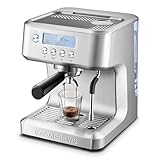
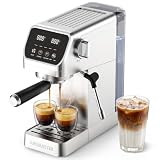
This espresso machine buying guide for beginners focuses on the specifications that affect daily use rather than impressive-sounding marketing claims. A compact machine such as the CASABREWS CM5418, an entry-level stainless-steel model such as the CASABREWS 3700 Essential, or a budget option such as the Aromaster 1400W machine may all suit a beginner, but only if the machine’s size, controls, pressure system, and maintenance requirements match your routine. Prices and included accessories can change, so use the ranges below as shopping benchmarks rather than guarantees.
As an Amazon Associate we earn from qualifying purchases at no extra cost to you. Product prices and availability are accurate as of the date shown and are subject to change.



- Decide These 3 Things First
- Size: Measure the Counter, Not Just the Machine
- Material and Construction: Look Beyond Stainless Steel
- Performance and Comfort: Wattage Is Only One Piece
- Price Tiers: Budget for the Grinder and Supplies
- Warranty and Service: Read the Fine Print
- Delivery and Assembly: Plan for a Simple Setup
- Spec Checklist
- Red Flags
- FAQ
Decide These 3 Things First
- How many drinks will you make? If you prepare one or two milk drinks each morning, a compact single-boiler machine may be sufficient. A household making six or more drinks daily will benefit from a larger water tank, faster recovery, and sturdier components.
- Will you use pre-ground coffee or whole beans? Pre-ground coffee is the simplest starting point. If you want fresher flavor, budget another $100 to $250 for a capable burr grinder. A good grinder often improves espresso more than spending the same amount on a more decorative machine.
- How much hands-on work do you want? Semi-automatic machines require dosing, tamping, milk steaming, and cleanup. Super-automatic machines handle more steps but usually cost $500 to $1,500 or more. Decide whether you want a quick beverage or a small coffee-making ritual.
Size: Measure the Counter, Not Just the Machine
See also: How to Replace Espresso Machine Water Filter (2026): Step-by-Step • How to Adjust Espresso Machine Brew Temperature (2026): Step-by-Step
Compact espresso machines commonly measure about 8 to 10 inches wide, 10 to 13 inches deep, and 11 to 13 inches tall. That footprint works well in a small kitchen, but leave additional clearance above the machine if the water reservoir lifts out from the top. A machine listed as 12 inches tall may need 16 to 18 inches of usable vertical space.
Depth matters when the machine sits beneath cabinets. Allow at least 2 inches behind it for the power cord and water-tank access. You also need room in front for the portafilter handle, which can extend 5 to 7 inches beyond the body while you lock it in place.
Water capacity is another size-related tradeoff. A 1-liter tank is adequate for roughly two to four espresso drinks once you account for brewing and steaming. Tanks from 1.5 to 2 liters are more convenient for families, although they add weight and take longer to refill. Check whether the tank is removable; a removable reservoir is much easier to wash than one that must be cleaned in place.
Material and Construction: Look Beyond Stainless Steel
“Stainless steel” may describe only the exterior panel, not the internal frame or the brewing components. Stainless-steel panels resist stains and look durable, while plastic housings can keep a machine lighter and less expensive. Neither material guarantees better espresso.
For a beginner, prioritize a stable base, a firm portafilter connection, and controls that do not wobble. A machine weighing about 8 to 12 pounds is easy to move but may slide when you lock in the portafilter. Models weighing 12 to 20 pounds generally feel more planted. Rubber feet help, particularly on polished stone or laminate counters.
Look for a portafilter with a standard diameter of 51, 54, or 58 millimeters. A 58-millimeter portafilter is common on larger prosumer machines and offers the widest range of replacement baskets. Smaller sizes are not automatically inferior, but accessories may be less interchangeable.
Performance and Comfort: Wattage Is Only One Piece
Entry-level machines typically use 1,000 to 1,500 watts. Higher wattage can help the machine heat quickly and maintain temperature during steaming, but it does not prove that the brew system is well designed. A 1,200-watt machine with poor temperature control can produce less consistent coffee than a lower-wattage model with better engineering.
Most affordable semi-automatic machines use a thermoblock or single-heating system. These are usually ready in 30 to 60 seconds and are practical for one drink at a time. The limitation is that brewing and steaming may require a short wait between steps. Machines with separate boilers or dual thermoblocks cost more, often $700 or above, but can brew and steam with less interruption.
Pressure ratings are frequently advertised at 15 or 20 bar. Espresso is generally extracted around 9 bar at the coffee puck, so a bigger maximum number is not necessarily better. A pressure gauge, adjustable controls, and a properly sized basket are more useful indicators than a headline pressure figure.
For milk drinks, examine the steam wand. A metal wand with a small, removable tip is easier to clean and offers more control than a fixed plastic frothing attachment. Beginners may prefer a faster, forgiving frother, while experienced users usually want a wand that can create fine microfoam. Expect steaming a small pitcher of milk to take roughly 30 to 90 seconds on a basic machine.
Price Tiers: Budget for the Grinder and Supplies
$70 to $130: This is the basic entry level. Machines in this range often include pressurized filter baskets, a plastic tamper, a small cup tray, and a manual steam wand or frother. They are suitable for occasional lattes and learning the process. The CASABREWS 3700 Essential, listed around $99.99 in the example lineup, and the XIXUBX machine, listed around $69.99, fit this general budget category. Expect more plastic, smaller tanks, and slower recovery.
$130 to $300: This range typically buys a more substantial housing, a better portafilter, clearer controls, and improved steam performance. The CASABREWS CM5418, listed around $139.99, is an example of the compact step-up category. You may also have room in the budget for a basic burr grinder priced around $100 to $150.
$300 to $700: Machines in this tier may offer more consistent temperature management, stronger steam power, larger water tanks, and more durable internal components. They still require technique, but they can be a better long-term choice for daily users.
$700 and up: Premium semi-automatic and prosumer machines may include dual boilers, rotary pumps, advanced temperature controls, and commercial-style 58-millimeter portafilters. These features make sense for frequent drinkers who are willing to learn and maintain the equipment. Do not buy at this level simply to avoid learning basic espresso steps.
Warranty and Service: Read the Fine Print
A one-year limited warranty is common for budget machines; two years is more reassuring. Check whether the warranty covers the pump, heating system, and electronics, or only manufacturing defects in the housing. Some warranties exclude damage caused by hard water, improper cleaning, commercial use, or unauthorized repairs.
Before buying, confirm the seller’s return window. A 30-day return period gives you time to check leaks, heating, portafilter fit, and steam performance. Keep the original packaging until you are satisfied. Also look for replacement gaskets, filter baskets, water tanks, and steam tips. A low-cost machine becomes difficult to live with if a small missing part cannot be replaced.
Delivery and Assembly: Plan for a Simple Setup
Most countertop espresso machines arrive mostly assembled. Setup usually involves removing protective film, washing the tank and accessories, installing the portafilter components, and running one or two water-only cycles. Allow 20 to 40 minutes before making the first drink.
Inspect the package immediately for a cracked water tank, bent portafilter, loose drip tray, or missing tamper. Machines weighing 15 pounds or more should be placed with two hands, especially on a high counter. Never operate a machine without the drip tray and adequate ventilation around the sides.
Delivery packaging is particularly important for low-cost machines. A damaged box does not always mean the machine is damaged, but photograph visible dents before opening and test every function during the return period. Avoid plugging a 1,200- to 1,500-watt machine into an overloaded power strip.
Spec Checklist
| Spec | Budget | Mid | Premium |
|---|---|---|---|
| Typical price | $70–$130 | $130–$300 | $300–$1,500+ |
| Width | 8–10 in. | 8–11 in. | 9–14 in. |
| Water tank | 0.8–1.2 L | 1.2–1.8 L | 1.5–3.5 L |
| Power | 1,000–1,300 W | 1,200–1,500 W | 1,400–2,000 W |
| Heating system | Thermoblock or single heater | Thermoblock or improved single heater | Single boiler, heat exchanger, or dual boiler |
| Portafilter | 51–54 mm | 51–58 mm | 58 mm, often commercial style |
| Best for | One or two drinks occasionally | Daily home use | Frequent drinks and advanced control |
Red Flags
- Only a maximum pressure number: “20 bar” without information about temperature control or extraction design tells you very little.
- No dimensions or tank capacity: Missing basic measurements make it difficult to plan counter space and refills.
- Unclear basket type: Beginners usually benefit from pressurized baskets, while aspiring enthusiasts may want both pressurized and non-pressurized options.
- A permanently attached water tank: This makes routine cleaning harder and increases the chance of stale water buildup.
- Vague warranty language: Be cautious when the seller does not identify the warranty length, return address, or replacement-parts process.
- Included grinder claims: A machine bundle is not a bargain if the grinder cannot make a fine, consistent grind.
- Too many touch controls at a very low price: Extra buttons may add convenience, but they can also introduce more electronics without improving the coffee.
FAQ
Do I need a grinder to use an espresso machine?
No. You can begin with pre-ground espresso coffee or use a pressurized basket designed to tolerate less precise grinding. However, a burr grinder gives you more control and usually produces a noticeable improvement. Plan on spending about $100 to $250 for a grinder that is genuinely useful for espresso.
Is a 15-bar espresso machine better than a 9-bar machine?
Not necessarily. The advertised figure is often the pump’s maximum capability, not the pressure at the coffee during extraction. Espresso is commonly brewed near 9 bar. Consistent temperature, an even coffee bed, and a suitable grind matter more than the largest pressure number.
How often should I clean a beginner espresso machine?
Rinse the portafilter and basket after every use, purge and wipe the steam wand immediately after steaming, and empty the drip tray regularly. Wash the water tank and removable parts at least weekly with normal use. Descale according to the manual and your water hardness, commonly every one to three months.
What is the best first espresso machine?
The best first machine is one that fits your counter, has a removable tank, includes a usable steam wand, and comes with a clear warranty. For occasional drinks, a $70 to $130 compact machine is reasonable. For daily lattes, spending $130 to $300 and reserving money for a burr grinder is often the more satisfying choice.
Ready to decide? Our #1 pick for 2026 is the Typical price.
Live price & availability on Amazon.