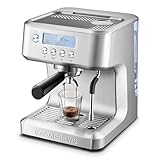
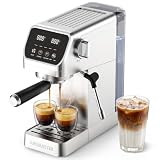
- Top Pick: CASABREWS CM5418 Compact Espresso Machine with Milk Frothing Steam Wand
- Best Value: Aromaster 1400W Espresso Machine with Milk Frother, Stainless Steel
- Premium Choice: Keurig K-Express Single Serve K-Cup Pod Coffee Maker, 3 Brew Sizes, Strong Button Feature, 42oz Removable Reservoir, Black
Last updated: September 18, 2026
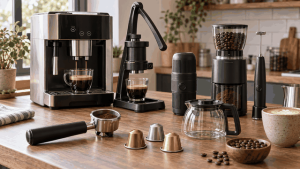
Choosing between an espresso machine and a pod machine is less about which appliance makes “better” coffee and more about how you want coffee to fit into your daily routine. A traditional espresso machine gives you control over grind size, dose, tamping, milk texture, and drink size. A pod machine trades that control for speed, consistency, and far less cleanup.
The real decision is whether you want a small coffee ritual or a nearly automatic button press. Counter space, household habits, long-term cost, and tolerance for maintenance all matter as much as flavor. In 2026, both categories include affordable options, from compact manual espresso machines priced around $100 to $150 to pod brewers that start below $100.
As an Amazon Associate we earn from qualifying purchases at no extra cost to you. Product prices and availability are accurate as of the date shown and are subject to change.



Quick Verdict
Choose an espresso machine if you enjoy café-style drinks, want to use fresh beans, care about dialing in flavor, or regularly make lattes and cappuccinos. A basic manual machine such as the $139.99 CASABREWS CM5418 or the $109.99 Aromaster 1400W Espresso Machine can provide a lower-cost entry into espresso, especially if you already own—or are willing to buy—a grinder.
Choose a pod machine if your priority is fast, repeatable coffee with minimal mess. A model such as the $89.99 Keurig K-Express is suited to straightforward everyday brewing, while the $149.99 Keurig K-Elite adds features such as strength and temperature controls, programmable brewing, and an iced coffee setting.
For one or two people who value convenience, pods are usually the easier choice. For coffee enthusiasts, milk-drink fans, and households willing to learn a process, espresso is more rewarding.
Side by Side
See also: How to Replace Espresso Machine Water Filter (2026): Step-by-Step • How to Adjust Espresso Machine Brew Temperature (2026): Step-by-Step
| Factor | Espresso machine | Pod machine |
|---|---|---|
| Comfort and convenience | Hands-on; typically 5–10 minutes including grinding and cleanup | Very easy; often ready in about 1–3 minutes |
| Durability | Often 3–8 years with regular care; pumps and seals eventually need service | Commonly 3–6 years; pumps, puncture mechanisms, and electronics can fail |
| Upfront price | About $100–$1,500+, plus a grinder for many setups | About $60–$250 for common home models |
| Drink cost | Roughly $0.35–$0.80 per shot using whole beans | Roughly $0.45–$1.10 per pod |
| Maintenance | Rinse the group area, clean the portafilter, purge the wand, and descale periodically | Empty the pod bin, rinse the reservoir, and descale periodically |
| Space needed | Usually 7–10 inches wide and 12–16 inches deep, plus grinder space | Often 6–8 inches wide and 10–15 inches deep |
| Look | More visual presence; stainless steel and café-inspired designs are common | More appliance-like, with compact plastic-bodied options |
| Resale value | Better for respected brands and well-maintained machines | Usually modest because models become outdated and are widely discounted |
| Best for | Espresso, americanos, cappuccinos, and lattes | Fast, consistent cups with little preparation |
Where Espresso Machine Wins
Flavor control is the biggest advantage. With an espresso machine, you can select the beans, adjust the grind, change the dose, and control extraction time. Freshly ground coffee can produce a more aromatic, textured shot than a pre-portioned pod. You can also make a double shot, an americano, or a stronger base for an iced drink without being limited to a pod’s preset quantity.
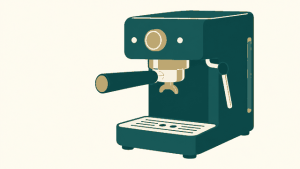
Manual espresso machines are especially appealing to people who drink milk-based beverages. A steam wand lets you texture milk for cappuccinos, lattes, and flat whites. The CASABREWS CM5418 and Aromaster 1400W models both represent the compact, entry-level format: a relatively small machine with a portafilter and milk-frothing wand rather than an automated bean-to-cup system. Their listed prices—$139.99 and $109.99—are accessible, but buyers should remember that a capable burr grinder may add roughly $50 to $200 or more.
Espresso machines can also reduce packaging waste. A bag of beans or ground coffee uses less individual packaging than a box of single-use pods. Used grounds can often go into compost, depending on local rules. This does not make every espresso setup automatically sustainable—electricity, shipping, packaging, and machine replacement still count—but it gives you more control over consumables.
Finally, an espresso machine can become a hobby. Learning to tamp evenly, steam milk, and adjust extraction is part of the appeal for some owners. If you like cooking, baking, or other hands-on kitchen projects, that added involvement may feel rewarding rather than inconvenient.
Where Pod Machine Wins
Convenience is difficult to beat. Add water, insert a pod, press a button, and the machine handles the dose and brewing time. There is no grinder to calibrate, no loose coffee to measure, and no portafilter full of wet grounds to knock out. That makes pod machines useful on busy mornings, in offices, and for people who want coffee without learning a technique.
Pods also deliver consistent results. Every serving is portioned in advance, so different people in the household can make similar cups. The Keurig K-Express, priced at $89.99, offers three brew sizes and a strong button in a compact format. The $149.99 Keurig K-Elite is a better fit for households wanting more customization, including strength and temperature control, programmable brewing, and iced coffee capability.
Pod machines are generally easier to share. One person can brew a mild cup, another can choose a darker roast, and a guest can select a flavored or decaffeinated option without changing a grinder’s settings. They are also less messy around children and pets because there are fewer loose beans, hot portafilters, and milk pitchers involved.
The trade-off is that pod coffee tends to cost more per serving and offers less control. Quality varies by brand and pod age, and the resulting beverage is usually closer to concentrated brewed coffee than café-style espresso. Some pod systems offer espresso-format capsules, but they do not necessarily create the same pressure, texture, or crema as a dedicated espresso setup.
Cost Over 5 Years
The cheapest machine is not always the cheapest system to own. Consider a household making two drinks per day, or about 730 drinks per year.
An espresso setup might cost $110–$150 for the machine and $50–$200 for a grinder, for an initial total of about $160–$350. At $0.35–$0.80 per serving, coffee costs approximately $1,278–$2,920 over five years. Add perhaps $50–$150 for descaling solution, replacement baskets, gaskets, and occasional accessories, and the five-year total is roughly $1,490–$3,420.
A pod setup might cost $90–$150 for the brewer. At $0.45–$1.10 per pod, five years of daily use costs approximately $1,643–$4,015. With an estimated $40–$100 for descaling and cleaning supplies, the total comes to about $1,770–$4,265.
These are planning ranges, not guarantees. Coffee prices, drink frequency, discounts, milk, syrups, grinder quality, and machine lifespan can change the result. An espresso machine can be cheaper to operate when you buy economical beans, while pods may be competitive for occasional drinkers who would otherwise waste coffee.
Which One for Your Home
Small apartment
A pod machine is usually the practical choice when counter space is limited. Measure the available width and depth, and leave room to open the water reservoir. A compact pod brewer often occupies less than 1 square foot, while an espresso machine may need a grinder beside it and extra clearance for a portafilter and steam wand.
Choose a compact espresso machine only if you are comfortable storing the grinder elsewhere or using pre-ground coffee. Also consider noise: grinding beans can be more disruptive than a pod brewer early in the morning.
Family with kids or pets
Pods minimize loose grounds and reduce preparation steps, which can be helpful when mornings are chaotic. A larger removable reservoir also means fewer refills. Look for an automatic shutoff, an easy-to-clean drip tray, and controls that are difficult to activate accidentally.
An espresso machine can still work well, but it requires more attention around hot surfaces, steam, and small accessories. Its wand and portafilter also need prompt cleaning after use, which may be easy to forget during a busy school-day routine.
Rental
Renters should favor a machine that is easy to move and does not require plumbing, cabinetry changes, or a dedicated cart. Both categories generally plug into a standard outlet, but check the circuit if other high-wattage appliances share it. Entry-level espresso machines commonly use about 1,000–1,500 watts; pod brewers often use roughly 1,000–1,500 watts during heating as well.
A pod machine is the safer low-commitment purchase if you may move soon. An espresso machine makes sense if you already own a grinder and expect to take the setup with you.
Long-term home
Homeowners who expect to stay put can prioritize enjoyment over minimum footprint. An espresso machine is a stronger long-term choice for people who want to improve their technique, buy fresh beans, and make milk drinks several times a week. Plan for a dedicated area with water access, storage for accessories, and enough ventilation around the machine.
A pod machine remains the better option if several household members have different schedules or if nobody wants a daily cleaning routine. The best appliance is the one people will actually use consistently.
FAQ
Is espresso stronger than pod coffee?
Espresso is more concentrated by volume, but a full mug of pod coffee may contain as much or more total caffeine than a single espresso shot. Strength depends on the serving size, coffee blend, dose, and brew setting—not just the machine type.
Do I need a grinder for an espresso machine?
Not always. You can use suitable pre-ground coffee, but a burr grinder gives you much more control and usually better freshness. A blade grinder is less consistent and can make dialing in espresso difficult.
Which machine is easier to clean?
Pod machines are generally easier for daily cleanup. Espresso machines need the portafilter and group area rinsed, and a steam wand must be purged and wiped after every milk drink. Both types should be descaled according to the manufacturer’s instructions.
Are pod machines worth it for one cup a day?
They can be. For occasional use, convenience may outweigh the higher per-cup cost and packaging. If you drink only one cup daily and enjoy fresh coffee, a manual espresso setup or a simple pour-over brewer may cost less over time, but neither is as effortless as a pod machine.
Ready to decide? Our #1 pick for 2026 is the Comfort and convenience.
Live price & availability on Amazon.