Last updated: October 11, 2026
For most small rooms, the Sonos Beam (Gen 2) is the best soundbar overall: at 25.6 inches wide it fits under a 43–55 inch TV, it uses a dedicated center driver for dialogue, and it needs no floor-standing subwoofer. If your budget is tight, the Roku Streambar is the value pick at just 14 inches wide, and if floor space is the hard limit, the Polk MagniFi Mini AX pairs a 13.4-inch bar with a compact wireless sub. Everything below compares these on width, dialogue clarity, bass, connectivity, and setup so you can match a bar to the room you actually have.
Quick answer: For most people in 2026, the best soundbars for small rooms and compact spaces is the Sonos Beam (Gen 2) — our #1 rated choice. See the full ranked comparison, alternatives and buying advice below.
- Quick comparison: compact soundbars for small rooms
- Best overall: Sonos Beam (Gen 2)
- Best budget: Roku Streambar
- Best for dialogue: Bose TV Speaker
- Best for the tightest spaces: Polk MagniFi Mini AX
- Best all-in-one under 0: Yamaha SR-C20A
- Best for movies with real bass: Samsung HW-Q600C
- How to choose: the numbers that actually matter
- Ownership realities: what wears out and what it costs
- Frequently Asked Questions
Quick comparison: compact soundbars for small rooms
| Pick | Best for | Bar width | Sub included | Key inputs | Typical price range |
|---|---|---|---|---|---|
| Sonos Beam (Gen 2) | Best overall | 25.6 in | No | HDMI eARC, optical (adapter), Wi-Fi, Bluetooth | $399–$499 |
| Roku Streambar | Best budget | 14.0 in | No | HDMI ARC, optical, Bluetooth | $99–$130 |
| Bose TV Speaker | Best for dialogue | 23.4 in | No | HDMI ARC, optical, 3.5 mm, Bluetooth | $199–$279 |
| Polk MagniFi Mini AX | Tightest floor space | 13.4 in | Yes (compact wireless) | HDMI eARC, optical, Wi-Fi, Bluetooth | $349–$499 |
| Yamaha SR-C20A | Best all-in-one under $200 | 23.6 in | Built-in subwoofers | HDMI ARC, optical, Bluetooth | $149–$199 |
| Samsung HW-Q600C | Movies with real bass | 40.6 in | Yes | HDMI eARC, optical, Bluetooth | $279–$499 |
Widths and input lists are taken from each manufacturer’s published spec sheet; prices are typical street ranges rather than sale pricing, and they move around a lot within a model year.

TCL S55H 2.1 Sound Bar with Wireless Subwoofer for Smart TV | Dolby Atmos DTS:X Auto Room Calibration| 220W Power Wireless Bluetooth Home Theater Audio | App Control & Remote Control | Latest Model
Included for 'Best Soundbars for Small Rooms and Compact Spaces' because the listing specifies Dolby Atmos DTS:X Auto Room Calibration and 220W Power Wireless Bluetooth Home Theater Audio, details this guide uses to compare options.
View on Amazon
Saiyin 11.7" Sound Bar with Subwoofer, Deep Bass, Bluetooth/AUX/Optical
Included for 'Best Soundbars for Small Rooms and Compact Spaces' because the listing specifies Deep Bass and Bluetooth/AUX/Optical, details this guide uses to compare options.
View on Amazon
Klipsch Flexus CORE 300 5.1.2 Channel Sound Bar with Dirac Live Room Correction, Dolby Atmos, Custom Tuned Bass and Powered by Onkyo - Black, 54" W
Included for 'Best Soundbars for Small Rooms and Compact Spaces' because the listing specifies Dolby Atmos and Custom Tuned Bass and Powered by Onkyo, details this guide uses to compare options.
View on Amazon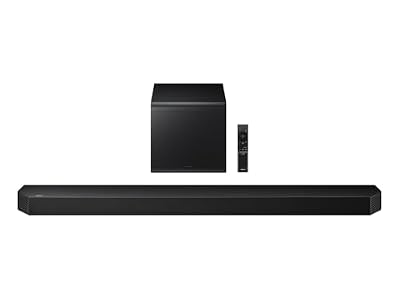
Samsung Q-Series Soundbar HW-Q800H with Wireless Subwoofer, 2026 Model
Included for 'Best Soundbars for Small Rooms and Compact Spaces' because the listing specifies 2026 Model, details this guide uses to compare options.
View on AmazonBest overall: Sonos Beam (Gen 2)
See also: AMD Radeon 9070 XT vs Compared: Specs & Performance • Best Wine Fermentation Fridge for Home Winemakers
The Beam is the pick for a room where the TV sits on a shared stand and nothing else can go on the floor. It measures 25.6 in wide, 2.7 in tall and about 6.2 lb per the spec sheet, so it disappears under a 43–55 inch set without stealing the shelf. Five drivers — including a dedicated center tweeter — do the work that most budget bars fake with processing, which is why voices stay anchored to the screen instead of smearing across the wall.
Who it suits: anyone who watches a lot of dialogue-driven TV and wants one box, one remote, and no subwoofer cable. Main trade-off: bass is honest but shallow, and the matching Sub Mini costs nearly as much as the bar itself. There is also no HDMI passthrough, so if your TV has only two HDMI ports and both are occupied, you will need to move a device to the TV and pass audio back over eARC.
Best budget: Roku Streambar
At 14 inches wide, the Streambar is narrower than most laptops’ screens and can sit on a shelf beside the TV rather than under it. It also bundles a 4K HDR streaming player, which means a small-room setup can go from one HDMI port to a full smart TV experience with a single purchase.
Who it suits: renters, dorm rooms, secondary TVs, and anyone under $150. Main trade-off: it is a 2.0 design with no subwoofer output on the base model, so bass is thin by design — dialogue and streaming convenience are the point, not impact. It connects over HDMI ARC or optical, not eARC, so you lose some of the newer handshake features.
Best for dialogue: Bose TV Speaker
Bose built this bar around a simple problem: people cannot hear what characters are saying. The 23.4-inch cabinet carries two full-range drivers plus a center tweeter, and a dedicated dialogue mode raises the vocal band without boosting everything else. For a bedroom, den, or any room where the volume has to stay low after 10 p.m., that voicing matters more than channel count.
Who it suits: low-volume listeners, anyone sharing walls, and viewers who have given up on their TV’s built-in speakers. Main trade-off: there is no subwoofer output and no Wi-Fi, so multi-room audio is off the table and deep bass simply is not part of the package. Connectivity is HDMI ARC, optical, 3.5 mm, and Bluetooth.
Best for the tightest spaces: Polk MagniFi Mini AX
This is the pick when the bar has to be tiny but you still want a subwoofer. The bar is 13.4 inches wide — about the width of a sheet of legal paper — and it ships with a compact wireless sub that tucks beside a sofa or under a side table. It decodes Dolby Atmos and DTS:X, and it supports Wi-Fi streaming plus AirPlay 2 and Chromecast built-in, so music playback is a first-class feature rather than an afterthought.
Who it suits: studio apartments, bedrooms with a dresser-mounted TV, and anyone whose “media console” is 30 inches wide. Main trade-off: you pay a premium for miniaturization, and the small sub cannot pressurize a large open-plan room the way a 10-inch sub can. In a genuinely small room that is an advantage; in a big one it is a ceiling.
Best all-in-one under $200: Yamaha SR-C20A
Yamaha’s compact bar solves the subwoofer problem by building the low-frequency drivers into the 23.6-inch cabinet. Total rated output is around 100 W, which is more than enough for a room under roughly 1,000 cubic feet, and the unit offers clear-voice and movie/game modes that are genuinely useful rather than decorative. Setup is about as simple as it gets: HDMI ARC or optical, plug in, done.
Who it suits: renters who cannot drill for wall mounts, anyone who refuses to run a power cable to a sub, and small bedrooms. Main trade-off: physics still applies — built-in woofers produce a firm mid-bass thump, not the chest-punch of a separate sub, and there is no HDMI passthrough or eARC.
Best for movies with real bass: Samsung HW-Q600C
If your “small room” is a 12 x 14 ft living room with a 55-inch TV, a full 3.1.2 system with a wireless sub can still fit — but measure first. The bar is 40.6 inches wide per Samsung’s spec sheet, the widest pick here, and the sub needs roughly a 10-inch square of floor. In exchange you get a true center channel, up-firing height drivers for Atmos, and DTS:X decoding, and it pairs with Q-Symphony on compatible Samsung TVs.
Who it suits: movie-first households with a mid-size TV and one spare corner. Main trade-off: it is not a compact bar. Under a 43-inch TV it will overhang both ends, and in a very small room the sub can overwhelm unless you turn it down 3–6 dB from the default.
How to choose: the numbers that actually matter
1. Do a width and height fit check before anything else
Use the TV’s physical width, not its diagonal. A 43-inch TV is about 38 in wide, a 50-inch about 44 in, a 55-inch about 48 in, and a 65-inch about 57 in. Aim for a bar that is 60–100% of that width. A 40.6-inch bar under a 55-inch TV leaves roughly 3.5 inches of clearance on each side; the same bar under a 43-inch TV overhangs by more than an inch at both ends. Height matters too: most compact bars are 2.2–2.7 in tall, so check that the bar does not block the TV’s IR receiver or the bottom of the screen.
2. Size the power to the room’s volume
Multiply length x width x ceiling height. A 10 x 12 ft room with an 8 ft ceiling is 960 cubic feet. For spaces under about 1,000 cu ft, a 100–200 W system is ample; 1,000–2,000 cu ft wants 200–300 W; open-plan areas that connect to a kitchen need a sub and more headroom. Buying a 500 W system for a 900 cu ft bedroom mostly buys you distortion at low volume and a bigger box.
3. Prioritize a center channel if dialogue is the complaint
Human speech intelligibility lives mostly between roughly 200 Hz and 4 kHz. A bar with a dedicated center driver — or at minimum a center-tuned dialogue mode — handles that band far better than a two-channel bar relying on virtual processing. This is the single biggest upgrade over TV speakers.
4. Match the sub to the room, not the spec sheet
In a room under 1,000 cu ft, a compact 6.5-inch-class sub is usually the sweet spot; a 10-inch sub in the same space tends to boom. Place it 6–12 inches from a wall and avoid corners, which can add 6 dB or more of uneven low-end. If the sub is included but the room is tiny, plan on lowering its level rather than returning the system.
5. Choose the connection deliberately
HDMI eARC carries full-quality audio and lets the TV remote control volume over CEC — use it whenever the TV has the port. Optical is limited to compressed 5.1 but is rock-solid and immune to CEC quirks, which makes it a good fallback. Bluetooth is fine for music but typically adds 100–200 ms of latency, so it is a poor choice for video. Wi-Fi (AirPlay 2, Chromecast) is for multi-room audio and app control.
Decision matrix
| Your situation | Start here | Why |
|---|---|---|
| Room under ~1,000 cu ft, TV 43–55 in, no floor space | Sonos Beam (Gen 2) | 25.6 in wide, center driver, no sub to place |
| Budget under $150 | Roku Streambar | 14 in wide and adds 4K streaming |
| Can’t hear dialogue at low volume | Bose TV Speaker | Dedicated dialogue mode, center tweeter |
| Apartment where you can’t drill or run cables | Yamaha SR-C20A | Built-in subwoofers, single power cable |
| You want a real sub but the bar must be tiny | Polk MagniFi Mini AX | 13.4 in bar plus compact wireless sub |
| 55–65 in TV, movie-first household | Samsung HW-Q600C | 40.6 in bar matches the TV; true center + sub |
Ownership realities: what wears out and what it costs
Soundbars have almost no consumables — the only recurring purchase is the remote’s coin cell battery. What fails is more predictable than most buyers expect. The subwoofer amplifier is usually the first component to go in an always-on system, particularly in units that never fully power down. Driver surrounds dry out over years in hot, dry rooms, and dust in a bass port dulls output. HDMI eARC handshake problems are common and are usually solved by a firmware update or a cable swap rather than a repair. Budget models typically stop receiving firmware updates within two to three years, which matters if you rely on app control or streaming features.
Run the ownership math before you buy up: a $300 bar over six years works out to about $50 a year, or roughly $4.17 a month. A $500 bar over the same period is about $8.33 a month. The gap is small enough that the fit and the dialogue quality should decide it, not the price tag.
Three mistakes account for most disappointing small-room setups: putting the bar inside a closed TV cabinet, where it muffles and overheats; parking the sub in a corner and then blaming the bar for boomy bass; and wall-mounting the bar well above ear level, which detaches dialogue from the picture. Leave 2–4 inches of clearance behind the bar for its rear ports, and keep it roughly at seated ear height or just below the TV.
Frequently Asked Questions
Do I need a subwoofer in a small room?
Not necessarily. In a room under about 1,000 cubic feet, a bar with built-in woofers or a compact 6.5-inch-class sub produces plenty of usable bass, and a larger sub often sounds boomy because the room is too small to absorb it. If your priority is dialogue and music at moderate volume, a sub-free bar is the cleaner choice. If you watch action films regularly, a small wireless sub is worth the floor space.
How wide should a soundbar be relative to my TV?
Aim for 60–100% of the TV’s physical width. A 55-inch TV is roughly 48 inches wide, so a 32–40 inch bar looks proportionate, while a 25-inch bar can look undersized. Never go wider than the TV itself unless the bar sits on a wider console. Measure the console too, since many are only 40–48 inches wide.
Is Dolby Atmos worth paying for in a small room?
It depends on whether the bar has real up-firing drivers. A bar with height drivers can create a modest sense of overhead sound even in a small room, provided the ceiling is flat and the seating position is not against the back wall. Bars that claim Atmos through processing alone add width more than height, and in a small room the difference is subtle. Spend the money on dialogue clarity and a decent sub instead if you have to choose.
Can I put a soundbar inside a TV cabinet or on a shelf?
Only if the shelf is open at the front and there is at least 2–4 inches of clearance behind the bar for its rear ports. Sealed cabinets muffle mid-range and trap heat, and many bars will throttle or shut down when enclosed. If the shelf is tight, a 13–24 inch bar is a much better fit than a 40-inch one.
Why is dialogue still hard to hear after adding a soundbar?
The three usual causes are a center channel set too low relative to the other channels, a bass or “movie” mode boosting low frequencies over voices, and a bar positioned too far below or above ear level. Raise the center channel level a few dB, enable the dialogue or clear-voice mode, and check the bar’s height before assuming the hardware is at fault. Turning off dynamic range compression can also help in quiet rooms.
Will a compact soundbar work with a projector or computer monitor?
Yes, as long as you match the connection. Many projectors and monitors lack HDMI ARC or eARC, so optical or a 3.5 mm analog output becomes the practical route, and both are supported by most compact bars. If the source has no audio output at all, you will need an HDMI audio extractor between the source and the display.
Ready to decide? Our #1 pick for 2026 is the Sonos Beam (Gen 2).
Live price & availability on Amazon.