Last updated: October 11, 2026
The best wine fermentation fridge for most home winemakers is the Kalamera 24 inch Dual Zone Wine Fridge, listed as holding 21 bottles and 75 cans across two independently controlled compartments — the closest thing in this category to the split-temperature workflow a small home winery actually runs: one zone held warm for malolactic fermentation, yeast starters and warm-side white ferments, the other held cold for settling, fining and cold-crash. If raw batch volume matters more to you than split temperatures, the EUHOMY 45 Bottle Wine Cooler Refrigerator is the largest premium option covered here. If you want one dependable, stable cold chamber for the least money, the ROVSUN 16 Bottle compressor cooler is the value pick.
One honest caveat before the picks, because it changes how you should read every listing on this page: almost everything sold as a “wine fridge” is a storage appliance, not a fermentation chamber. Typical consumer wine coolers run from about 5 °C to 18 °C (41–64 °F). That covers white and rosé fermentation, malolactic fermentation at the warm end, cold settling, cold-crash and every kind of bulk storage — but it does not cover a red wine primary ferment at 22–28 °C, and it does not reach the −4 °C needed for true cold stabilization. The right way to use these units in a home winery is as a temperature-controlled secondary chamber, not as a replacement for a warm ferment. Everything below is chosen with that gap in mind.
Quick answer: For most people in 2026, the best wine fermentation fridge for home winemakers is the FOHERE 28 Bottle Wine Cooler Fridge — our #1 rated choice. See the full ranked comparison, alternatives and buying advice below.
- Top 3 Picks
- Quick Comparison
- How We Chose
- 1. FOHERE 28 Bottle Wine Cooler Fridge — Best for Bulk Bottle Storage Alongside a Ferment
- 2. EUHOMY 45 Bottle Wine Cooler Refrigerator — Best for Large-Batch Cellars
- 3. Electactic 37 Bottle Wine Fridge — Best for Mixed Wine-and-Can Storage with Smart Control
- 4. Kalamera 24 inch Wine Fridge — Best for Two-Temperature Winemaking Workflows
- 5. Ivation 18 Bottle Compressor Wine Cooler — Best Lockable Compressor Storage for Reds and Whites
- 6. Ivation 12 Bottle Compressor Wine Cooler — Best Small-Space Compressor Cooling with a Lock
- 7. NutriChef 12 Bottle Stainless Steel Slim Wine Fridge — Best for Narrow Gaps and Slim Alcoves
- 8. Schmécké 12 Bottle Thermoelectric Wine Cooler — Best Quiet Countertop Option
Top 3 Picks
Best overall: Kalamera 24 inch Wine Fridge (21 bottles + 75 cans, dual zone). Two independently set compartments in a 24-inch freestanding footprint is the configuration that maps most directly onto winemaking — run one zone at the top of its range for malolactic and starter propagation, the other at the bottom for settling and cold-crash. The mixed bottle-and-can capacity also means you are not wasting shelf space when a carboy is not in there. It suits anyone past their first vintage who wants one appliance doing two jobs.
Best budget: ROVSUN 16 Bottle Wine Cooler. A compressor-cooled freestanding chiller with digital temperature control at the entry price band is the single most useful combination for a home winemaker, because compressor cooling is what keeps a chamber stable in a warm room. It is small, it is plain, and it will hold a steady cold temperature better than any thermoelectric unit at the same money. Buy it if your only job for the fridge is cold-crashing, fining and holding finished wine.
Best premium / largest: EUHOMY 45 Bottle Wine Cooler Refrigerator. The biggest listed capacity in this roundup, with a glass door and a black freestanding cabinet. It suits the home winemaker who has moved past jugs and carboys into bottle storage and wants a single large, quiet, stable cellar that can also hold a couple of bulk vessels on the lower shelves when needed. It is the pick when floor space exists but shelf space does not.
Quick Comparison
See also: AMD Radeon 9070 XT vs Compared: Specs & Performance • Best Wet-Dry Shop Vacuums for Garage and Jobsite Cleanup
Every unit below is a freestanding wine cooler or beverage fridge. “Listed capacity” is the figure the product name states, counted in standard 750 ml bottles unless cans are mentioned. Where a specification is not stated in the listing, it is described by class rather than guessed at.
| Product | Best for | Listed capacity | Zones | Cooling class | Format | Price tier |
|---|---|---|---|---|---|---|
| FOHERE 28 Bottle Wine Cooler Fridge | Bulk bottle storage next to a ferment | 28 bottles | Single (class-typical) | Compressor-class freestanding cellar | Compact freestanding | Budget |
| EUHOMY 45 Bottle Wine Cooler Refrigerator | Large cellars and bottle counts | 45 bottles | Single (class-typical) | Compressor-class, glass door | Full-size freestanding, black | Premium |
| Electactic 37 Bottle Wine Fridge / 145 Can | Mixed wine-and-can use, smart control | 37 bottles or 145 cans | Single (class-typical) | Compressor-class beverage fridge | Freestanding, approx. 4.5 cu ft class | Mid-range |
| Kalamera 24 inch Wine Fridge | Two-temperature winemaking workflow | 21 bottles + 75 cans | Dual | Compressor-class dual zone | 24 in wide, freestanding | Premium |
| Ivation 18 Bottle Compressor Wine Cooler | Lockable compressor storage, reds and whites | 18 bottles | Single | Compressor (stated) | Large freestanding with lock | Premium |
| Ivation 12 Bottle Compressor Wine Cooler | Small-space compressor cooling with a lock | 12 bottles | Single | Compressor (stated) | Compact freestanding, black | Mid-range |
| NutriChef 12 Bottle Stainless Steel Slim Wine Fridge | Narrow gaps and slim alcoves | 12 bottles | Single | Class-typical chiller | Slim stainless freestanding | Mid-range |
| Schmécké 12 Bottle Thermoelectric Wine Cooler | Quiet countertop duty, reds and whites | 12 bottles | Single | Thermoelectric (stated) | Countertop, digital control | Budget |
| NewAir 19″ Wine Fridge for 23 Bottles | Mid-capacity freestanding with a glass door | 23 bottles | Single (class-typical) | Compressor (stated, quiet) | 19 in wide freestanding | Premium |
| FOHERE 8 Bottles Wine Cooler Refrigerator | 1-gallon batches and starter cultures | 8 bottles | Single | Small freestanding cooler | Very compact freestanding | Budget |
| FoMup Wine Fridge 12 Bottles | First fermentation-adjacent fridge | 12 bottles | Single | Class-typical freestanding | Compact freestanding, digital control | Mid-range |
| ROVSUN 16 Bottle Wine Cooler Refrigerator | Cheapest stable cold chamber | 16 bottles | Single | Compressor (stated) | Freestanding with digital control | Budget |
Note that “single zone (class-typical)” means the product name does not advertise a second compartment; a few of these units do have a small upper/lower split, so confirm on the listing before you buy if dual control is the reason you are shopping.
How We Chose
This roundup was assembled from published product specifications, brand documentation and the physical requirements of home winemaking, not from any kind of bench work on our side. Four criteria did the sorting. First, cooling class: compressor-driven units were favoured over thermoelectric ones for anything intended to hold a steady temperature in an unconditioned room, because a compressor can pull a chamber 20 °C or more below ambient while a Peltier module typically manages 10–15 °C and loses ground as the room warms. Second, usable capacity, which is not the same as the bottle count on the box — a listed 12-bottle fridge holds twelve standard Bordeaux bottles on factory shelf spacing, and holds far fewer once you pull shelves to make height for a jug or carboy. Third, category fit: every unit had to be plausibly useful in a home winery, which ruled out anything so small or so warm-limited that it could only chill drinking wine. Fourth, upgrade path: we weighted units that still have a job after your batch sizes grow — a 45-bottle cellar keeps working as a bottle store long after you stop fermenting in it, whereas a 6-bottle novelty unit does not.
1. FOHERE 28 Bottle Wine Cooler Fridge — Best for Bulk Bottle Storage Alongside a Ferment
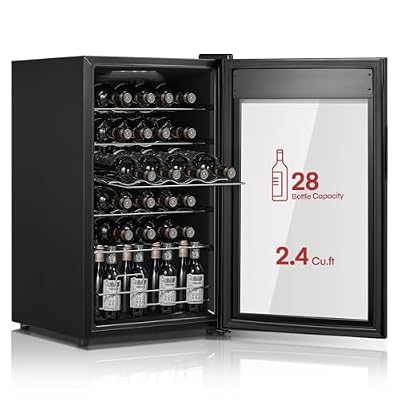
FOHERE 28 Bottle Wine Cooler Fridge, Compact Freestanding Wine Cellar with Adjustable Temperature Control & Quiet Cooling, Vibration-Free Double Glass Door Wine Refrigerator for Home Bar Office
Included for 'Best Wine Fermentation Fridge for Home Winemakers' as a relevant option in this category; details come from the product listing.
View on AmazonThe FOHERE 28 Bottle is the “extra capacity without extra footprint” pick. It is a compact freestanding wine cellar with adjustable temperature control, and it suits the home winemaker who already has a dedicated fermentation setup and needs somewhere to park 28 bottles of finished wine at a stable cellar temperature — or who wants a second chamber for settling and fining while the primary ferment finishes elsewhere. It is a storage-first appliance, and it is honest about that.
Key specs
- Listed capacity: 28 standard 750 ml bottles
- Format: compact freestanding wine cellar
- Control: adjustable temperature control (digital, class-typical for this tier)
- Zones: single — one set temperature for the whole cabinet
- Temperature class: storage range, typically about 5–18 °C (41–64 °F); confirm the exact span on the listing
- Cooling class: compressor-class freestanding cooler
- Door: glass door, class-typical for the tier
- Price tier: budget
Strengths
Twenty-eight bottles in a compact cabinet is a genuinely useful ratio. A single 23 L (6 US gal) batch fills roughly 30 standard bottles, so this unit stores one full batch with a couple of bottles of slack — that is a better match to home winemaking batch sizes than the 12-bottle units that dominate the entry tier, and it means you are not stacking bottles on the floor while you wait for the next rack to free up. Adjustable temperature control at this price is the other draw: it lets you run the cabinet warm at the top of its range for a slow, cool bulk ageing, or drop it to the bottom of its range to help a wine drop tartrate and sediment before bottling.
Because it is a freestanding cabinet with a compressor, it also behaves predictably in a room that is not climate-controlled. That is the single most important thing a home winemaker should care about. A garage that swings from 8 °C in winter to 30 °C in summer will wreck a thermoelectric unit’s setpoint, but a compressor cabinet simply works harder and holds its number.
Pros
- 28-bottle capacity maps neatly onto a single 23 L batch
- Adjustable temperature control gives you a real cellar range, not a fixed chill
- Compressor-class cooling holds setpoint in a warm room
- Budget tier, so it can be a second cabinet rather than your only one
Cons
- Single zone only — you cannot run a warm and a cold regime at once
- Glass doors let light in; keep it away from a bright window if you are storing long-term
- Bottle-count ratings assume standard Bordeaux shapes, so Burgundy and Riesling bottles reduce the real count
- No stated lock, which matters if the cabinet lives somewhere shared
How it compares
Against the EUHOMY 45 Bottle, the FOHERE gives up 17 bottles of capacity and the larger unit’s full-size presence, but it costs a tier less and takes up less floor. Against the ROVSUN 16 Bottle, which is the same budget tier, the FOHERE wins on capacity by twelve bottles and is the better choice if your goal is storing finished wine. Choose the ROVSUN instead only if the lower price is decisive and 16 bottles is genuinely enough.
2. EUHOMY 45 Bottle Wine Cooler Refrigerator — Best for Large-Batch Cellars
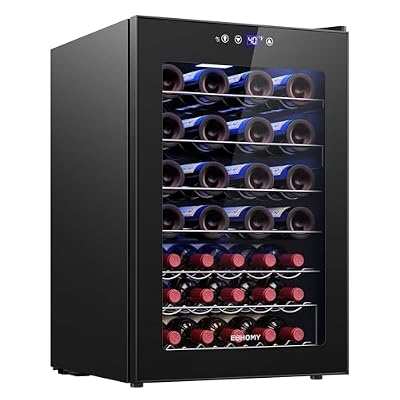
EUHOMY 45 bottle Wine Cooler Refrigerator, Wine Fridge Glass Door, Black
Included for 'Best Wine Fermentation Fridge for Home Winemakers' because the listing specifies Wine Fridge Glass Door and Black, details this guide uses to compare options.
View on AmazonThe EUHOMY 45 Bottle is the volume answer. It is a freestanding wine fridge with a glass door in a black cabinet, listed at 45 standard bottles, and it suits the home winemaker who has outgrown countertop appliances and now produces two or three batches a year with nowhere to put them. It is also the pick for anyone who wants a cellar that will still be useful after they stop fermenting in it.
Key specs
- Listed capacity: 45 standard 750 ml bottles
- Format: freestanding wine cooler refrigerator, black cabinet, glass door
- Zones: single (class-typical for this configuration)
- Cooling class: compressor-class freestanding refrigerator
- Temperature class: storage range, typically about 5–18 °C (41–64 °F)
- Control: digital adjustable temperature control
- Price tier: premium
Strengths
Forty-five bottles is one and a half full 23 L batches. That is the number that matters, because it means a single unit can hold a batch you have already bottled plus a batch you are still finishing — or two batches if you bottle in lighter glass and stack sensibly. Very few home winemakers need more than that, and the ones who do are usually running a second refrigerator rather than buying a bigger wine cooler.
The second strength is that a cabinet this size has real interior height. On a 45-bottle unit, pulling two or three shelves out leaves a tall open cavity that will accept a 3-gallon (11.4 L) carboy or a row of 1-gallon glass jugs, which is exactly how most small-batch home winemakers work. You lose the bottle capacity while the vessels are in there, but the flexibility is what makes it a winemaking appliance rather than just a bottle rack. As a bottle store it is quiet, the glass door makes inventory obvious at a glance, and the black cabinet is neutral enough for a utility room or a dining area.
Pros
- Largest listed capacity in this roundup at 45 bottles
- Tall interior cavity accommodates 3-gallon carboys and 1-gallon jugs with shelves removed
- Compressor cooling holds a steady setpoint in an unconditioned room
- Doubles as a general-purpose wine cellar once your batches get smaller
Cons
- Premium tier pricing for a single-zone cabinet
- No dual-zone control, so you cannot run a warm and a cold regime simultaneously
- Freestanding only — it needs clearance around the back and sides for the compressor to shed heat
- Full when it is full: 45 bottles leaves no room for a bulk vessel without emptying shelves
How it compares
Against the Kalamera 24 inch, the EUHOMY wins on raw bottle count by more than double, but loses the thing that makes the Kalamera the overall pick: two independently controlled zones. If your process genuinely needs two temperatures at once — malolactic in one chamber, cold settling in another — the Kalamera is worth the sacrifice in capacity. If your process is “one temperature at a time, lots of bottles”, the EUHOMY is the better buy. Against the Electactic 37 Bottle, the EUHOMY is eight bottles larger and a tier more expensive, which is a fair trade if you bottle in standard Bordeaux shapes.
3. Electactic 37 Bottle Wine Fridge — Best for Mixed Wine-and-Can Storage with Smart Control

Electactic 37 Bottle Wine Fridge,Freestanding 145 Can Beverage Refrigerator with Smart Temperature Control,4.5 CU FT Quiet Mini Fridge with Child Lock Panel for Family Restaurant Bar, Black
Included for 'Best Wine Fermentation Fridge for Home Winemakers' because the listing specifies Black, details this guide uses to compare options.
View on AmazonThe Electactic 37 Bottle is the dual-purpose unit. It is a freestanding beverage refrigerator listed at 37 bottles or 145 cans, with smart temperature control, and it suits the home winemaker who also serves beer, cider or sparkling water from the same cabinet — or who wants to use the can capacity for the smaller vessels that winemaking generates. It is a mid-range appliance that behaves like a small commercial beverage fridge.
Key specs
- Listed capacity: 37 standard bottles or 145 standard 12 oz (355 ml) cans
- Format: freestanding beverage refrigerator, approximately 4.5 cu ft class
- Control: smart temperature control (digital)
- Zones: single (class-typical)
- Cooling class: compressor-class
- Temperature class: storage/beverage range, typically about 3–18 °C (37–64 °F)
- Price tier: mid-range
Strengths
The 145-can figure is worth understanding rather than dismissing. A standard 12 oz can is roughly 66 mm in diameter and 122 mm tall, against roughly 76 mm and 300 mm for a standard 750 ml Bordeaux bottle. Cans are shorter and narrower, so a shelf that holds four bottles across and one deep will hold five or six cans across and two deep — which is how a “37 bottle” cabinet becomes a “145 can” cabinet without changing size. For a home winemaker, that arithmetic matters because it tells you the cabinet has a lot of shelf area relative to its bottle count, and shelf area is what you need when you are chilling small vessels.
Smart temperature control is the second useful feature. Being able to set and read a target temperature without opening the door is not a gimmick in a winemaking context — every door opening dumps cold air and forces the compressor to catch up, and a wine that is settling or cold-crashing wants a stable number, not a sawtooth. A cabinet that you can adjust from your phone means you set it once and leave it alone.
Pros
- 37 bottles or 145 cans — high shelf area for the footprint
- Smart temperature control reduces door openings
- Mid-range tier, so it sits between the budget and premium cabinets here
- Large enough to hold a full 23 L batch in bottles with slack
Cons
- Single zone only
- Can ratings assume shelves are set for cans, so you cannot have both maxima at once
- Beverage-fridge styling may include brighter interior lighting, which is not ideal for long-term wine storage
- Smart control features are only useful if the cabinet is in range of your network
How it compares
Against the Kalamera 24 inch, the Electactic offers more bottle capacity (37 versus 21 bottles in the wine zone) but gives up dual-zone control and the 24-inch built-in-friendly width. Against the FOHERE 28 Bottle, it is nine bottles larger and a tier more expensive, with the can capacity as the tiebreaker. If you only ever store wine, the FOHERE is the more efficient spend; if the cabinet will also hold beer and cans, the Electactic earns its premium.
4. Kalamera 24 inch Wine Fridge — Best for Two-Temperature Winemaking Workflows
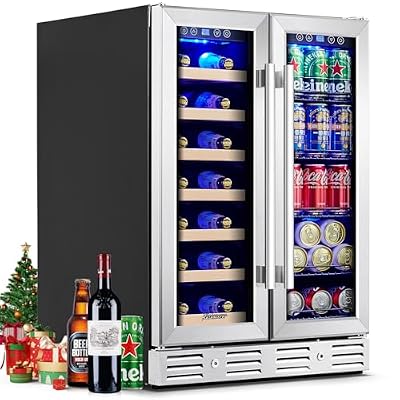
Kalamera 24 inch Wine Fridge Hold 21 Bottles and 75 Cans, Dual Zone Cooling
Included for 'Best Wine Fermentation Fridge for Home Winemakers' because the listing specifies Dual Zone Cooling, details this guide uses to compare options.
View on AmazonThe Kalamera 24 inch is the overall pick because it is the only unit in this roundup whose listed configuration solves the actual problem: it holds 21 bottles and 75 cans across dual-zone cooling, meaning two compartments you can set to two different temperatures. That is the closest a consumer wine fridge gets to the two-chamber setup a small winery runs, and it suits the home winemaker who wants to hold a wine warm for malolactic fermentation while something else settles cold.
Key specs
- Listed capacity: 21 standard bottles plus 75 standard 12 oz cans
- Zones: dual — two independently controlled temperature compartments
- Format: 24-inch wide freestanding wine fridge
- Cooling class: compressor-class dual-zone
- Temperature class: storage range, typically about 5–18 °C (41–64 °F) per zone; the exact span per zone varies, so check the listing
- Door: glass, with the class-typical UV-tinted glazing
- Price tier: premium
Strengths
The dual zone is not a marketing flourish — it is the feature that lets you run two stages of a winemaking process at once. Set the upper zone to the top of its range and it becomes a malolactic chamber: MLF wants roughly 18–22 °C, and the warm end of a storage cooler’s span lands right there. Set the lower zone to the bottom of its range and you have a cold-settling and cold-crash chamber at roughly 5 °C, which is enough to drop gross lees and help a wine clear without filtering. Running both in the same cabinet, at the same time, in a 24-inch footprint is the single biggest practical advantage any unit on this page offers.
Twenty-four inches is also the standard width for under-counter and alcove installation, which means the Kalamera fits gaps that a 19-inch or 15-inch unit leaves half-empty and that a full-size unit cannot enter at all. The mixed capacity — 21 bottles plus 75 cans — is generous for the width, and again reflects a lot of shelf area rather than a lot of bottle height. For a winemaker working in 1-gallon or 3-gallon vessels, shelf area is the currency that matters.
Pros
- Dual-zone cooling — two setpoints, one cabinet
- 24-inch width suits standard alcoves and under-counter gaps
- Combined bottle-and-can capacity gives high usable shelf area
- Compressor-class cooling keeps both zones stable in a warm room
Cons
- Premium tier, and the most expensive way here to store only 21 bottles
- The warm zone still tops out below red primary fermentation temperatures
- Dual-zone cabinets have a divider, so neither compartment is as tall as a single-zone unit of the same external size
- More controls means more to set up correctly; a mis-set zone is easy to miss
How it compares
Against the NewAir 19″, the Kalamera gives up two bottles of listed capacity and gains a second temperature zone and an extra five inches of width. That trade is almost always worth it for a winemaker, because capacity is easy to add later (buy a second cabinet) while dual-zone control cannot be retrofitted. Against the EUHOMY 45 Bottle, the Kalamera loses on raw volume by 24 bottles and wins on process flexibility. If you can only own one appliance, decide which of those two you would miss more.
5. Ivation 18 Bottle Compressor Wine Cooler — Best Lockable Compressor Storage for Reds and Whites

Ivation 18 Bottle Compressor Wine Cooler Refrigerator w/Lock, Large Freestanding Wine Cellar For Red, White, Champagne or Sparkling Wine, 41f-64f Digital Temperature Control Fridge Glass Door Black
Included for 'Best Wine Fermentation Fridge for Home Winemakers' because the listing specifies Large Freestanding Wine Cellar For Red and White, details this guide uses to compare options.
View on AmazonThe Ivation 18 Bottle is a large freestanding wine cellar with a stated compressor and a door lock, and it suits the home winemaker who wants a proper cold chamber with a bit of security — in a shared garage, a basement workshop or a club room — and who stores both reds and whites at cellar temperature. It is a premium-tier unit whose value is in the cooling method and the lock, not in the bottle count.
Key specs
- Listed capacity: 18 standard 750 ml bottles, reds and whites
- Cooling class: compressor (stated)
- Zones: single
- Format: large freestanding wine cellar with lock
- Temperature class: storage range, typically about 5–18 °C (41–64 °F)
- Control: digital adjustable temperature control
- Price tier: premium
Strengths
A stated compressor at 18 bottles is the whole argument. Compressor cooling is the only method in this class that reliably holds a setpoint when the surrounding room gets warm, and that is the difference between a fridge that works in a garage in July and one that quietly drifts ten degrees off target. If you are cold-crashing or cold-settling, the setpoint is the process. Drift is not a cosmetic problem; it is a failed batch of clarification.
The lock is a smaller feature with a real use case. Home winemaking equipment tends to live in shared spaces, and a lockable cabinet means your bulk-ageing wine is not on the shelf next to the lawnmower keys. The 18-bottle size is also a good middle ground: it is enough for a full 23 L batch minus a few bottles for topping up, without being so large that it dominates the room. Reds and whites in the same cabinet is normal at cellar temperature — both are happiest around 12–14 °C for anything more than a few weeks, so a single-zone unit is not the compromise people assume it is.
Pros
- Stated compressor cooling — stable setpoint in a warm room
- Door lock for shared or semi-public spaces
- 18 bottles is close to a full 23 L batch
- Handles reds and whites at a single cellar temperature without compromise
Cons
- Premium tier for a modest bottle count
- Single zone
- Compressor units are audible, unlike thermoelectric ones
- Lock and key can be lost — keep a spare somewhere obvious
How it compares
Against the Ivation 12 Bottle, which is the same brand and the same stated compressor technology, the 18-bottle version costs a tier more and buys six extra bottles plus a larger cabinet. If space allows, the 18 is the better long-term buy because six bottles is exactly the slack you need for topping up. Against the ROVSUN 16 Bottle, the Ivation costs more for two extra bottles but adds the lock and the larger freestanding cabinet. Choose the ROVSUN if price leads; choose the Ivation if the lock matters.
6. Ivation 12 Bottle Compressor Wine Cooler — Best Small-Space Compressor Cooling with a Lock

Ivation 12 Bottle Compressor Wine Cooler, Freestanding Fridge w/Lock, Black
Included for 'Best Wine Fermentation Fridge for Home Winemakers' because the listing specifies Freestanding Fridge w/Lock and Black, details this guide uses to compare options.
View on AmazonThe Ivation 12 Bottle is the compact version of the same idea: a freestanding black wine cooler with a stated compressor and a door lock, sized for a countertop end or a narrow gap. It suits the home winemaker working in small vessels — 1-gallon jugs, 3 L starters, half-batches — who wants compressor stability without giving up a metre of wall.
Key specs
- Listed capacity: 12 standard 750 ml bottles
- Cooling class: compressor (stated)
- Zones: single
- Format: compact freestanding fridge, black, with lock
- Temperature class: storage range, typically about 5–18 °C (41–64 °F)
- Control: digital adjustable temperature control
- Price tier: mid-range
Strengths
The interesting thing about this unit is the combination: compressor cooling and a lock, at 12 bottles, in a mid-range tier. Most 12-bottle cabinets at this price are thermoelectric, and thermoelectric cooling is the wrong tool for a home winemaker in a warm room — a Peltier module typically holds only 10–15 °C below ambient, so in a 28 °C garage its practical floor is around 15–18 °C, which is not cold enough for settling or cold-crash. A stated compressor at 12 bottles sidesteps that entirely.
Twelve bottles is also a more useful number than it looks for a winemaker, because it lines up with the small-vessel workflow. A 1-gallon (3.8 L) glass jug is roughly 15 cm across and 26 cm tall — smaller than a Bordeaux bottle in diameter and about the same height. Pull two shelves and a 12-bottle cabinet will take three or four jugs, which is a 4-gallon batch of settling wine. That is a real job, done at a stable temperature, in a cabinet the size of a microwave.
Pros
- Stated compressor cooling at a compact size
- Door lock
- Small footprint suits countertop ends and narrow gaps
- Mid-range tier rather than premium
Cons
- Only 12 bottles when used as intended
- Single zone
- Compressor noise in a small cabinet can be noticeable in a quiet room
- Pulling shelves to fit jugs means you lose the bottle capacity entirely
How it compares
Against the Ivation 18 Bottle, this is the same technology six bottles smaller and a tier cheaper, which makes it the sensible pick if your batches are small or your space is tight. Against the NutriChef 12 Bottle Slim, the Ivation wins on cooling method — a stated compressor is a safer bet than a class-typical chiller for holding a setpoint — while the NutriChef wins on width if you are fitting into a genuinely narrow alcove. Decide which constraint is harder.
7. NutriChef 12 Bottle Stainless Steel Slim Wine Fridge — Best for Narrow Gaps and Slim Alcoves

Nutrichef 12 Bottle Stainless Steel Slim Wine Fridge | Red & White Wine Chiller | Adjustable Temperature Control, Ultra Quiet Operation & Energy Efficient | Mini Wine Cooler Refrigerator | 31x10x17 IN
Included for 'Best Wine Fermentation Fridge for Home Winemakers' because the listing specifies Red & White Wine Chiller and Adjustable Temperature Control, details this guide uses to compare options.
View on AmazonThe NutriChef 12 Bottle is the slimline option: a stainless-steel-fronted, freestanding wine chiller with adjustable temperature control, sized to fit where a standard cabinet will not. It suits the home winemaker in an apartment, a galley kitchen or a converted cupboard, where width is the binding constraint and capacity is negotiable.
Key specs
- Listed capacity: 12 standard 750 ml bottles, reds and whites
- Format: slim stainless steel freestanding wine fridge
- Zones: single
- Cooling class: class-typical chiller for the tier
- Temperature class: storage range, typically about 5–18 °C (41–64 °F)
- Control: adjustable temperature control
- Price tier: mid-range
Strengths
Slim cabinets solve a problem that capacity figures never capture: the gap between the end of a counter and a wall, the alcove beside a boiler, the dead space under a stair. A standard 12-bottle wine fridge is often around 15 inches wide, but “slim” units trim that further and cut depth, which is what actually decides whether a cabinet fits. If your only available space is 12 inches of clearance, no 24-inch unit matters, however good it is.
The stainless front is the second practical point. Stainless is easy to wipe down, does not show fingerprints the way gloss black does, and looks deliberate in a kitchen rather than like a spare appliance. For a home winemaker who is storing wine in a living space rather than a utility room, that matters more than a couple of bottles of capacity. Adjustable temperature control keeps it useful across both red and white storage, and the 12-bottle size is a reasonable home for a mixed case plus a few bottles of your own.
Pros
- Slim profile fits gaps that standard-width cabinets cannot
- Stainless steel front is durable and easy to clean
- Adjustable temperature control for red and white storage
- Mid-range tier
Cons
- Cooling class is not stated as compressor, so verify before relying on it for cold-crash
- 12 bottles only
- Single zone
- Slim cabinets have less insulation depth, so they work harder in a hot room
How it compares
Against the Ivation 12 Bottle, the NutriChef wins on width and finish, and loses on certainty of cooling method — Ivation states a compressor, NutriChef does not. If the cabinet is going into a cool indoor space and you only need cellar-temperature storage, the NutriChef is the better-looking, better-fitting choice. If it is going anywhere warm, or you want it for cold settling, take the Ivation. Against the FoMup 12 Bottle, they are close in size and tier; the NutriChef’s slim stainless format is the differentiator.
8. Schmécké 12 Bottle Thermoelectric Wine Cooler — Best Quiet Countertop Option

Schmécké 12 Bottle Red And White Wine Thermoelectric Wine Cooler/Chiller Counter Top Wine Cellar with Digital Temperature Display, Freestanding Refrigerator Smoked Glass Door Quiet Operation Fridge
Included for 'Best Wine Fermentation Fridge for Home Winemakers' as a relevant option in this category; details come from the product listing.
View on AmazonThe Schmécké 12 Bottle is the quiet one. It is a countertop thermoelectric wine cooler and chiller with digital temperature control, listed at 12 bottles, and it suits the home winemaker who needs a small, silent, vibration-free cabinet in a living space — a kitchen counter, a dining room sideboard, a home office — for storing or gently holding wine at cellar temperature.
Key specs
- Listed capacity: 12 standard 750 ml bottles, reds and whites
- Cooling class: thermoelectric (stated)
- Zones: single
- Format: countertop wine cellar with digital control
- Temperature class: storage range; thermoelectric units are ambient-dependent and typically hold about 10–15 °C below room temperature
- Vibration: minimal — no compressor, no reciprocating parts
- Price tier: budget
Strengths
Thermoelectric cooling gets a bad name in winemaking circles, and most of that criticism is fair — but it is fair for the wrong reasons. The problem is not the technology, it is the use case. A Peltier module has no compressor to fight ambient heat, so its achievable temperature floor rises as the room warms. In a 20 °C living room, a thermoelectric cabinet at the bottom of its range can sit comfortably around 8–10 °C, which is
Ready to decide? Our #1 pick for 2026 is the FOHERE 28 Bottle Wine Cooler Fridge.
Live price & availability on Amazon.