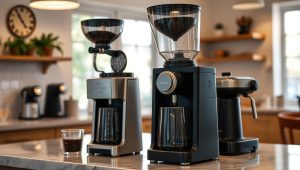
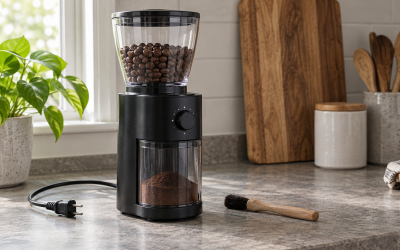
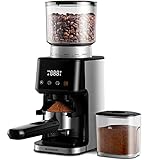
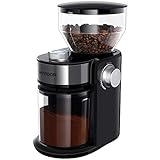
- Top Pick: SHARDOR Conical Burr Espresso Coffee Grinder Electric with Precision Timer 2.0, Touchscreen Adjustable Burr Mill with 51 Precise Settings for Home Use, Anti-static, Stainless Steel
- Best Value: SHARDOR Electric Burr Coffee Grinder 2.0, Automatic Coffee Bean Grinder for Home Use, Adjustable Burr Mill with 16 Precise Settings for Espresso & French Press, Glossy Black
- Premium Choice: OXO Brew Conical Burr Electric Coffee Bean Grinder – 12 Oz, Matte Black
Last updated: September 18, 2026
Choosing an espresso grinder by its display, bean-hopper size, or number of grind settings is an easy mistake. Those specifications can be useful, but they do not automatically indicate better espresso. A grinder with 51 settings may still make large jumps between usable espresso adjustments, while a simpler grinder with 16 settings can perform well if its burrs adjust smoothly and hold their position.
The more important question is how consistently the burrs cut coffee, how precisely they move, and whether the grinder can produce a fine, repeatable grind without excessive heat or mess. This guide explains what to look for in espresso grinder burrs in 2026, including burr shape, material, size, alignment, adjustment, and the practical ownership details that are easy to overlook.
As an Amazon Associate we earn from qualifying purchases at no extra cost to you. Product prices and availability are accurate as of the date shown and are subject to change.


- Decide These 3 Things First
- Size: Burr Diameter, Footprint, and Hopper Capacity
- Material: Steel, Ceramic, and Burr Coatings
- Construction: Alignment and Adjustment Matter More Than Setting Count
- Comfort and Performance: Retention, Heat, Noise, and Dosing
- Price Tiers: What You Actually Get
- Warranty and Replacement Parts
- Delivery and Assembly
- Spec Checklist
- Red Flags
- FAQ
Decide These 3 Things First
- Choose your brewing range. If you make espresso only, prioritize fine adjustment and repeatability. If you also brew French press or drip coffee, choose a grinder with a broader range and a clearly marked adjustment system.
- Choose your daily volume. A single espresso or two each morning places different demands on a grinder than a household making 8 to 12 shots per day. Higher volume favors larger burrs, stronger motors, and better heat management.
- Choose your workflow. Decide whether you want timed dosing, weight-based dosing, a hopper, or single dosing. A convenient grinder that is difficult to clean can become frustrating, while a manual workflow may provide less retention and easier switching between coffees.
Size: Burr Diameter, Footprint, and Hopper Capacity
See also: How to Clean an Espresso Grinder Burrs (2026): Step-by-Step • Espresso Grinder Hopper Capacity How Much Size Guide With Measurements (2026)
Burr diameter is one of the most useful numbers to compare, although it should not be treated as a performance guarantee. For home espresso, a practical range is approximately 40 to 65 millimeters. Grinders with burrs around 40 to 48 millimeters are usually compact and affordable. Burrs around 50 to 55 millimeters offer a balanced choice for most households. Models with 60-millimeter or larger burrs can grind faster and may be better suited to frequent use, but they often cost more and occupy more counter space.
Check the complete footprint rather than the burr diameter alone. A typical countertop grinder may measure roughly 5 to 8 inches wide, 7 to 10 inches deep, and 12 to 17 inches tall. Allow extra clearance above the grinder if the hopper or lid must be removed. A 10- to 12-ounce hopper is common for home use, but a smaller 4- to 6-ounce hopper can be preferable if you switch beans often.
Capacity also affects freshness. Unless you use the beans quickly, avoid choosing a very large hopper simply because it sounds convenient. For one or two daily drinks, storing most beans in an airtight container and loading only what you need can be a better routine.
Material: Steel, Ceramic, and Burr Coatings
Most espresso grinders use stainless-steel burrs, ceramic burrs, or steel burrs with a specialized coating. Steel is the most common choice for electric home espresso grinders because it is durable, widely available, and effective across a broad grind range. Ceramic burrs resist corrosion and can last a long time, but they may be more vulnerable to damage from a hard foreign object.
Do not assume that a coating automatically makes a burr superior. Coatings may be advertised as harder or more wear-resistant, but the grinder’s alignment, burr geometry, motor, and adjustment mechanism remain just as important. Ask whether replacement burrs are available and how much they cost. A grinder with inexpensive, accessible replacement burrs can be a better long-term purchase than one with impressive materials but no service path.
For espresso, look for burrs specifically described as espresso-capable rather than relying on the word “burr” alone. Some entry-level burr grinders are designed primarily for coarse brewing and may struggle to produce a sufficiently fine, even grind.
Construction: Alignment and Adjustment Matter More Than Setting Count
Good burr construction starts with alignment. The two burrs should remain parallel and stable as the adjustment collar moves. Poor alignment can create a mixture of very fine particles and larger pieces, making espresso extraction unpredictable. Manufacturers do not always publish alignment tolerances, so examine reviews and return policies when this information is unavailable.
Look for a rigid metal or reinforced housing around the burr assembly, a secure adjustment collar, and minimal wobble in the moving burr. Stepped adjustment offers defined clicks, while stepless adjustment allows finer control but can be less convenient to repeat. For espresso, a grinder with at least 20 to 30 meaningful fine-grind positions is a reasonable target. A claim of 45 or 51 total settings is not necessarily better if most of those settings are intended for drip or French press.
Also check whether the grinder remembers the setting after cleaning and whether the collar can drift during operation. A locking mechanism or firm detents are useful because a small adjustment can significantly change espresso flow.
Comfort and Performance: Retention, Heat, Noise, and Dosing
Performance is not just speed. A grinder should deliver a repeatable dose with manageable retention and without excessive clumping. Retention varies by design, coffee, humidity, and cleaning habits, so be cautious about universal claims. For home use, a grinder that leaves roughly 0.5 to 2 grams behind after a normal cleaning routine is generally easier to manage than one that traps a larger amount, but manufacturer specifications and independent testing should be checked before purchase.
Motor power commonly falls between about 150 and 300 watts for compact electric home grinders. Wattage alone does not reveal grinding quality, but adequate power can help a grinder work through espresso-fine coffee without frequent stalling. A timed grinder may offer settings from 5 to 40 seconds, while a manual start button can give you more direct control. If the product uses a timer, confirm whether it adjusts in whole seconds or smaller increments.
Noise is rarely listed in a standardized way. A claimed decibel figure is useful only if the testing method is explained. Instead, look for a stable base, vibration-damping feet, and a motor that does not sound strained. Anti-static features may reduce stray grounds, but they cannot eliminate mess under every condition.
Ease of use matters every morning. A readable display, a portafilter holder that fits your basket, a removable hopper, and tool-free access to the upper burr can make routine adjustments much easier. Make sure the grinder can accommodate your portafilter width; many home holders are designed for approximately 54- or 58-millimeter baskets, but fit varies.
Price Tiers: What You Actually Get
Budget: $40 to $80. Entry-level models often include steel conical burrs, 16 to 25 settings, a small digital timer, and a hopper holding roughly 8 to 10 ounces. Examples in this category include models such as the $39.99 SHARDOR and the $71.99 SHARDOR with a larger advertised setting range. Expect more plastic in the housing, greater variation between units, and fewer replacement parts. These grinders can be suitable for occasional espresso, especially when paired with a pressurized basket.
Midrange: $80 to $160. This tier commonly adds sturdier adjustment mechanisms, better dosing controls, improved access for cleaning, and more consistent support. The $109.95 OXO Brew example fits within this general price band, although its suitability for espresso depends on the exact burr and adjustment design. Look for a stronger warranty, clearer replacement-part availability, and a stable portafilter holder.
Premium home: $160 to $400 or more. Premium grinders may offer larger burrs, stepless adjustment, lower retention, stronger alignment, quieter operation, and more refined single-dose or timed workflows. The added cost makes the most sense for daily espresso drinkers who frequently adjust grind size or prepare several drinks in succession. Do not pay premium pricing solely for a touchscreen, a high setting count, or a large hopper.
Warranty and Replacement Parts
A one-year limited warranty is common at the lower end. Two years is a more reassuring target, while longer coverage may be available on selected premium models. Read what the warranty excludes: burr wear, misuse, commercial use, damage from foreign objects, and unauthorized repairs are often treated differently from motor or electronics failures.
Before buying, confirm that the upper and lower burrs, hopper, grounds cup, adjustment collar, and gasket can be purchased separately. Replacement burrs may cost approximately $20 to $80 for home models, while proprietary assemblies can cost more. A user-accessible burr chamber is valuable because coffee oils and fines can accumulate quickly, particularly with dark-roasted beans.
Delivery and Assembly
Most electric home grinders require little assembly, but delivery condition still matters. Check that the burrs, hopper, lid, grounds container, portafilter support, and cleaning brush are included. Some models arrive with the hopper and collar detached, requiring only a short installation; others need calibration or a purge of several grams of coffee before use.
Measure your counter and verify the return window before opening the box. A grinder that is 16 inches tall may not fit beneath a cabinet once the hopper is installed. Inspect the burr chamber for shipping damage, make sure the adjustment collar turns smoothly, and test the motor before committing to a full bag of coffee. Keep the packaging until you know the grinder is aligned, stable, and suitable for your portafilter.
Spec Checklist
| Spec | Budget | Mid | Premium |
|---|---|---|---|
| Typical price | $40–$80 | $80–$160 | $160–$400+ |
| Burr diameter | 40–48 mm | 48–55 mm | 55–65+ mm |
| Burr material | Steel; ceramic on some models | Steel, often replaceable | Steel or coated steel, usually replaceable |
| Espresso adjustment | 16–25 steps | 25–50 useful steps or stepless | Stepless or highly refined micro-adjustment |
| Motor rating | 150–200 watts | 180–250 watts | 200–300+ watts |
| Hopper capacity | 6–10 oz | 8–12 oz | Single-dose or 10–14 oz |
| Warranty target | 1 year | 1–2 years | 2 years or more |
Red Flags
- A high number of grind settings with no explanation of how many are suitable for espresso.
- No information about burr diameter, material, replacement parts, or access for cleaning.
- Promises of “café-quality” results without details about alignment, dosing, or adjustment.
- A hopper or grounds cup that is difficult to remove, especially if you switch beans regularly.
- A portafilter holder that does not support your basket size or requires you to hold the portafilter by hand.
- No clear warranty terms, customer-service contact, or return policy.
- A grinder that is much taller than your available cabinet clearance.
FAQ
Are conical or flat burrs better for espresso?
Neither shape is automatically better. Conical burrs are common in compact home grinders and can work very well for espresso. Flat burrs are also capable of excellent results and may offer a different particle distribution and flavor profile. Alignment, burr geometry, adjustment precision, and the grinder’s overall design matter more than the shape alone.
How large should espresso grinder burrs be?
For most home users, 48 to 55 millimeters is a practical middle ground. Choose around 40 to 48 millimeters when counter space and price are the priorities. Consider 55 millimeters or larger if you make many drinks per day and value faster grinding, but confirm the grinder’s heat management and footprint.
How many grind settings do I need?
At least 20 to 30 useful espresso adjustments is a sensible target, but the number printed on the box is only part of the story. A stepless collar can provide finer control than a grinder advertising dozens of widely spaced clicks. The important test is whether you can make small, repeatable changes to espresso flow.
Should I buy a grinder with a hopper or use single dosing?
A hopper is convenient for one coffee used every day and can speed up preparation for several drinks. Single dosing is better for switching beans, controlling the exact dose, and limiting the time beans spend exposed to air. Choose the workflow you will actually maintain, and look for low-retention design details rather than assuming either format is automatically fresher.
Ready to decide? Our #1 pick for 2026 is the Typical price.
Live price & availability on Amazon.