Last updated: October 2, 2026
A doserless espresso grinder sends grounds straight into the portafilter or a catch cup instead of holding them in a dosing chamber. For home use, that usually means less stale coffee and less cleanup. It does not automatically mean less mess: clumping, static, and an awkward portafilter fork can still scatter grounds across the counter.
For most home espresso setups, the best choice is a dedicated grinder with stepless or fine-grained adjustment, a stable grind setting, and a dosing method that fits your routine. A single-dose grinder makes sense if you switch coffees or brew methods often. If you make several espresso drinks a day from one bag, a hopper-fed doserless grinder is often quicker and easier.
Quick answer: For most people in 2026, the best doserless espresso grinder is the Hopper-fed, timed or manual dosing — our #1 rated choice. See the full ranked comparison, alternatives and buying advice below.
What to look for in a doserless grinder
Adjustment matters more than a feature checklist. Espresso needs small changes as beans age or humidity shifts. Stepless adjustment gives you fine control, but can be harder to read and return to a previous setting. A stepped grinder is easier to navigate, though the gap between settings may leave you choosing between a shot that runs too fast and one that chokes.
Decide how you want to dose. Hopper-fed grinders let you grind only what you need while keeping beans ready to go. Single-dose models are designed for weighing each dose into the grinder, often with a bellows or short chute to clear retained grounds. They are convenient for changing beans, but add weighing and handling to the routine.
Check the fit and cleanup. A portafilter fork should hold your basket at the right height without wobbling. Some grinders are designed around a particular portafilter size, while others work better with a catch cup. Look for easy access to the burr chamber: regular cleaning is part of ownership, and a grinder that is awkward to open is easier to neglect.
Choose the style that fits your routine
See also: Best Espresso Grinders for Home: Burr Size, Workflow and Budget Matched • Breville Smart Grinder Espresso
| Grinder style | Best for | Main trade-off |
|---|---|---|
| Hopper-fed, timed or manual dosing | Several drinks a day, usually from one coffee | Some grounds remain inside; timed doses can vary |
| Single-dose with bellows | Rotating coffees or weighing every dose | More steps, and bellows do not remove all retention |
| Entry-level stepped grinder | New espresso drinkers on a tight budget | Adjustment steps may be too large for a particular coffee |
| Stepless espresso grinder | Dialing in espresso and making frequent fine changes | Settings are less repeatable unless you record them |
Best options by buyer
Best for most home espresso setups: a dedicated hopper-fed grinder
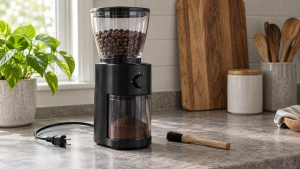
If you mostly use one coffee and make drinks back to back, start with a dedicated espresso grinder that has a hopper and direct grinding into the portafilter. It keeps the workflow simple, and there is no need to weigh beans before every shot. Look for a usable timer or a manual on/off switch, plus an adjustment mechanism fine enough to dial in your coffee.
The downside is that a timer measures time, not coffee weight. Dose can shift with bean density, roast level, and grind setting, so weigh the output at first and recheck it when you change beans. This type suits convenience-focused households; it is less appealing if you change coffees daily or want to use the same grinder for filter brewing. Browse doserless espresso grinders and compare adjustment range, burr access, and portafilter fit rather than choosing by appearance alone.
Best for rotating coffees: a single-dose grinder
A single-dose grinder is a better fit if you switch between decaf and regular beans, sample different roasts, or want to weigh each dose. You add only the amount you plan to grind, which makes it easier to control the dose and avoids leaving a large quantity of beans in the hopper. A bellows can help clear the chute, but it is not a guarantee of zero retention; a few taps or a small amount of leftover coffee may still be normal.
Single dosing also has costs: weighing beans, loading them, and clearing the grinder takes longer than using a hopper. Some models are optimized for espresso and may be less convenient to adjust for filter coffee. Compare single-dose espresso grinders if switching beans matters more to you than speed.
Best on a tighter budget: an entry-level espresso grinder
A less expensive grinder can be fine if you are starting out, drink milk-based espresso, or are still learning to dial in. The key question is whether it can grind fine enough and whether its adjustment steps let you get a reasonable shot with the coffee you buy. A stepped model may work well with one bean and frustrate you with another. If you can, buy from a retailer with a useful return policy in case the adjustment range does not suit your machine and coffee.
Do not assume that a grinder marketed for drip coffee will handle espresso just because it has a fine setting. If espresso is the main job, search for an entry-level doserless espresso grinder, then check owner reports for adjustment range, clumping, and whether the portafilter sits securely.
Common problems to expect
Mess around the chute: Static can make grounds cling to the chute or scatter onto the counter. A catch cup, a short chute, and a small brush help; a dosing funnel can keep grounds in the basket while you distribute them.
Inconsistent timed doses: A grinder timer is a convenience, not a scale. Weigh the dose when dialing in, and check it again when changing coffee or grind size.
Grinds left inside: Every grinder retains some grounds. Single dosing and bellows can reduce the amount left behind, but do not promise a perfectly empty grinder. If stale grounds bother you, purge a small amount after a major setting change or coffee swap.
Hard-to-repeat settings: Stepless adjustment allows precise changes but may not have numbered positions. Take a photo or note the setting before changing coffees. On stepped grinders, test whether the available increments let you reach a workable shot time without choking the machine.
FAQ
Is a doserless grinder better for home espresso?
Usually, yes: it avoids storing grounds in a dosing chamber and suits one-shot-at-a-time use. The best choice still depends on how much you value speed versus weighing each dose.
Do I need a single-dose grinder?
No. A hopper-fed grinder is often easier if you make several drinks from the same beans. Choose single dosing if you frequently switch coffees or want to weigh every dose.
Can one grinder handle espresso and filter coffee?
Some can, but changing between brew methods may be slow, and returning to the exact espresso setting can be difficult. Check whether the adjustment is easy to repeat before relying on one grinder for both.
How often should I clean a doserless grinder?
Brush away loose grounds regularly and clean the burr chamber according to the manufacturer’s instructions. How often it needs a deeper clean depends on use and how oily the beans are.
Ready to decide? Our #1 pick for 2026 is the Hopper-fed, timed or manual dosing.
Live price & availability on Amazon.