Last updated: October 2, 2026
For a compact prosumer espresso machine, the La Marzocco Linea Micra sits in an expensive but clearly defined part of the market. In the United States, its list price is typically around $3,900, although retailer promotions, shipping, color, and regional pricing can change the final cost. That price buys a polished dual-boiler machine built for repeated milk drinks, not simply a small appliance for occasional espresso.
The more useful question is not whether the Linea Micra is “worth it” in isolation. It is whether its speed, size, temperature stability, and La Marzocco ownership experience justify spending several thousand dollars instead of buying a single-boiler machine or a larger prosumer model.
Quick answer: Our top pick in 2026 is the La Marzocco Linea Micra — our #1 rated choice. See the full ranked comparison, alternatives and buying advice below.
What you get for the price
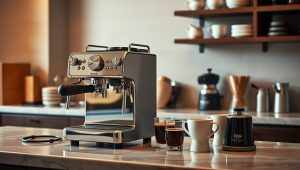
The Linea Micra uses separate boilers for brewing and steaming. This matters when making cappuccinos or lattes: you can brew espresso and steam milk with much less waiting than with a single-boiler machine. Its compact saturated brew group, PID temperature control, rotary pump, hot-water outlet, and insulated steam wand give it the basic architecture of a serious home espresso setup.
It also has a relatively quick startup for this class of machine. “Ready quickly” does not mean the machine is instantly at its best, however. The boilers may be ready before your grinder, portafilter, and cups are properly prepared. The first few shots can still vary if the coffee dose, grind, or puck preparation is inconsistent.
The Micra includes app connectivity and convenient controls, but it is not a one-button coffee maker. You still need a capable grinder, fresh beans, a scale, and some practice. At this price, the grinder is often the most important missing purchase.
La Marzocco Linea Micra price versus the total setup
See also: Breville Bench Saver • Rocket Espresso Coffee Machine
A $3,900 machine is only part of the investment. A suitable espresso grinder can add several hundred dollars, while a premium grinder may cost more than $1,000. You may also need a bottomless portafilter, dosing funnel, tamper, distribution tool, knock box, water treatment, and a small scale.
For a first setup, budget at least another $500 to $1,000 for accessories and coffee equipment. If your existing grinder is designed for drip coffee or French press, it probably will not provide the fine, precise adjustment espresso requires. In that case, start by comparing home espresso grinders before committing to the machine.
| Option | Typical cost position | Main advantage | Main compromise |
|---|---|---|---|
| La Marzocco Linea Micra | Premium | Compact dual-boiler workflow and strong milk-drink performance | High price, limited workspace, no built-in grinder |
| Quality single-boiler machine | Lower | Good espresso for less money | Must switch between brewing and steaming |
| Larger dual-boiler machine | Premium to very high | More water, steam capacity, and often more controls | Takes more counter space and may heat up more slowly |
| Superautomatic espresso machine | Low to premium | Push-button convenience and integrated grinder | Less control and usually less convincing manual milk texture |
Who should buy the Linea Micra?
The Micra makes sense for someone who drinks espresso or milk drinks every day and wants a compact machine that feels immediate and repeatable. It is especially attractive if your counter space is limited but you do not want to give up a real steam wand or dual-boiler operation.
It is also a good fit for households where several people make drinks in succession. The separate boilers reduce the frustrating pauses associated with single-boiler machines. The machine’s controls are relatively approachable, so it does not require the ritual-heavy workflow of some traditional lever or manually controlled machines.
Choose the Micra if you value build quality, a recognizable service network, and a compact footprint. La Marzocco’s parts and support ecosystem can be meaningful over years of ownership, although service availability depends on your location.
Who should skip it?
The cheaper option is fine if you usually make one espresso in the morning and rarely steam milk. A good single-boiler machine, paired with a better grinder, can produce excellent coffee for substantially less. The trade-off is waiting between brewing and steaming and managing a slightly more involved workflow.
The Micra is also a poor value if you expect convenience similar to a pod or superautomatic machine. You must grind beans, distribute and tamp the coffee, lock in the portafilter, steam milk, and clean after every session. A superautomatic espresso machine is a better match for users who prioritize speed and minimal cleanup over manual control.
Finally, consider a larger dual-boiler machine if you regularly entertain, make many drinks back-to-back, or want extensive pressure and flow adjustments. The Micra is compact partly because its water reservoir and steam capacity are smaller than those of larger machines. It can handle normal home use, but it is not a miniature café machine.
Common failure points and ownership costs
The most common bad experience is not a defective machine; it is an underpowered grinder. A grinder that produces inconsistent particles will cause sour, bitter, thin, or channeling-prone shots no matter how good the Micra is. If the espresso tastes wrong, adjust grind size, dose, yield, and puck preparation before assuming the machine is at fault.
Water quality is another long-term concern. Hard water can create scale inside boilers and valves, while poorly maintained filters can become a source of unpleasant taste. Follow the manufacturer’s water guidance and use appropriate filtration. Do not treat descaling as a substitute for using suitable water from the beginning.
Milk residue can block the steam tip if you fail to purge and wipe the wand immediately after steaming. The group gasket, shower screen, and portafilter also need routine cleaning. These tasks are small, but neglect causes leaks, poor flow, stale flavors, and expensive service visits.
A sensible way to buy
If the Linea Micra price fits your budget, reserve money for the grinder first rather than spending the entire budget on the machine. A balanced setup with a less extravagant accessory kit will outperform a Micra paired with a mediocre grinder.
Buy from an authorized retailer when possible, confirm warranty coverage, and check whether the quoted price includes shipping, tax, water accessories, and the portafilter configuration you want. If you are uncertain about manual espresso, try a local café class or borrow a machine before making a $3,900 commitment. For a lower-cost starting point, compare semi-automatic espresso machines with a separate grinder.
FAQ
What is the La Marzocco Linea Micra price?
Its U.S. list price is typically around $3,900, but actual prices vary by retailer, finish, promotions, taxes, and shipping. Check the current authorized-retailer price before buying.
Does the Linea Micra include a grinder?
No. You need a separate espresso-capable grinder, and it should be included in your total budget.
Is the Linea Micra good for beginners?
It is approachable for a beginner who is willing to learn grinding, dosing, tamping, and milk steaming. It is not the right choice if you want push-button convenience.
Is a cheaper espresso machine good enough?
Often, yes. A quality single-boiler machine can make excellent espresso for less, especially if you mainly drink straight shots and make only one drink at a time. The Micra’s premium pays for speed, compact dual-boiler operation, and ownership refinements.
Ready to decide? Our #1 pick for 2026 is the La Marzocco Linea Micra.
Live price & availability on Amazon.