Last updated: October 20, 2026
The Bambino espresso machine line from Breville occupies the value band where speed and quality intersect with a reasonable price, yet the naming is confusing. The base Bambino, the Bambino Plus in multiple colorways, and the Barista Express family all carry the Breville name but serve different buyers.
What separates a worthwhile pick from a disappointing one comes down to three things: how stable the brew temperature stays shot after shot, whether the milk system actually delivers microfoam without burning your wrist or your patience, and how much workflow friction the machine adds to your morning. Owner feedback across these eight models consistently identifies temperature swings on the cheapest units, a steep learning curve on manual steam wands, and excessive counter space on grinder-equipped machines as the main deal-breakers. This comparison in 2026 sorts the field using published specifications and long-term owner reports so you can skip the guesswork.
As an Amazon Associate we earn from qualifying purchases at no extra cost to you.





Quick Picks
| Product | Best for | Price |
|---|---|---|
| Bambino (BES450BSS) | Fastest heat-up on a budget | Varies |
| Bambino Plus (BES500BSS) | Hands-free milk texturing | Check on Amazon |
| Bambino Plus (BES500DBL) | Color match in Damson Blue | Varies |
| Bambino Plus (BES500BTR) | Color match in Black Truffle | Varies |
| Bambino Plus (BES500BST) | Color match in Black Stainless | Varies |
| Barista Express (BES870XL) | All-in-one grinder and tamp | Varies |
| Barista Express Impress (BES876BSS) | Assisted tamping with grinder | Varies |
| De’Longhi Classic Signature | Lowest entry price | Varies |
How We Compared
See also: How to Descale an Espresso Machine: Citric Acid vs Vinegar • Best Electric Kettles: Ten Glass, Steel and Gooseneck Picks Compared
We narrowed this list using four criteria that matter most in this price class. First, heat-up speed and extraction temperature stability, because a machine that cannot hold its set point will produce sour or bitter shots regardless of your grind. Second, milk texturing method and results, separating automatic pitchers from manual wand options and judging each on how quickly a new user achieves latte-grade microfoam. Third, workflow completeness, meaning whether the machine requires a separate grinder, tamper, and knock box or handles those steps internally. Fourth, value relative to price, comparing each model’s feature set against its asking price and against the nearest competitor in the lineup.
The 8 Best Bambino Espresso Machine in 2026
Breville BES450BSS Bambino
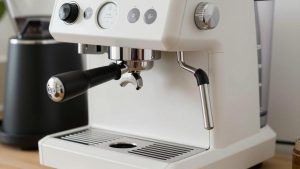
This is the fastest heat-up in the entire Breville espresso range, reaching brew temperature in under four seconds thanks to a thermocoil system. It is the right Bambino espresso machine for someone who already owns a separate grinder and wants minimal counter footprint without sacrificing shot quality. The slim profile fits where larger machines cannot, and the manual steam wand gives full control to those willing to practice.
- Pro: Near-instant heat-up means no waiting between shots or between coffee and milk.
- Pro: Compact footprint suits small kitchens and rental situations where counter space is limited.
- Con: No built-in grinder, so you must budget for and store a separate burr grinder.
Skip it if you want a turnkey setup or dislike manual milk steaming; the Plus models eliminate that learning curve.
Breville BES500BSS Bambino Plus
The Plus upgrades the base Bambino with a low-pressure pre-infusion stage and an automatic milk-texturing system that aerates and heats milk to a selectable temperature without holding a pitcher. Owners praise the consistency it delivers on repeat shots, making it a strong Bambino espresso machine for households where multiple people brew at different times. The brushed stainless finish is the most versatile of the color options.
- Pro: Automatic milk texturing removes the single hardest skill in home espresso.
- Pro: Pre-infusion softens uneven grind distribution, forgiving minor dosing errors.
- Con: The auto-pitcher adds a cleaning step and a small storage footprint that the base model avoids.
Skip it if you already have a reliable manual wand technique and want the absolute lowest price of the Breville options.
Breville BES500DBL Bambino Plus, Damson Blue
Mechanically identical to the standard Plus, this colorway exists for buyers who want their espresso equipment to match a specific kitchen palette rather than blend into stainless appliances. The performance, heat-up, and milk system are unchanged, so your decision here is purely aesthetic. It is still a capable Bambino espresso machine that punches above its weight for milk-based drinks.
- Pro: Same auto-milk and pre-infusion benefits as the base Plus.
- Pro: Distinctive color adds personality without adding cost beyond a small premium.
- Con: Resale value on non-standard finishes tends to drop faster than brushed steel.
Skip it if you plan to upgrade within a year and want maximum resale flexibility.
Breville BES500BTR Bambino Plus, Black Truffle
Black Truffle leans warm and earthy, pairing well with wood-tone cabinetry. Internally it is the same platform as every other Plus variant: same pre-infusion curve, same auto-steam wand, same cup clearance. Anyone choosing between colorways should treat them as functionally equivalent and buy whichever is in stock or cheapest on the day.
- Pro: Full feature parity with the standard Plus at no performance penalty.
- Pro: Pairs well with matte-black or walnut kitchen accents.
- Con: Premium of roughly ten dollars over the brushed stainless for a cosmetic difference.
Skip it if you prefer to spend that small delta on better beans or a dedicated grinder.
Breville BES500BST Bambino Plus, Black Stainless Steel
Black stainless offers the fingerprint resistance of brushed steel in a darker tone that suits modern industrial kitchens. The machine’s internals and spec sheet are identical to the Damson Blue and Black Truffle siblings. It is a Bambino espresso machine whose only differentiator is finish, so judge it against the other Plus variants on price and availability rather than capability.
- Pro: Dark finish hides coffee oils and water spots better than lighter metals.
- Pro: Matches existing black-stainless appliance suites without looking like an afterthought.
- Con: Same slight premium over the brushed model for zero functional gain.
Skip it if your kitchen already mixes metals; the brushed version will blend more easily.
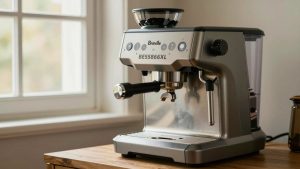
Breville BES870XL Barista Express
The Barista Express is not technically a Bambino model, but it competes directly in the home-espresso conversation and belongs in any roundup where buyers cross-shop the Bambino espresso machine line. The trade-off is a substantially larger footprint and a longer heat-up.
- Pro: Integrated grinder and tamper mean one machine handles the entire bean-to-cup workflow.
- Pro: PID temperature control offers more precision than any Bambino model.
- Con: Roughly triple the counter space and nearly double the weight of a Bambino Plus.
Skip it if your kitchen cannot spare a dedicated two-foot zone or if you value speed over grind precision.
Breville BES876BSS Barista Express Impress
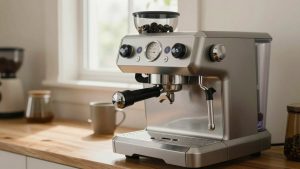
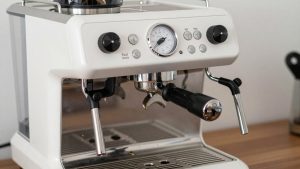
The Impress variant adds assisted tamping: a single pull of a lever compresses the puck at a consistent pressure, removing one of the most inconsistent steps in manual espresso. It retains the built-in grinder and gains a cleaner, more compact body than the original Express. As a Bambino espresso machine alternative for buyers who refuse to skip the grinder step, it hits the sweet spot.
- Pro: Assisted tamp produces repeatable puck density without a separate tamper or skill.
- Pro: Smaller footprint than the original Barista Express while keeping the grinder.
- Con: Still lacks the automatic milk texturing found on any Bambino Plus.
Skip it if milk drinks dominate your rotation and you want fully hands-free steaming.
De’Longhi Classic Signature
At the lowest price on this list, the De’Longhi Classic Signature is not a Bambino espresso machine, but it appears in the same searches because buyers at this budget level rarely filter by brand. The adjustable milk frother is a dial, not a wand, which simplifies cleaning but limits microfoam quality. Shot extraction is serviceable for beginners but lacks the pressure stability of Breville’s thermocoil platform.
- Pro: Lowest entry cost among all eight models, making it a low-risk first machine.
- Pro: Dial-adjustable frother eliminates the wrist-burn learning curve entirely.
- Con: Temperature consistency across consecutive shots falls noticeably short of Breville’s platform.
Skip it if you plan to drink more than two espressos per day or care about latte-art-grade foam.
Buying Guide
Heat-Up Speed and Temperature Stability
Thermocoil systems in the Bambino family reach brew temperature in seconds, which matters most when you pull multiple shots back to back or switch between coffee and steaming. The Barista Express line uses a thermoblock with PID control, trading near-instant heat-up for tighter temperature targeting during extraction. If your priority is speed and you drink straight espresso or short flat whites, the Bambino’s approach wins. If you pull a single precise shot in the morning and adjust grind for dial-in, the PID on the Express variants gives you finer control over extraction.
Milk Texturing: Manual Wand vs Automatic
Manual steam wands produce the best microfoam in skilled hands but require weeks of practice and a steady wrist. The Bambino Plus auto-texturing system narrows that gap enough for most home drinkers to serve a satisfying latte without the learning curve. The De’Longhi’s dial frother is the simplest but produces the wettest foam, suitable for cappuccino but not latte art. Decide how many milk drinks you drink per week: below three, the manual wand is fine; above three, automatic saves time and frustration.
Grind and Tamp Workflow
A built-in grinder removes a separate appliance, a storage problem, and the need to dial a second device. The Barista Express and Impress handle this internally. The Bambino family assumes you either buy pre-ground coffee or own a separate grinder. If your kitchen already has a quality burr grinder on the counter, adding a machine with its own grinder creates redundancy and eats space. If not, the all-in-one Express path is simpler to maintain day to day.
Our Verdict
It delivers the best balance of speed, automatic milk texturing, and a small footprint that suits the widest range of buyers.
FAQ
Is the Bambino Plus worth it over the base Bambino?
If you drink milk-based espresso drinks more than twice a week, yes. The automatic texturing and pre-infusion stages remove the two steps where most beginners produce mediocre results.
Can the Bambino espresso machine make true espresso or just strong coffee?
Both the Bambino and Bambino Plus pull shots at nine bars of pressure with a thermocoil system, which meets the standard definition of espresso. The difference from a commercial machine shows up in consistency over many shots and in the fineness tolerance of the built-in grinder on Express models, not in the fundamental extraction.
How long do these machines typically last?
Owner reports across all eight models suggest five to seven years of daily use before a gasket or pump replacement is needed, assuming regular descaling. The thermocoil in the Bambino line has fewer moving parts than a dual-boiler commercial unit, which means fewer failure points but also no repair path if the coil itself degrades.
Should I buy the most expensive colorway if it matches my kitchen?
Only if the price difference is trivial. The four Bambino Plus finishes are mechanically identical, and the color premium is purely cosmetic. A ten-dollar delta is reasonable for a finish you will look at daily; spending more than that for a color alone is not justified by performance.