Last updated: September 18, 2026
Quick answer: Our top pick in 2026 is the Keep using the machine’s original basket — our #1 rated choice. See the full ranked comparison, alternatives and buying advice below.
The Short Answer
Yes—an espresso machine with a pressurized basket is worth considering if you want forgiving, low-fuss coffee and are not trying to perfect every variable of the shot. The basket is especially useful when your grinder is basic, your coffee is pre-ground, or you are still learning. The one condition is that you must accept less control and a lower ceiling for flavor than you get from a properly matched, non-pressurized basket.
What You Actually Get
See also: How to Replace Espresso Machine Water Filter (2026): Step-by-Step • How to Adjust Espresso Machine Brew Temperature (2026): Step-by-Step
A pressurized basket, also called a dual-wall basket, has two layers. The first layer looks like a normal filter and holds the coffee. The second layer has a much smaller outlet, often just one controlled opening. That restricted exit creates back pressure even when the coffee bed itself is not perfectly prepared.
As an Amazon Associate we earn from qualifying purchases at no extra cost to you. Product prices and availability are accurate as of the date shown and are subject to change.
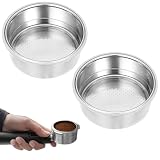

In practical terms, the basket does some of the work normally handled by a fine grind, even tamping, and careful dose. It can produce a layer of foam that resembles crema, though appearance alone does not guarantee a balanced or freshly extracted shot.
Replacement baskets are commonly sold by portafilter diameter. The two related examples here are 51mm pressurized baskets: a two-piece MBAIYO set listed at $9.88 and a two-pack of 51mm dual-wall baskets listed at $9.99. Both advertise one- and two-cup capacity, but “one cup” and “two cup” are not universal dose standards. A smaller basket may hold roughly 7–10 grams, while a larger one may hold roughly 14–18 grams, depending on its depth and the machine’s design.
Compatibility matters more than the low price. A 51mm basket may not fit a 54mm or 58mm portafilter, and even two baskets with the same diameter can differ in rim shape, depth, locking tabs, or the number of ears that hold the basket in place. Check your machine manual and measure the original basket before ordering. Also confirm whether your portafilter is designed to accept a pressurized insert. Some machines use a special spout or valve arrangement that a generic replacement will not replicate.
Pros
- More forgiving preparation. A pressurized basket can still produce drinkable espresso when the grind is slightly too coarse, the dose is inconsistent, or the tamp is less than perfect. That is helpful for beginners and households where several people use the same machine.
- Works with entry-level grinders. A basic blade grinder or inexpensive burr grinder often cannot produce the fine, uniform grind required for a non-pressurized basket. A dual-wall basket reduces the importance of precise particle size.
- Convenient with pre-ground coffee. Store-bought espresso grounds can be used without immediately buying a $150–$500 espresso grinder. You can also change coffees without recalibrating a grinder for every bag.
- Lower learning curve. You can focus on dosing, tamping, milk steaming, and cleaning without troubleshooting every shot that runs too quickly. For occasional espresso drinkers, that simplicity may be more valuable than maximum flavor control.
- Usually inexpensive to replace. A compatible basket can cost about $8–$15, with two-packs often near $10. Replacing a scratched, clogged, or lost basket is much cheaper than replacing a portafilter or machine.
- Useful for milk drinks. In a latte, cappuccino, or iced coffee, the basket’s convenience may matter more than subtle tasting notes. Espresso with adequate body and sweetness can work well once milk, syrup, or ice is added.
- Can extend the life of an older machine. If the original basket is damaged or missing, a compatible dual-wall replacement may restore basic operation without requiring a new machine.
Cons
- Less control over extraction. The restricted outlet creates much of the resistance, so changing grind size and tamp pressure has a smaller, less predictable effect. That makes it harder to deliberately tune a shot.
- A lower flavor ceiling. Fresh coffee can taste good in a pressurized basket, but the setup generally does not reveal as much clarity, sweetness, or separation as a well-prepared shot from a single-wall basket.
- Foam can be misleading. The basket may produce a thick crema-like layer from pressure rather than from ideal extraction and very fresh coffee. A full-looking crema is not proof that the shot is balanced.
- Cleaning can be fussy. The tiny outlet can clog with fine grounds, coffee oils, or mineral buildup. Rinsing immediately after use and occasionally soaking the basket in an espresso-safe cleaner can prevent problems. Do not poke the opening with a sharp object that could damage it.
- Generic fit is not guaranteed. A basket labeled 51mm may still sit too high, fail to lock into the portafilter, or leak around the rim. Measurements, tabs, and depth matter. A return policy is useful when buying an inexpensive replacement.
- It can hide equipment problems. If every shot tastes weak, sour, bitter, or burnt, the basket may mask the underlying issue instead of helping you learn how dose, temperature, grind, and time interact.
- Not ideal for serious experimentation. Home baristas who want to compare recipes, adjust flow, or use a high-quality grinder will likely outgrow a pressurized basket quickly.
Who Should Buy It
Buy a pressurized basket if you own an entry-level espresso machine and do not yet have a capable espresso grinder. It is also a sensible choice for people who use pre-ground coffee, make espresso only a few times per week, or mainly prepare milk-based drinks.
It makes particular sense as a low-cost replacement. A $9.88 or $9.99 basket is a modest way to test whether your machine can produce better results before spending on a grinder, tamper, bottomless portafilter, or upgraded machine. It can also be the right basket for a shared kitchen where speed and consistency matter more than a hobbyist-level workflow.
Who Should Skip It
Skip it if you already own a quality burr grinder and want to learn traditional espresso technique. A non-pressurized basket gives you direct feedback: grind finer or coarser, adjust the dose, improve distribution, and observe how the shot changes.
You should also skip a generic basket when your machine requires a proprietary design, when you cannot confirm the portafilter diameter, or when the original basket uses a built-in valve. In those cases, the manufacturer’s replacement may cost more but is less likely to leak or fit poorly.
Cheaper Alternatives
| Option | Cost | Trade-off |
|---|---|---|
| Keep using the machine’s original basket | $0 | Cheapest choice, assuming it is not clogged, damaged, or missing; performance depends on its condition. |
| Single replacement pressurized basket | About $5–$10 | Usually less expensive than a multi-pack, but you get no spare if the basket clogs or the fit is wrong. |
| Pre-ground coffee with a compatible pressurized basket | About $8–$18 per bag | Avoids buying a grinder, but coffee loses freshness faster and offers less control over extraction. |
| Non-pressurized basket already included with the machine | $0 | Offers more control, but requires a suitable fine grinder and more practice. |
| Moka pot for strong coffee | About $20–$40 | Lower ongoing cost and no espresso machine basket needed, but it produces concentrated coffee rather than true espresso. |
FAQ
Does a pressurized basket make real espresso?
It makes espresso-style coffee under pressure and can produce a concentrated shot with crema-like foam. However, traditional espresso preparation relies on the coffee bed—not only a restricted basket outlet—to create resistance. For everyday cappuccinos and lattes, the difference may be minor; for tasting straight shots, it is easier to notice.
Will a 51mm pressurized basket fit any 51mm machine?
No. Diameter is only one measurement. Check the basket’s depth, rim, locking tabs, and cup capacity, as well as the shape of your portafilter. A generic 51mm basket may fit one machine but sit too deep or fail to lock securely on another. Never force the portafilter closed.
Can I use finely ground coffee in a pressurized basket?
Usually, but extremely fine coffee can slow the shot, clog the outlet, or create excessive pressure. Start with the grind recommended for your machine, use the intended dose, and avoid over-tamping. If coffee drips very slowly or the pump sounds strained, use a slightly coarser grind and clean the basket.
Should I buy the MBAIYO set or the two-pack priced near $10?
Choose based on confirmed fit rather than the small price difference. The MBAIYO two-piece set is listed at $9.88, while the other 51mm dual-wall two-pack is listed at $9.99. Compare the stated cup sizes, basket depth, rim design, and return terms. If both are compatible, either can be a practical spare for an entry-level machine in 2026.
Ready to decide? Our #1 pick for 2026 is the Keep using the machine’s original basket.
Live price & availability on Amazon.