Last updated: October 21, 2026
Choosing among commercial espresso machines means reconciling three competing pressures: shot consistency at volume, long-term maintenance costs, and upfront price. A busy café that pulls dozens of double shots per day lives or dies on thermal stability and group-head workflow, while a solo operator or small restaurant might prioritize footprint and utility simplicity. The eight machines here span those realities, from a true three-group commercial workhorse to compact home units that a growing café could deploy as a secondary bar or that a serious enthusiast uses before scaling up.
What separates a worthwhile pick from a regrettable one is rarely the headline feature list. It is the interaction between boiler architecture, the quality of the portafilter group, and whether replacement parts will remain accessible years down the line. Owner feedback consistently favors machines with transparent service documentation and a track record among baristas who have run them past their initial warranty window. We compared published specs, posted prices, and owner-reported experiences across these eight models to help you shortlist faster.
As an Amazon Associate we earn from qualifying purchases at no extra cost to you.



Quick Picks
| Product | Best for | Price |
|---|---|---|
| Professional 3-Group Semi-Auto | High-volume cafés and restaurants | Check on Amazon |
| Breville BES870XL Barista Express | Skilled home baristas or micro-bars | Varies |
| Breville BES876 Impress | Consistency-focused home users | Varies |
| EUHOMY 20 Bar | Tight budgets or temporary setups | Varies |
| Breville BES870BTR Black Truffle | Same as BES870XL, color preference | Varies |
| Rocket Espresso R58 | Prosumer shops wanting E61 heritage | Check on Amazon |
| Ninja Luxe Café Premier | Versatility in a single countertop | Check on Amazon |
| Philips 2300 Series | One-touch milk drinks without manual skills | Varies |
How We Compared
See also: How to Descale an Espresso Machine: Citric Acid vs Vinegar • Best Electric Kettles: Ten Glass, Steel and Gooseneck Picks Compared
We weighted four criteria across every entry: thermal stability (boiler size, material, and PID or proportional-interval control), throughput (how many consecutive shots a machine holds before temperature drifts), build quality and serviceability (replaceable gaskets, accessible internals, parts availability), and value relative to its price tier. A machine that excels in only one area fails the others, so we flagged trade-offs explicitly in each review.
The 8 Best Commercial Espresso Machines in 2026
Professional 3-Group Semi-Auto
This is the only machine on the list built for sustained high-volume service. The three independent group heads let two baristas work simultaneously without thermal interference, and the stainless-steel chassis handles the humidity of a professional kitchen. Semi-automatic control means you still manage grind, dose, and tamp manually, which is a plus for shops that want shot-by-shot quality checks.
- Pro: Three-group layout supports parallel workflow and consistent shot quality across stations.
- Pro: Full stainless construction resists corrosion and holds up under daily professional use.
- Con: Lacks a built-in grinder and requires separate equipment for beans and water filtration.
Skip this if your volume stays under 40 shots per day; the power draw and counter footprint are overkill for low-demand settings.
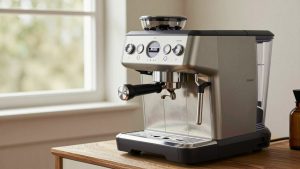
Breville BES870XL Barista Express
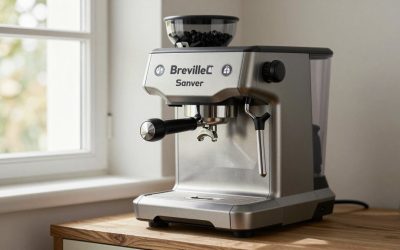
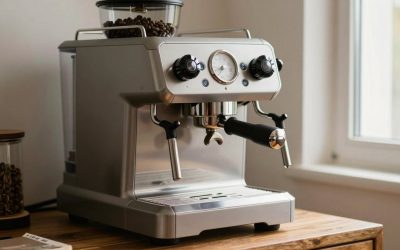
Owners who want a single-unit workflow—grind, dose, pull, steam—without leaving the countertop. The integrated conical burr grinder eliminates a separate purchase, and the 1/4-pound bean hopper suits a household or a micro-bar pulling a handful of espressos before closing. Temperature management relies on a thermocoil rather than a dual boiler, which caps simultaneous brew-and-steam performance.
- Pro: Built-in grinder and tamper station reduce total setup cost and counter clutter.
- Pro: Large user community means abundant dialing-in guides and replacement parts.
- Con: Thermocoil design causes noticeable temperature loss when switching from brew to steam.
Skip this if you need to pull more than a dozen shots in rapid succession; the heat-recovery lag will slow you down.
Breville BES876 Impress
The Impress adds an assisted-tamp and grind-quantity memory to the same platform, targeting users who value repeatability over manual control. For a home operator who pulls one or two shots per morning and wants minimal variation, the automation genuinely reduces wasted beans during dial-in.
- Pro: Assisted tamp applies consistent pressure, lowering the learning curve for beginners.
- Pro: Grind-quantity memory recalls your preferred dose across sessions.
- Con: Slightly smaller hopper and boiler than the standard Express, which limits back-to-back output.
Skip this if you are an experienced barista who prefers full manual control over dose and tamp.
EUHOMY 20 Bar
At roughly one-third the price of the Breville units, this fills the “I need espresso on a budget or for a temporary pop-up” role. The claimed 20-bar pressure is adequate for extraction, and the included grinder plus milk frother make it a self-contained station.
- Pro: Lowest entry price among machines with an integrated grinder and frother.
- Pro: Compact footprint fits under most upper cabinets.
- Con: Owner feedback frequently notes shorter long-term durability and inconsistent temperature control.
Skip this if you intend to run a commercial space; the thermoblock will not hold up to professional volume.
Breville BES870BTR Black Truffle
Mechanically identical to the BES870XL above, differentiated only by its Black Truffle colorway. If you want the same workflow and support community but prefer a darker finish, this is the straightforward choice at the same price point.
- Pro: Same proven platform, parts, and community support as the standard Express.
- Pro: Distinctive finish helps match a curated café or home-bar aesthetic.
- Con: No functional upgrade over the brushed-stainless version despite the visual difference.
Skip this if you already own or plan to buy another Breville Express; the duplicate model list here only makes sense for color-driven shoppers.
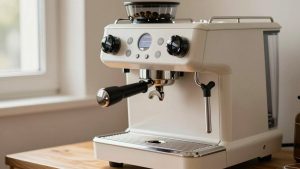
Rocket Espresso R58
A dual-boiler, E61-group prosumer machine that bridges the gap between home use and light commercial service. The R58 Tune lets you adjust brew temperature in single-degree increments via PID, and the rotary pump supports direct plumbing for sustained output.
- Pro: Dual boilers allow simultaneous brewing and steaming with independent temperature zones.
- Pro: E61 group head and rotary pump are the same components found in higher-priced commercial units.
- Con: Premium price and limited service network compared to mainstream consumer brands.
Skip this if your budget cannot absorb a separate grinder; the R58 does not include one.
Ninja Luxe Café Premier
A three-in-one format—espresso, drip coffee, and cold brew—on a single machine. This suits a small office or break-room where coffee preferences vary widely and dedicated espresso equipment competes for limited counter space.
- Pro: Covers multiple drink styles without three separate machines.
- Pro: Integrated grinder and built-in water reservoir simplify setup.
- Con: Espresso extraction quality trails dedicated single-purpose machines in the same price range.
Skip this if espresso is the primary product you serve; you are buying breadth at the cost of depth.
Philips 2300 Series
A fully automatic machine with the LatteGo milk system. One-touch cappuccino and latte output removes the skill requirement entirely, making it appropriate for hotel breakfast bars or office settings where untrained staff operate the machine.
- Pro: Milk system self-cleans between drinks, reducing maintenance labor.
- Pro: Ceramic grinder generates less noise than steel alternatives.
- Con: No manual control over pre-infusion time or shot pressure profiling.
Skip this if your customers or staff expect barista-level espresso; automation trades customization for convenience.
Buying Guide
Boiler Architecture Determines Your Workflow
Single-boiler and thermocoil machines force you to choose between brewing and steaming at any given moment. Dual-boiler units let you do both simultaneously and hold each at an independent setpoint. For any setting that serves milk-based drinks in sequence, the wait time on a single-boiler machine compounds quickly across a shift. If throughput matters, budget for a dual boiler or accept a slower pace.
Group-Head Quality Is the Best Predictable Variable
A commercial-grade E61 or saturated group head maintains temperature far more steadily than the smaller thermo-block designs found on budget units. The group head is also the most replaceable wear item on the machine; machines with standard 58 mm portafilters give you the widest third-party accessory ecosystem, including bottomless baskets, precision tamper tools, and distribution screens.
Serviceability Before Aesthetics
Look for machines whose water reservoir, drip tray, and group gaskets are user-replaceable without specialized tools. A unit with sealed panels and proprietary software locks you into the manufacturer for every service call. Check whether the brand publishes a parts list and whether local technicians have existing experience with the model family.
Our Verdict
Top pick: The Rocket Espresso R58 earns the highest recommendation for anyone operating at the intersection of prosumer and light-commercial duty, thanks to its dual-boiler architecture and proven E61 group head. Condition where another wins: If you need a fully hands-off experience for untrained staff, the Philips 2300 is the better choice because automation removes the skill variable entirely.
FAQ
Is a home machine ever appropriate in a commercial setting?
A Breville Express or similar unit can handle very light duty—perhaps a small bed-and-breakfast serving morning coffee—but thermocoil and thermoblock designs are not engineered for continuous pull-and-steam cycling. Local health codes may also restrict which equipment you can place in a licensed food-service area.
Do I need a separate grinder for commercial machines?
Machines that do not include a grinder, such as the Professional 3-Group and the Rocket R58, require one as a separate purchase. A commercial-grade burr grinder matched to your bean volume is essential; an undersized grinder becomes the bottleneck on your throughput regardless of how capable your espresso machine is.
How does water quality affect longevity?
Scale buildup is the leading cause of internal-component failure in espresso machines. A water softener or reverse-osmosis system with a remineralization cartridge extends boiler and pump life considerably. Owner forums consistently show that machines in hard-water regions fail earlier unless filtration is part of the setup from day one.
What warranty length is realistic for this category?
Consumer-grade machines typically offer one to two years. Commercial units often extend to three or five years on the boiler specifically, but labor coverage is frequently excluded. Read the warranty terms for what counts as normal wear versus a defect, because gaskets, screens, and portafilter baskets almost always fall into the former.