Last updated: October 2, 2026
Quick answer: Our top pick in 2026 is the De'Longhi EC9355M Prestigio — our #1 rated choice. See the full ranked comparison, alternatives and buying advice below.
What the EC9355M Is Trying to Be
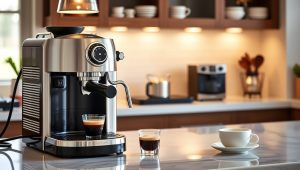
The De’Longhi La Specialista Prestigio EC9355M sits in that awkward middle ground between a super-automatic and a full manual setup. It has a built-in conical burr grinder, automatic dosing, and hands-free tamping, but you still lock in a portafilter, brew with a traditional 58mm? No, 51mm group, and steam milk yourself. De’Longhi calls this sensor grinding and smart tamping. In practice, it removes the two steps beginners mess up most: dosing and tamping.
Street price usually lands around $750-$850, though it dips to the high $600s on sale. For that money you get dual heating for brew and steam (actually a single thermoblock with independent circuits), active temperature control, a shot timer, and a fairly capable steam wand. The “M” in EC9355M is just the metal colorway – brushed stainless with black accents. Functionally it’s identical to the EC9355 in other finishes.
This is not a machine for someone who wants to single-dose, weigh to 0.1g, and chase light roasts with a separate espresso grinder. It’s for someone who wants consistent, good espresso at home without becoming a hobbyist, but who also doesn’t want the compromised coffee of a fully automatic bean-to-cup machine.
Grinder and Smart Tamping: Useful, But Limited
See also: Breville Bench Saver • Rocket Espresso Coffee Machine
The heart of the EC9355M is its integrated grinder and tamping station. You place the portafilter in the cradle, it grinds directly into the basket, and a sensor stops when the dose is correct. You then pull the tamping lever on the left side and it presses the puck with consistent ~30 lbs of pressure.
When it works, it works well. Dose-to-dose variance is tighter than what most beginners get hand-grinding and eyeballing. It also keeps the counter cleaner than grinding into a dosing cup. The grinder has 8 stepped settings, adjusted with a dial on the left. That’s coarse by specialty standards, but fine enough for medium and dark roasts, which is what this machine is tuned for.
The trade-offs are real:
First, the grinder is not stepless and not great for very light roasts. If you buy light, dense, single-origin beans, you’ll often find yourself wanting a setting between 2 and 3, and you can’t get it. Second, the sensor dosing can be fooled. Oily dark roasts, static, or a partially clogged chute will cause under or overdosing, and the machine doesn’t tell you the weight – it just stops when the basket “looks” full. If your shots start running fast one day and slow the next with the same beans, check the chute for retention. A quick brush-out fixes most of it, but it’s a failure mode De’Longhi doesn’t advertise.
Third, the built-in tamping is even and level, which is a genuine improvement over a cheap plastic tamper, but you lose feel. You can’t do a light tamp for a light roast or adjust pressure. And the tamping mechanism needs a firm, deliberate pull. Hesitate halfway and you’ll get an uneven tamp.
If you eventually outgrow the grinder, you can’t bypass it easily – there’s no way to turn off the sensor and just grind on demand by time. You can grind into the portafilter and then adjust manually, but you’re still locked into De’Longhi’s hopper and burr set.
Brewing: Stable, Forgiving, Not Fussy
The EC9355M uses a thermoblock with De’Longhi’s Active Temperature Control. You get three temperature profiles (low, medium, high), corresponding roughly to 92C, 94C, and 96C, plus a cold-brew-style “Cold Extraction” preset that brews at low pressure. In testing, temperature stability is decent for a thermoblock but not PID-flat like a prosumer machine. Shot-to-shot recovery is about 30-40 seconds, which is fine for 2-3 drinks in a row.
Pressure is factory set to about 15 bars with an overpressure valve that bleeds down to around 9-11 bars at the puck. You can’t adjust it. Pre-infusion is automatic and not adjustable either. This makes the machine forgiving: medium and dark roasts extract evenly without channeling as much as they would on a more aggressive machine. It also means you can’t really tune pre-infusion length to save a light roast.
The 51mm portafilter is a De’Longhi standard. It comes with both pressurized (dual-wall) and non-pressurized (single-wall) baskets. Beginners should start on the pressurized baskets – they hide grind errors. Switch to single-wall once your grind dialed-in, otherwise you’ll get frustrated. The included baskets are non-standard size, so if you want precision baskets or a bottomless portafilter later, you need De’Longhi-compatible 51mm accessories, not the common 58mm parts you see for Breville or Gaggia.
Shot quality with fresh medium roasts is genuinely good for the price – thick crema, balanced extraction, shot time around 25-30 seconds when dialed. With light roasts, expect sourness unless you push temperature to high and grind as fine as the machine allows. This is not the machine to buy if your bag says “notes of jasmine, 2100 masl, washed Ethiopian.”
Milk Steaming and Daily Workflow
The steam wand is De’Longhi’s My LatteArt style – a powerful, traditional-looking wand with a small hole tip. It’s not a panarello, so you can actually texture milk properly, but it takes technique. Steam pressure is strong initially, then drops slightly after about 45 seconds. You can texture 6-8 oz of milk to good microfoam in about 30-40 seconds, enough for one latte. For two back-to-back lattes, you’ll need to steam in two batches. The dual heating circuit means you don’t wait to switch from brew to steam, which is a big workflow win over single-boiler machines like the Gaggia Classic.
Daily workflow is fast: fill the bean hopper, fill the 2-liter water tank in the back, place portafilter, grind, tamp, brew. Cleanup is the weak point. The tamping lever and grind chute retain grounds. If you don’t wipe them daily, old coffee falls into the next puck and makes shots bitter. The drip tray fills quickly and the “empty me” float sticks. Descaling is mandatory every 2-3 months with hard water – ignore it and the thermoblock clogs, which is the most common long-term failure on these machines. De’Longhi’s descaling process takes about 30 minutes and you can’t skip steps.
How It Compares
Most shoppers cross-shop the EC9355M against Breville/Sage and the cheaper De’Longhi Arte. This table puts the practical differences in one place.
| Machine | Grinder Control | Tamping | Heat System | Portafilter | Best For |
|---|---|---|---|---|---|
| De’Longhi EC9355M Prestigio | 8-step, sensor-dosed | Lever, automatic | Thermoblock, brew + steam with no wait | 51mm, pressurized + non-pressurized baskets | Beginner who wants consistency with minimal technique |
| Breville Barista Express BES870 | 16-step, timed dose | Manual with included tamper | Single thermocoil, short wait between brew/steam | 54mm | Tinkerer who wants more grind adjustability on a budget |
| De’Longhi La Specialista Arte EC9155 | 8-step, manual dose | Manual with tamping mat | Thermoblock, brew + steam with no wait | 51mm | Buyer who wants to save ~$150 and doesn’t need auto-tamping |
| Breville Bambino Plus + Separate Grinder | None built-in (requires separate grinder) | Manual | ThermoJet, 3-sec heat-up | 54mm | Someone who wants better long-term grinder and upgrade path |
If you value hands-off consistency, the Prestigio wins. If you value control and future upgrades, a Bambino Plus paired with a good burr coffee grinder for espresso will outlast it and allow stepless adjustments, even if it takes more learning upfront. And frankly, if you mostly drink milk drinks and don’t care about dialing shots, the cheaper Arte EC9155 makes almost identical coffee – you just tamp yourself.
Who Should Buy It, Who Should Skip It
Buy the EC9355M if you want espresso and cappuccinos at home, drink medium or medium-dark roasts, and want to avoid a separate grinder, scale, and tamping ritual. It’s excellent for a household where two people make coffee before work and need repeatability without weighing. It’s also a good fit if you found the Barista Express too fiddly or messy.
Skip it if you are already deep into specialty coffee, roast light, or want to single-dose and weigh everything. The grinder resolution, 51mm ecosystem, and lack of pressure/pre-infusion control will frustrate you within months. Also skip if you have very hard water and won’t commit to filtering and descaling – thermoblock machines scale fast and repairs are rarely economical.
A practical middle path: if you’re unsure, buy from a retailer with a 30-day return policy. Dial in for a week on a single bag of fresh, medium-roast beans before judging it. Many negative reviews come from using stale supermarket beans on the finest setting and expecting great espresso. No machine can fix stale beans.
Ownership Costs and Longevity
Expect to replace the water filter every 2 months, descaler every quarter, and the brew gasket annually if you pull 2-4 shots a day. The grinder burrs are rated for several years of home use but are not user-replaceable as easily as on a standalone grinder. Most failures reported after year 2 are either the grinder motor jamming from oily beans or steam thermoblock scale. Both are preventable: use dry, medium roasts, not shiny French roasts, and use filtered water.
For accessories, budget for a proper 51mm tamper if you ever want to tamp manually, a small scale to check dose weight, and a knock box. If you look for espresso accessories kit options, make sure you filter for 51mm – 58mm tools won’t fit.
FAQ
Is the EC9355M good for beginners?
Yes, that’s its strongest case. The sensor dosing and lever tamping remove the two biggest beginner variables. Pair it with pressurized baskets for the first two weeks, then move to single-wall baskets once you can consistently get 25-30 second shots.
Can it make true espresso or just strong coffee?
With fresh beans and the non-pressurized baskets, it makes true espresso at 9+ bars with crema. With pressurized baskets or stale beans, it’s closer to strong coffee. Bean freshness matters more than the machine here.
Do I need a separate grinder?
No, and you shouldn’t buy one at first. Use the built-in grinder until you hit its limits. If you later want finer control for light roasts, you’ll get better results from a dedicated grinder and a machine without a built-in one, rather than running two grinders.
How is the EC9355M different from the EC9155 Arte?
Same thermoblock and brew system, but the Prestigio (EC9355M) adds automatic sensor dosing and the lever tamping system. The Arte is manual dose and manual tamp, costs less, and gives you slightly more control. Espresso quality in the cup is nearly identical when both are dialed in.
Ready to decide? Our #1 pick for 2026 is the De'Longhi EC9355M Prestigio.
Live price & availability on Amazon.