Last updated: October 2, 2026
Quick answer: Our top pick in 2026 is the Barista Express BES870XL — our #1 rated choice. See the full ranked comparison, alternatives and buying advice below.
What the Steam Lever Actually Does on the Barista Express
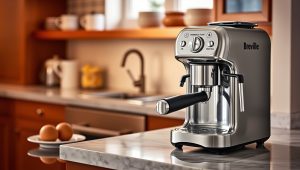
The Breville Barista Express (BES870XL) doesn’t have a lever by default – it has a black steam dial on the right side of the machine. When people say “steam lever” they usually mean one of two things: the aftermarket lever mod that replaces that dial, or they’re confusing it with the newer Barista Express Impress and Barista Pro, which come stock with a lever. Functionally they all do the same job: open and close the steam valve to send steam to the wand.
On the stock BES870, you turn the dial from 0 to the steam icon. It’s a proportional valve, so a quarter turn gives you a little steam, full open gives you full pressure. The lever version is just a faster, more tactile way to do that. Flip it up or forward and steam is instantly on, flip it back and it’s off. There’s no change to the boiler, pump, or wand itself. You’re only changing the interface.
Dial vs. Lever in Daily Use
See also: Breville Bench Saver • Rocket Espresso Coffee Machine
If you’ve only used the stock dial, the difference feels bigger than it sounds. The dial takes a half-turn with your wrist, which is awkward when you’re holding a milk jug with your other hand and trying to control angle and depth. It also has a slightly vague stop – you can overshoot or undershoot if the dial is greasy.
A lever gives you one-handed, positive on/off. That matters for microfoam. Good texture comes from a short stretch phase (5-8 seconds of light chirping) then a rolling phase with the tip just under the surface. Being able to kill steam instantly when the jug hits 140-150°F makes it easier to avoid scorching milk. With the dial, beginners tend to be late closing it while they fumble the turn.
There is a trade-off. The dial lets you throttle steam. You can run it at 50% to stretch slowly if you’re making a small 4-5 oz milk drink. Most levers are binary – fully open or closed. On the stock Breville thermocoil system, which is already not the most powerful steamer, that binary control can make small drinks harder. You get a full blast or nothing, so you have to work faster. Some aftermarket levers claim progressive control if you only crack them partway, but the throw is short and it’s not very precise.
Durability is the other difference. The dial assembly is plastic with a D-shaft. Over time the knob can crack, strip, or get loose and wobble. The lever mods are usually aluminum or printed PETG with a set screw. They grip tighter and are easier to replace if they break, but a cheap 3D-printed one can loosen with heat cycling and slip on the shaft.
Should You Mod Your BES870 With a Lever?
For the standard Barista Express, the lever is a $15-30 handle swap. You pull off the dial, loosen a set screw, and push the lever on. It takes two minutes. No wiring, no gasket changes.
It makes sense if:
You steam every day and want faster control. If you make two flat whites back-to-back, the time saved and the one-handed operation is genuinely nice.
Your stock knob is already cracked or spins. This is common after 2-3 years. Replacement OEM dials cost about the same as a metal lever, so you might as well upgrade.
You have wrist or grip issues. The dial requires torque. A lever is much lighter.
It doesn’t make sense if you like to throttle steam for small jugs. The dial is actually better for that. And it won’t fix the underlying limits of the machine. The Barista Express uses a single thermocoil that has to switch between brewing and steaming. You still need 20-30 seconds to get up to steam temperature, you still get about 45-60 seconds of usable steam before pressure drops, and you still need to purge water from the wand before steaming. A lever doesn’t make steam stronger or drier.
If you are shopping new and the lever is a priority, look at machines that ship with it from the factory. The steaming logic is tuned for it, and you get a warranty.
How Breville’s Steam Controls Compare
Breville has moved almost everything to a lever or switch. Here’s how the common home models line up:
| Model | Steam Control | Heat System | Steam Power & Workflow | Best For |
|---|---|---|---|---|
| Barista Express BES870XL | Dial (knob) | Single thermocoil | Moderate, must wait to switch from brew to steam, single-hole tip | Beginners who want control to throttle steam |
| Barista Express Impress BES876 | Lever | Single thermocoil (ThermoJet) | Heats faster (3 sec), still single boiler logic, quicker recovery | People who want assisted tamping + faster lever steaming |
| Barista Pro BES878 | Lever | ThermoJet thermocoil | Heats in 3 seconds, more consistent steam than BES870 | Those who prioritize speed and daily milk drinks |
| Barista Touch / Touch Impress | Touchscreen + lever (auto steam option) | ThermoJet | Auto-frothing with temp sensor, manual lever also available | Hands-off milk or households with different skill levels |
In practice, the ThermoJet models with a lever feel noticeably quicker day to day. You pull a shot, flip the lever, and steam is ready in a few seconds instead of waiting for the BES870’s temp light to stop flashing. Steam pressure itself isn’t dramatically higher – Breville caps it for safety – but the fast switchover makes you more likely to steam at the right time, while the milk is still fresh.
Real-World Failure Modes and Fixes
The steam circuit is where most Barista Express issues show up, lever or not. Know what to watch for before you buy used or mod.
Weak, wet steam. If you get sputtering water instead of dry steam, you probably didn’t wait long enough after the steam light went solid, or you didn’t purge the wand. Always run 2-3 seconds of steam into the drip tray before putting the jug under. If it’s still wet after a full heat-up, the thermocoil may be scaled. Descale and check water hardness.
Steam valve leaking. A constant hiss or drip from the wand even with the dial/lever closed means the valve seat is worn or has scale. The lever won’t fix this. You need to backflush and descale, and eventually replace the steam valve assembly. It’s a $30-40 part but requires opening the machine.
Wand clogged. The single-hole tip clogs easily if you don’t wipe and purge immediately after steaming. Milk bakes on inside. Soak the tip in hot water, clear the hole with the included needle tool. Don’t drill it out.
Lever slipping. Aftermarket levers that use a single set screw can slip on the D-shaft, so steam stays on when you think it’s off. Use a metal lever with two screws if you mod, and check tightness monthly. If the flat of the D-shaft is rounded off, you need a new valve stem, not just a handle.
If you want a true upgrade in steam power rather than just control, you need a different heat system. Machines with a dual boiler or heat exchanger – even at the entry level like the Breville Dual Boiler espresso machines – give you simultaneous brew and steam and much drier, more sustained pressure. That is a different budget tier, but it’s the only way to get cafe-like steaming for larger jugs.
Who Should Choose Which
Keep the stock dial if you already own a BES870 and like to make small cortados or macchiatos. The ability to feather steam at half-open is useful, and you don’t need to spend anything.
Add a lever mod if your dial is damaged or you steam daily for lattes and flat whites and want faster shutoff. It’s cheap, reversible, and helps consistency. Look for a solid Breville Barista Express steam lever mod in aluminum rather than thin printed plastic.
Buy a factory-lever model if you’re buying new. The Barista Pro or Express Impress cost more than the base Express, but you get ThermoJet heating plus the lever, which together make the morning workflow meaningfully faster. If you can stretch the budget and mostly drink milk, that combo is worth it. For straight espresso, save money and keep the base Express – steam control barely matters.
And if you’re comparing across brands, a lever on a thermocoil still won’t match a single boiler with strong steam like the Rancilio Silvia espresso machines or a dual boiler. Those machines have levers or knobs too, but the boiler behind them is what determines texture and speed. Don’t buy based on handle shape alone.
FAQ
Can I add a steam lever to any Barista Express?
Yes, to any BES870XL / BES870BSXL. The dial just pulls off the D-shaped shaft. Most mods fit all years, but check if your shaft is the newer splined version on very late production units – a few levers need an adapter. No tools beyond an Allen key are needed.
Does a lever make milk foam better?
Not by itself. Foam quality comes from tip position, milk temperature, and steam dryness. A lever helps you start and stop at the right moment, which reduces late shutoff and scorching, so beginners often get more consistent results, but it doesn’t increase power or change the hole pattern.
Why does my Barista Express hiss after I close the steam lever or dial?
A brief hiss for 2-3 seconds is normal as pressure vents. If it hisses continuously or drips, the steam valve isn’t sealing. Try descaling. If it persists, the valve o-ring or seat is worn and needs replacement.
Is the ThermoJet lever system more reliable than the old dial?
The lever mechanism itself is simpler and less prone to cracking than the plastic dial, but reliability is mostly about scale and heat cycling. Both systems need regular cleaning, filtered water, and purging after each use. With hard water and no descaling, either valve will fail early.
Ready to decide? Our #1 pick for 2026 is the Barista Express BES870XL.
Live price & availability on Amazon.