Last updated: September 18, 2026
Choosing the right water tank is easy to underestimate. Many shoppers focus on the machine’s pump, pressure rating, or capsule compatibility, then discover that the reservoir is the part they handle every morning. A tank that is too small means constant refilling; one that is too large may be awkward to remove, slow to clean, or incompatible with the machine’s lid and sensors.
If you are replacing a damaged reservoir or comparing machines, the key question is not simply how many ounces it holds. This guide explains how to choose espresso machine water tank size by matching capacity to serving habits, counter space, cleaning preferences, and replacement cost. The same approach works for compact pod machines, larger capsule models, and many entry-level semi-automatic espresso machines.
As an Amazon Associate we earn from qualifying purchases at no extra cost to you. Product prices and availability are accurate as of the date shown and are subject to change.


- Decide These 3 Things First
- 1. Choose Size for Your Daily Routine
- 2. Check Material and Food-Safe Durability
- 3. Evaluate Construction and Compatibility
- 4. Prioritize Comfort and Performance
- 5. Compare Price Tiers Realistically
- 6. Check Warranty and Return Protection
- 7. Factor in Delivery and Assembly
- Spec Checklist
- Red Flags
- FAQ
Decide These 3 Things First
- How many drinks will you make between refills? A single espresso typically uses about 1 to 2 ounces of brewing water, but the machine may also use water for rinsing, heating, and milk-system cleaning. A practical allowance is 8 to 12 ounces per drink for a capsule machine when automatic rinsing is included.
- Where will the tank sit? Measure the clearance above, behind, and beside the machine. A top-loading reservoir may need 8 to 12 inches of vertical clearance to lift out, while a rear tank needs room to slide backward.
- Are you buying a complete machine or a replacement tank? Replacement reservoirs must match the exact model family. Capacity alone is not enough; the lid, valve, mounting points, float, and water-level sensor must also align.
1. Choose Size for Your Daily Routine
See also: How to Replace Espresso Machine Water Filter (2026): Step-by-Step • How to Adjust Espresso Machine Brew Temperature (2026): Step-by-Step
For most households, a water tank between 0.7 and 1.2 liters is the useful middle ground. A 0.7-liter tank holds about 24 fluid ounces, enough for several short espresso drinks but less if the machine performs frequent rinse cycles. A 1.0-liter tank holds about 34 ounces, and a 1.5-liter tank holds about 51 ounces.
Use these guidelines:
- 0.6 to 0.8 liters: Best for one or two people making one to three drinks per day. Compact tanks save counter space but may require daily refills.
- 0.9 to 1.2 liters: A good choice for two to four daily drinks, especially when the machine is used for americanos or larger coffee servings.
- 1.3 to 1.8 liters: Better for families, offices, or frequent milk drinks. Expect a larger footprint and more water weight when the tank is full.
- 2.0 liters or more: Usually intended for larger semi-automatic machines or high-volume use. Confirm that you have enough rear and overhead clearance.
Do not calculate capacity from espresso volume alone. A machine making four 2-ounce shots may consume substantially more than 8 ounces after startup and rinsing. For a replacement tank, match the original capacity unless the manufacturer specifically lists another compatible option.
2. Check Material and Food-Safe Durability
Most removable reservoirs are made from clear or translucent food-contact plastic, commonly polypropylene or a similar molded plastic. Plastic keeps weight low and allows you to see the water level. A full 1-liter tank adds roughly 2.2 pounds of water, before the tank itself is counted.
Look for walls that feel rigid rather than thin and flexible, especially around the handle, base, and valve. A replacement tank priced around $18 to $35 may be perfectly adequate for a compact pod machine, but examine product photos for stress cracks, rough seams, and a poorly supported lid. Transparent plastic is convenient, although it can show scale more visibly than tinted plastic.
Glass reservoirs are uncommon in compact espresso machines because they add weight and can break if dropped. If a listing describes a replacement as “plastic,” that is generally expected. The important details are a secure fit, a functioning valve, and material intended for contact with drinking water—not a premium-sounding finish.
3. Evaluate Construction and Compatibility
Construction matters more than capacity when you are replacing a tank. Confirm all of the following before ordering:
- The exact machine name, model number, and generation
- Tank dimensions, including the lid and valve area
- Whether the lid is included
- The location and shape of the bottom outlet valve
- Any float, magnetic sensor, or water-level indicator
- Whether the tank is rear-mounted, side-mounted, or top-loading
For example, a tank listed for a Nespresso Inissia should not automatically be assumed to fit an Essenza Mini, even though both are compact capsule machines. Likewise, a reservoir for a Vertuo Next is not interchangeable with one for a Vertuo Plus simply because both use Vertuo capsules. Model families can have different tank angles, lid hinges, and sensor placements.
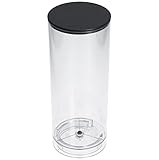
Replacement listings such as a 0.7-liter Paxanpax tank for the Krups Nespresso Inissia, an Essenza Mini reservoir, or a tank and lid for the Vertuo Next illustrate why exact compatibility is essential. Treat “suitable for” as a starting point, then verify the model number and images against your original part.
4. Prioritize Comfort and Performance
A large tank is not automatically more convenient. Water weighs approximately 2.2 pounds per liter, so a 1.5-liter tank can weigh more than 3.5 pounds once the plastic reservoir is included. If you refill at a sink several feet away, a smaller tank with a wide opening may be easier to carry and clean.
Measure the tank’s practical dimensions, not just its stated capacity. A compact reservoir may be approximately 7 to 9 inches tall, 4 to 6 inches wide, and 3 to 5 inches deep. Larger models can exceed 10 inches in height or depth. Leave at least 1 inch of handling space around a side-mounted tank, and check that a rear reservoir can be removed without moving the machine.
For performance, look for a valve that does not drip when the tank is removed, a lid that closes fully, and visible minimum and maximum fill lines. Avoid filling beyond the marked maximum. Overfilling can cause spills, and it does not increase usable capacity.
5. Compare Price Tiers Realistically
Replacement tank pricing generally falls into three practical ranges:
- Budget: $15 to $25: Basic plastic tanks, often without sophisticated packaging or extra accessories. Suitable when the fit is well documented.
- Midrange: $26 to $45: Often includes a lid, improved molding, or a better-known replacement-parts brand. This is a sensible range for many compact machines.
- Premium or original-equipment: $45 to $80 or more: More likely to come directly from the manufacturer or an established parts supplier. The higher price can be worthwhile for uncommon models or critical sensor components.
Examples in the lower-cost market include a $19.99 Inissia tank, a $25.99 Vertuo Next tank and lid, a $29.99 Essenza Mini reservoir, and an $18.69 Krups Vertuo Plus replacement. These prices show that capacity is not a reliable predictor of cost. A smaller tank can cost more if its valve, lid, or sensor design is harder to reproduce.
6. Check Warranty and Return Protection
A replacement tank should have a clear return policy, particularly when compatibility is uncertain. Look for at least 30 days for returns, and preferably 90 days or a stated six- to 12-month replacement warranty. The policy should cover cracks, leaks, warped lids, and defective valves—not only shipping damage.
Before installing it, inspect the tank under bright light. Check the seam, handle, hinge, and outlet. Fill it with cold water over a sink and leave it undisturbed for 10 to 15 minutes. This is not a performance test, but it can reveal an obvious leak before water reaches the machine. Keep the packaging until the tank has been installed and checked.
7. Factor in Delivery and Assembly
Many replacement reservoirs require no tools, but some include a separate lid, silicone seal, float, or valve component. Confirm whether the listing shows the complete part or only the tank body. Assembly should normally involve transferring a lid or inserting a supplied component—not modifying the plastic, drilling holes, or forcing a valve into place.
For delivery, check the estimated arrival date and packaging quality. A tank with a protruding valve can crack if shipped loosely. If the product arrives bent, cloudy from stress, or with a loose fitting, photograph it before installation and request a replacement.
Spec Checklist
| Spec | Budget | Mid | Premium |
|---|---|---|---|
| Capacity | 0.6–0.8 L | 0.9–1.2 L | 1.3–2.0+ L |
| Typical price | $15–$25 | $26–$45 | $45–$80+ |
| Approximate full water weight | 1.3–1.8 lb | 2.0–2.6 lb | 2.9–4.4+ lb |
| Likely daily use | 1–3 drinks | 3–6 drinks | 6+ drinks or office use |
| Common material | Food-safe plastic | Rigid food-safe plastic | Thicker plastic or original-equipment plastic |
| Useful warranty target | 30 days | 90 days to 6 months | 6–12 months |
Red Flags
- The listing gives a capacity but no compatible model numbers.
- Product photos show a different lid, valve, or tank orientation than your original.
- There is no information about returns, leaks, cracks, or defective parts.
- The description says “universal” without providing dimensions and connection details.
- The tank has no visible fill markings or appears cloudy, warped, or poorly molded.
- The price is unusually low but excludes the lid, valve, or sensor shown in the main image.
- The replacement requires cutting, drilling, heating, or forcing the tank into position.
FAQ
How large should an espresso machine water tank be for two people?
A 0.9- to 1.2-liter tank is a practical target for two people making several drinks daily. If you mainly pull short espressos and do not mind refilling, 0.7 liter may be enough. Choose closer to 1.2 liters if you make americanos or use automatic rinse cycles frequently.
Can I use a larger replacement tank than the original?
Usually not unless the manufacturer specifically approves it. The machine’s mounting points, lid clearance, water valve, and sensor are designed around a particular reservoir. A larger tank may physically fit but still fail to trigger the pump or water-level detection.
How often should I clean a removable water tank?
Rinse it daily or whenever water has been sitting for more than 24 hours. Wash it with mild dish soap about once a week, rinse thoroughly, and descale according to the machine’s instructions. Do not put a plastic tank in a dishwasher unless the manufacturer says it is dishwasher-safe.
Is a replacement tank with a lid worth paying more for?
Yes, when your original lid is cracked, loose, or no longer seals. A separate lid can also prevent dust from entering the reservoir. Compare the combined cost with a complete tank-and-lid assembly, and verify that the hinge and latch match your exact model before ordering.
Ready to decide? Our #1 pick for 2026 is the Capacity.
Live price & availability on Amazon.