Last updated: September 24, 2026
The price of a home espresso setup is almost never just the machine. Newcomers budget $500 for a machine and then discover they need a grinder, a scale, a tamper, a milk pitcher and a water plan, plus ongoing costs for beans, milk and cleaning supplies. This guide breaks down realistic totals at four common budget levels, lists the accessories people forget, and estimates yearly running costs so you can plan the real number before you buy anything.
Quick answer: Our top pick in 2026 is the Starter — our #1 rated choice. See the full ranked comparison, alternatives and buying advice below.
The three big pieces
Machine
Entry-level semi-automatic machines range from roughly $150 to $500. Mid-range single boiler and heat exchanger machines usually cost $600 to $1,600. Dual boiler and high-end machines typically run $1,800 to $4,500 or more. Bean-to-cup machines span about $500 to $2,500.
Grinder
A grinder capable of espresso matters as much as the machine. Hand grinders suited to espresso cost about $80 to $250; entry electric espresso grinders about $150 to $300; mid-range single-dose and stepless grinders about $350 to $900; high-end grinders $1,000 and up. All-in-one machines with built-in grinders fold this cost into the machine price.
Accessories
Budget $80 to $250 for the essentials: a 0.1 g scale, a properly sized tamper, a milk pitcher, a knock box, a WDT tool and cleaning supplies.
Four realistic setup budgets
Starter: about $400 to $700
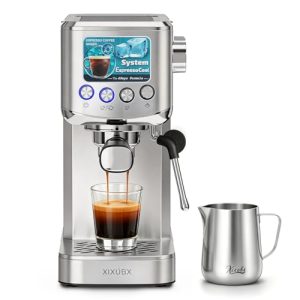
A compact semi-automatic like the Breville Bambino or a Gaggia Classic Pro, paired with a capable hand grinder or entry electric grinder, plus basic accessories. Makes genuinely good espresso with some effort.
All-in-one: about $700 to $1,000
A machine with a built-in grinder such as the Breville Barista Express Impress, plus a scale and pitcher. Convenient and space-saving, with a known upgrade ceiling.
Enthusiast: about $1,500 to $2,800
A heat exchanger or entry dual boiler machine plus a quality single-dose grinder. This is where milk steaming and temperature stability become excellent.
High-end: $3,500 and up
Premium dual boiler or flow-control machines and high-end grinders. The gains from here are real but smaller per dollar.
| Budget tier | Machine | Grinder | Accessories | Water/filtration | Typical total |
|---|---|---|---|---|---|
| Starter | $150–$450 | $100–$250 | $60–$120 | $0–$40 | $400–$700 |
| All-in-one | $600–$900 (grinder built in) | Included | $60–$120 | $0–$40 | $700–$1,000 |
| Enthusiast | $1,000–$2,000 | $400–$800 | $100–$200 | $30–$100 | $1,500–$2,800 |
| High-end | $2,500–$5,000+ | $900–$2,000+ | $150–$300 | $50–$200 | $3,500–$7,000+ |
| Bean-to-cup | $500–$2,500 | Built in | $20–$60 | $0–$60 | $550–$2,600 |
Costs people forget
Water treatment is the most overlooked. Hard water scales boilers and shortens machine life. Depending on your tap water, you might use filter pitchers, in-tank filters, or mineral recipes with distilled water, costing $20 to $100 a year. Replacement parts such as group gaskets and shower screens cost $10 to $40 every year or two on a boiler machine. Many people also end up buying a bottomless portafilter, precision basket or better tamper within the first few months, so leave $50 to $150 of wiggle room.
Yearly running costs
Beans
At 18 g per double shot and two drinks a day, you use about 13 kg of beans a year. Specialty beans often cost $15 to $25 per 340 g bag, which works out to roughly $570 to $950 a year. Supermarket whole-bean espresso can cut that roughly in half.
Milk
Two 200 ml milk drinks a day uses about 146 litres a year. Dairy milk runs roughly $150 to $250 a year; barista oat milks cost more, often $300 to $500.
Cleaning and maintenance
Detergent, descaler and cloths typically total $30 to $80 a year. Bean-to-cup machines may need additional cleaning tablets and milk cleaner.
How to spend wisely
Put more of the budget into the grinder than you think; a mid-range grinder with a modest machine usually beats an expensive machine with a poor grinder. Buy the machine that suits your drinks: milk lovers benefit from strong steam power, straight espresso drinkers from temperature stability. Check the used market for well-maintained machines, which can save 30 to 50 percent.
FAQ
What is the minimum cost for a decent home espresso setup?
Around $400 to $500 gets a capable entry machine, an espresso-capable hand grinder and basic accessories. Below that, results tend to depend heavily on pressurised baskets and pre-ground coffee.
Is it better to spend more on the machine or the grinder?
For most people, the grinder. Shot quality and consistency are limited by grind quality, and a good grinder carries over when you upgrade the machine later.
Bottom line
A capable home espresso setup costs roughly $400 to $700 at entry level, $700 to $1,000 for an all-in-one, and $1,500 to $2,800 for an enthusiast setup, before beans and milk. Expect roughly $800 to $1,500 a year in running costs for two milk drinks a day. Plan for the grinder, accessories and water from day one, and the setup will cost what you expected instead of creeping upwards.
Ready to decide? Our #1 pick for 2026 is the Starter.
Live price & availability on Amazon.