Last updated: September 18, 2026
Shopping for a milk frother can look deceptively simple: choose a color, compare a few star ratings, and pick the lowest price. The more important decision is usually hidden in the specifications. Wattage affects heating speed, foam volume, batch size, and the frother’s ability to handle thicker drinks—but it is not a quality score by itself.
One common mistake is assuming that the highest wattage always produces the best foam. Another is comparing a battery-operated whisk with an automatic countertop frother as if they perform the same job. A handheld model may use only a few watts while an automatic steamer uses 400 to 600 watts, yet each can be the right choice for a different routine.
As an Amazon Associate we earn from qualifying purchases at no extra cost to you. Product prices and availability are accurate as of the date shown and are subject to change.


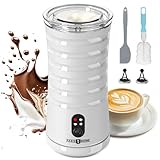

This guide explains what to look for in milk frother wattage, along with the practical details that determine whether the appliance is convenient to own. The goal is not to chase the biggest number, but to match wattage with capacity, controls, materials, cleaning needs, and price.
- Decide These 3 Things First
- Size: Match Capacity to Your Drink Routine
- Material: Prioritize the Surfaces That Touch Milk
- Construction: Wattage Works Only When the Design Supports It
- Comfort and Performance: Consider Noise, Controls, and Texture
- Price Tiers: Buy the Wattage You Will Actually Use
- Warranty: Protect the Motor and Heating System
- Delivery and Assembly: Check What Arrives in the Box
- Spec Checklist
- Red Flags
- FAQ
Decide These 3 Things First
- Do you need heating or only foaming? A handheld whisk aerates cold or warm milk but generally does not heat it. An automatic frother can heat, stir, and foam in one container.
- How much milk will you prepare? A single latte may need 6 to 8 ounces of milk, while two drinks can require 12 to 16 ounces. Capacity determines whether a compact appliance is sufficient.
- How often will you use it? Occasional users may prefer an $8 to $15 handheld whisk. Daily users are more likely to appreciate an automatic model priced around $35 to $70.
Size: Match Capacity to Your Drink Routine
See also: How to Froth Oat Milk with Steam Wand (2026): Step-by-Step • What Size Milk Pitcher for Two Lattes? Size Guide With Measurements (2026)
Milk frothers often list separate maximum capacities for heating and frothing. Foam expands, so the maximum frothing volume is usually lower. For example, a unit may warm approximately 10 to 14 ounces but foam only 4 to 8 ounces at a time.
For one drink, look for at least 6 ounces of heating capacity and 3 to 4 ounces of frothing capacity. For two cappuccinos, a more useful target is 10 to 14 ounces for heating and 6 to 8 ounces for foaming. If you regularly make several drinks, a larger 16- to 20-ounce heating capacity can reduce repeat cycles, although the appliance will take up more counter space.
Measure the available area before buying. Compact automatic models are commonly about 4.5 to 6 inches wide and 6 to 9 inches tall, not including the lid. Handheld whisks are much easier to store, often measuring roughly 8 to 10 inches long, but they require a separate mug or saucepan.
Material: Prioritize the Surfaces That Touch Milk
For an automatic frother, a stainless-steel interior is generally easier to clean and more resistant to staining than exposed plastic. Look for a smooth, nonporous interior with minimal seams around the base. A nonstick coating can also simplify cleanup, but it needs gentler utensils and a soft sponge to prevent scratching.
The exterior may be plastic, stainless steel, or a combination of both. Plastic keeps weight and cost down; metal can feel sturdier and resist heat better. Neither exterior material guarantees better foam. More important details include whether the interior is smooth, whether the whisk is removable, and whether the base or electrical connector can be kept dry.
For handheld models, stainless steel is a sensible choice for the whisk shaft and coil. Check that the shaft is firmly attached and that the handle has a sealed battery compartment. A removable whisk head is convenient, but it should lock securely without wobbling.
Construction: Wattage Works Only When the Design Supports It
Wattage indicates how much electrical power the appliance can draw, not how efficiently it turns that power into heat or foam. A 500-watt automatic frother may heat milk faster than a 300-watt model, but insulation, thermostat control, whisk shape, and batch size also matter.
For automatic frothers, approximately 300 to 500 watts is a practical range for everyday drinks. Models around 400 to 500 watts commonly offer enough power for heating and stirring modest batches without demanding a large footprint. Higher wattage can be useful for larger capacities or faster heating, but it may also increase noise, energy use, and the risk of overheating if temperature control is poor.
Handheld frothers are a different category. Their small motors may be rated around 1 to 5 watts, or the packaging may list battery voltage rather than wattage. Do not compare a 3-watt whisk directly with a 500-watt automatic machine. The handheld device is only spinning a small coil; it is not heating the milk.
Look for a stable base, a lid that fits securely, and a whisk mechanism that does not scrape the container. A detachable jug is helpful for pouring and washing. Controls should clearly distinguish settings such as hot foam, cold foam, heating, or stirring.
Comfort and Performance: Consider Noise, Controls, and Texture
Power matters most when it produces the texture you want without making the routine frustrating. A handheld whisk should have a comfortable grip, a one-button control, and enough speed to create foam in roughly 30 to 90 seconds, depending on milk type and starting temperature. It should not require excessive pressure against the bottom of the cup.
For an automatic unit, useful performance features include automatic shutoff, temperature sensing, and a low-speed stirring mode for warm milk. A practical temperature range for heated milk is approximately 140°F to 160°F, although preferred serving temperature varies. Extremely hot milk can taste flat and makes foam less pleasant, so more wattage is not a reason to skip temperature control.
Noise ratings are not consistently reported, so avoid treating a manufacturer’s silence as proof that a model is quiet. Instead, look for reviews that describe the motor and alert sounds. If your kitchen has limited counter space, illuminated buttons and a clear cycle indicator may be more valuable than an extra mode.
Price Tiers: Buy the Wattage You Will Actually Use
At the budget level, roughly $8 to $20, most choices are handheld battery-operated whisks. The SIMPLETASTE Handheld Electric Foam Maker, for example, is listed around $8.99. These are inexpensive and compact, but you must heat the milk separately and may need to replace batteries.
The $30 to $50 range is the main value tier for automatic frothers. Four-in-one models from SIMPLETASTE and Paris Rhône are commonly listed around $38 to $40, including examples priced at $38.97, $39.97, and $39.98. In this range, look for approximately 400 to 500 watts, several drink modes, a removable whisk, and a heating capacity suitable for one or two servings.
Premium models often cost $60 to $120 or more. The additional price may provide quieter operation, stronger temperature control, better insulation, larger capacity, or more durable finishes. Do not pay extra solely for a 600-watt rating. If the premium model has the same capacity and controls as a $40 competitor, the higher wattage may not deliver a noticeable advantage.
Warranty: Protect the Motor and Heating System
A basic handheld whisk should ideally include at least a 90-day return window and a one-year limited warranty. For an automatic frother, a one-year warranty is a reasonable minimum because the motor, heating element, temperature sensor, and control board all add potential failure points.
Read what the warranty excludes. Damage from immersion, scale buildup, overheating, or use outside the stated capacity may not be covered. Keep the receipt, register the product when required, and confirm whether the manufacturer or retailer handles replacement claims. A longer two-year warranty is useful, but only if the terms are clear and the company provides a practical service process.
Delivery and Assembly: Check What Arrives in the Box
Most milk frothers require little assembly, but the box should include every removable part needed to use the advertised modes. Confirm that it includes the whisk, lid, power base or batteries, and any alternate attachments. A missing whisk or specialized coil can make a new appliance unusable.
For countertop models, check the shipping dimensions and final weight. A typical automatic unit may weigh about 2 to 4 pounds and need at least 6 inches of vertical clearance so the lid can be removed. If it has a detachable jug, verify that the handle will clear nearby cabinets and that the jug can be lifted without moving the base.
Inspect the appliance promptly after delivery. Look for dents, a cracked lid, loose attachments, or damage to the power cord. Do not operate a unit with a wet electrical base or a damaged cord.
Spec Checklist
| Spec | Budget | Mid | Premium |
|---|---|---|---|
| Typical price | $8-$20 | $30-$60 | $60-$120+ |
| Format | Handheld whisk | Automatic countertop frother | Automatic countertop frother |
| Wattage | About 1-5 watts, or battery voltage listed | About 300-500 watts | About 400-700 watts |
| Heating | No | Yes | Yes, often with tighter controls |
| Foaming capacity | Use a separate cup; commonly 6-12 ounces | About 3-8 ounces | About 6-12 ounces |
| Heating capacity | Use a separate saucepan or microwave-safe cup | About 8-14 ounces | About 12-20 ounces |
| Best for | Occasional foam and small kitchens | Daily one- or two-drink routines | Frequent use and larger households |
Red Flags
- Wattage without capacity information: A large number means little if the manufacturer does not state how much milk the unit can heat or foam.
- No separate heating and frothing limits: Treat one undifferentiated capacity number with caution because foam expansion can cause overflow.
- Unclear cleaning instructions: Avoid models that do not explain whether the jug, whisk, or lid can be removed and washed safely.
- Exposed electrical connections: The base and connector should be designed to stay dry.
- Thin or loose attachments: A whisk that rattles, bends, or detaches during use may wear out quickly.
- Too many claims and too few specifications: “Professional,” “powerful,” and “barista” language does not replace wattage, capacity, temperature, and warranty details.
- No overheat protection or auto-shutoff: These are particularly important for automatic heating appliances.
FAQ
What wattage is best for a milk frother?
For an automatic frother, 300 to 500 watts is a practical target for most households. Choose closer to 400 to 500 watts when you want faster heating or routinely prepare two drinks. For a handheld whisk, wattage is much lower—often about 1 to 5 watts—and heating ability is not part of the design.
Does higher wattage make better milk foam?
Not necessarily. Higher wattage can support faster heating and stronger stirring, but foam quality also depends on the whisk, milk volume, temperature control, and milk type. A well-designed 400-watt appliance can be more useful than a poorly controlled 600-watt model.
Is a handheld or automatic frother better?
A handheld model is better for shoppers who want the lowest cost, smallest storage footprint, and control over the heating process. An automatic model is better if you want one appliance to heat and foam milk with minimal supervision. The choice is about workflow, not simply motor power.
How much should I spend on a milk frother in 2026?
Plan on $8 to $20 for a basic handheld whisk, $30 to $60 for a capable automatic model, and $60 to $120 or more for premium construction and controls. For most daily coffee drinkers, the $35 to $50 range offers the best balance of wattage, capacity, convenience, and replacement cost.
Ready to decide? Our #1 pick for 2026 is the Typical price.
Live price & availability on Amazon.