Last updated: October 2, 2026
What “On Demand” Actually Means
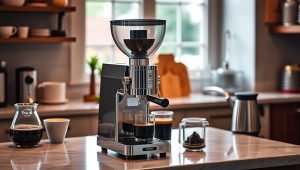
An on-demand grinder doses coffee directly into your portafilter only when you press the button. There’s no dosing chamber full of grounds sitting around going stale, like on old-school doser grinders. You put beans in the hopper, the grinder weighs or times out a dose, and fresh grounds land in the basket seconds before you pull the shot.
The practical benefit is freshness: grounds start losing aromatics within minutes, so grinding per-shot matters more than most accessories people obsess over. The trade-off is workflow. On-demand grinding adds 5-15 seconds per shot, which is fine at home and annoying if you’re pulling four back-to-back drinks for guests.
Two sub-types exist within the category, and knowing the difference saves you money:
- Timed dosing: the grinder runs for a set number of seconds. Cheap and common, but dose drifts as beans age, the hopper empties, or humidity changes. Expect to re-dial.
- Gravimetric (grind-by-weight): a built-in scale stops the motor at a target weight. More consistent, more expensive, and the feature that actually eliminates the scale-and-funnel ritual.
Single-Dose vs. Hopper-Fed On-Demand
See also: Best Espresso Grinders for Home: Burr Size, Workflow and Budget Matched • Breville Smart Grinder Espresso
This is the fork in the road most buyers actually face, and it’s worth being blunt about it.
A hopper-fed on-demand grinder holds a pound or more of beans and grinds a programmed dose on command. It suits people who drink the same coffee for weeks, make milk drinks daily, and don’t want to weigh beans every morning. The downside is retention and staleness: grounds sit in the chamber between shots, and the beans at the bottom of the hopper have been sitting there exposed to air. Purging a gram or two before your first shot of the day mostly solves this.
A single-dose grinder has no hopper — you weigh 18g of beans, drop them in, and grind through. Retention is near zero with a bellows or a few taps, so what goes in comes out. This is the right choice if you switch coffees often, drink light roasts where grind precision matters, or make only a couple of drinks a day. The downside is the ritual itself: weighing, loading, sometimes spritzing beans to kill static. If that sounds tedious rather than satisfying, buy the hopper-fed machine and don’t let forum culture talk you out of it.
What Actually Matters When Buying
Burr size and type. Flat burrs around 64mm are the enthusiast default — good clarity, widely available aftermarket burr sets. Conical burrs run cheaper and produce a more traditional, blended espresso flavor. Neither is objectively better. Below 40mm conical burrs in budget grinders, you’re mostly paying for convenience, not cup quality.
Adjustment mechanism. Stepless adjustment matters for espresso. Stepped grinders force you to pick between “too fast” and “too slow” more often than you’d think. If a grinder has steps, they need to be very fine or paired with a micro-adjust collar.
Retention. Anything under about 1 gram of retained grounds is fine in daily use because yesterday’s residue gets pushed out by today’s first purge. Chasing 0.0g is marketing.
Dosing accuracy. Timed dosing typically lands within ±0.5-1g, which is enough to move your shot. Gravimetric holds closer to ±0.1-0.2g. If you’re buying a grind-by-weight espresso grinder, check whether the scale works with your portafilter size and dosing cup — some units only weigh into their own cup.
How the Options Stack Up
| Type | Typical price | Dose consistency | Best for | Weakness |
|---|---|---|---|---|
| Hopper-fed, timed dose | $150-500 | ±0.5-1g, drifts | Daily milk drinks, same beans for weeks | Stale grounds in chamber; re-dialing |
| Hopper-fed, grind-by-weight | $400-900 | ±0.1-0.2g | High-volume homes, convenience-first buyers | Cost; more electronics to fail |
| Single-dose flat burr | $300-1,000+ | Weighed manually, exact | Bean switchers, light roasts, straight shots | Slower workflow; static without RDT |
| Single-dose conical (budget) | $150-300 | Weighed manually | First serious grinder on a budget | Coarser stepped adjustment; lower burr quality |
Who Should Buy What
The two-lattes-a-day household: a hopper-fed timed grinder is fine. This is where I’m honest about the cheaper option — if you’re drinking milk drinks with medium roast, dose drift of half a gram gets buried. Spend the savings on better beans. Look at on-demand espresso grinders in the mid-range and prioritize burr quality and serviceable parts over screen size.
The straight-shot drinker who tries new roasters: single-dose, flat burr, no exceptions. Timed dosing makes no sense when you’re weighing beans anyway, and low retention means yesterday’s natural-process Ethiopian doesn’t ghost into today’s washed Colombian.
The mixed household: one person wants convenience, one wants to play. Gravimetric hopper-fed machines are the compromise that actually works — consistent enough for the enthusiast, one-button simple for everyone else.
Tight budget: a manual hand grinder or a budget single-dose electric beats a cheap hopper-fed grinder with a doser-style timer. Burr quality is the thing you’re buying; features are not.
Common Failure Modes to Plan For
On-demand grinders fail in predictable ways. Chute clogs happen with oily dark roasts — a brush-out every week prevents it. Timer drift is normal, not a defect; recalibrate when you open a new bag. Gravimetric scales can be thrown off by vibration from other appliances on the same counter. And cheap grinders with plastic grind-path internals develop static and channeling issues that no amount of tapping fixes — if a machine has a reputation for spraying grounds everywhere, believe it.
One more thing: whatever you buy, pair it with a basic 0.1g espresso scale for the first few weeks. Verify what the grinder actually delivers before trusting the display.
FAQ
Do I need an on-demand grinder, or is a doser grinder fine?
If you pull several shots in a row, a doser is genuinely fine and often faster. For one or two drinks at a time, on-demand keeps grounds fresher and is the better buy.
Is grind-by-weight worth the extra money?
Only if consistency and convenience both matter to you. If you already weigh every dose manually, you’re paying for a feature that replaces a habit you don’t mind keeping.
Can I use an on-demand espresso grinder for drip or French press?
Most dedicated espresso grinders either can’t go coarse enough or lose their espresso calibration when you swing the adjustment. If you brew multiple methods, either buy a grinder designed for the range or keep a separate brew grinder.
How often do I need to clean it?
Brush the chute and burr area weekly, deep-clean the burrs every month or two — sooner if you run oily beans. Retained stale grounds are the main downside of the format, and cleaning is how you control it.