Last updated: September 18, 2026
Quick answer: Our top pick in 2026 is the Manual espresso maker with pre-ground coffee — our #1 rated choice. See the full ranked comparison, alternatives and buying advice below.
The Short Answer
Yes—an espresso machine with a built-in grinder is worth it if you make espresso at least several times a week and want fresh grounds without buying two separate appliances. It is not the best choice if you value maximum simplicity, switch between coffee styles often, or do not want to learn basic dialing-in and cleaning.
The appeal is easy to understand: one machine grinds whole beans, doses them into a portafilter, brews espresso, and usually steams milk. That can save counter space and make better coffee than a basic pod machine. The trade-off is that combination machines put more parts in one housing, so they require more adjustment and maintenance than a simple drip brewer or capsule system.
As an Amazon Associate we earn from qualifying purchases at no extra cost to you. Product prices and availability are accurate as of the date shown and are subject to change.


What You Actually Get
See also: How to Replace Espresso Machine Water Filter (2026): Step-by-Step • How to Adjust Espresso Machine Brew Temperature (2026): Step-by-Step
A built-in grinder espresso machine combines three jobs: grinding coffee, brewing under pressure, and, on most models, producing steam for milk. You typically adjust the grind size, dose, and brew volume. Some machines also let you control water temperature, pre-infusion, and milk-steaming power.
In practical terms, you get a compact home coffee station rather than a fully automatic appliance. You still need to place the portafilter under the grinder, distribute the grounds, tamp them evenly, lock it into the group head, and start the shot. That workflow takes more effort than pressing a button, but it also gives you more control over flavor and texture.
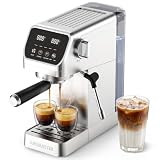
Expect to spend roughly $200 to $800 for a consumer machine with an integrated grinder. Entry-level models, such as the AMZCHEF Espresso Machine With Grinder listed at $199.98, often include multiple grind settings and basic temperature controls. Higher-priced machines, such as the Breville BES870XL Barista Express listed at $689.99, generally offer more substantial controls, a sturdier feel, and a more established repair and accessory ecosystem.
Allow approximately 12 to 16 inches of counter width and 16 to 20 inches of depth for many machines, plus clearance above or beside the unit for filling the bean hopper and water tank. Exact dimensions vary, so measure your counter before buying. You will also need a knock box or another place to discard used coffee pucks, a small scale if you want consistent results, and cleaning supplies.
Pros
- Freshly ground coffee: Grinding immediately before brewing preserves more aroma than using pre-ground coffee that has been open for days or weeks.
- One-appliance convenience: The grinder and espresso maker share a footprint, which is useful in smaller kitchens.
- Better control than pods: You can change the grind, coffee dose, extraction time, and milk quantity instead of being locked into a capsule’s recipe.
- Lower long-term coffee costs: Whole beans usually cost less per serving than branded capsules, especially for households making two or more drinks daily.
- More drink flexibility: The same machine can make espresso, americanos, cappuccinos, lattes, and smaller coffee drinks.
- Less equipment clutter: You do not need to buy a separate grinder, although a standalone grinder may eventually provide better adjustment and consistency.
- Good learning platform: A combination machine can teach you the fundamentals of espresso without requiring a professional setup.
Cons
- A learning curve: Changing beans or humidity can alter the ideal grind setting. You may need several attempts to produce a balanced shot.
- Regular cleaning: You must rinse the group head, empty the drip tray, clean the portafilter, purge the steam wand, and periodically descale the machine.
- More potential failure points: If the grinder, pump, electronics, or heating system develops a problem, the entire appliance may be unavailable.
- Compromised grinder performance: Built-in grinders are convenient, but some do not offer the consistency or fine adjustment of a good standalone burr grinder.
- Countertop height and depth: These machines can be bulky, particularly when you need room to open a top-loading hopper or remove a water reservoir.
- Noise and mess: Grinding is loud, and espresso preparation creates loose grounds, drips, and occasional splashes.
- Milk steaming takes practice: A steam wand can produce café-style foam, but it will not do the work automatically. Beginners may create large bubbles or overheat the milk.
- Limited upgrade path: When the grinder and brewer are permanently paired, replacing one component later is less straightforward.
Who Should Buy It
Buy an espresso machine with a grinder if you drink espresso-based beverages three or more times per week, have room for a dedicated coffee station, and enjoy a hands-on routine. It is particularly practical for couples or families who make several drinks each morning. The integrated grinder can also be a sensible first step for someone who wants café-style coffee without immediately investing in separate equipment.
It is a good match for buyers who care about freshly ground beans but do not want to choose a grinder, portafilter, tamper, and espresso machine individually. A model in the $200 to $350 range can provide an inexpensive introduction, while a machine around $600 to $800 may be more appealing to regular users who want stronger materials and a more refined workflow.
Who Should Skip It
Skip this format if you want coffee with virtually no cleanup. A pod machine or superautomatic espresso maker will be easier for many people, even if it provides less control. You should also consider separate appliances if you are serious about espresso quality and expect to upgrade over time. A standalone grinder gives you more flexibility, and a separate espresso machine can be replaced or repaired independently.
It may not make financial sense for occasional drinkers. If you prepare espresso only once or twice a month, the machine can spend most of its time occupying valuable counter space. A compact manual brewer, moka pot, or coffee shop visit may be more practical. Finally, skip a built-in grinder if you drink mostly drip coffee; a quality drip machine and burr grinder will better suit that routine.
Cheaper Alternatives
| Option | Cost | Trade-off |
|---|---|---|
| Manual espresso maker with pre-ground coffee | $50–$150 | Lowest entry cost, but requires more hand pressure and does not grind beans. |
| Entry-level espresso machine plus basic burr grinder | $250–$450 | Can offer better grinder flexibility, but uses more counter space and two power appliances. |
| Moka pot plus electric burr grinder | $80–$220 | Produces strong, concentrated coffee rather than true espresso with café-style crema. |
| Pod espresso machine | $80–$250 | Fast and simple, but capsules cost more over time and create more packaging waste. |
| French press or pour-over setup | $30–$150 | Excellent for regular coffee, but it cannot produce espresso-based milk drinks. |
FAQ
Is an espresso machine with a grinder better than buying them separately?
Not automatically. A combination machine is usually better for convenience and space, while separate equipment often wins for repairability, upgrade options, and grinder performance. If you are new to espresso, an integrated model simplifies the buying process. If you already know you are particular about grind consistency, separate appliances may be the better long-term choice.
How much should I spend on an espresso machine with a grinder?
Plan on about $200 to $350 for an entry-level machine and roughly $500 to $800 for a more established midrange model. Spending more does not guarantee better coffee; fresh beans, correct grind size, water quality, and technique matter greatly. A $199.98 machine can be reasonable for occasional drinks, while a $689.99 machine may be easier to live with for daily use.
How difficult is maintenance?
Routine maintenance is manageable but cannot be ignored. Rinse the portafilter and group head after brewing, wipe and purge the steam wand immediately after steaming, empty standing water and coffee grounds, and follow the manual’s schedule for descaling and grinder cleaning. These tasks take a few minutes each day, with deeper cleaning required less often.
Can it make regular coffee?
It can make an americano by adding hot water to espresso, but that is not identical to drip coffee. Some machines include a dedicated coffee setting, while others are designed almost entirely around espresso. If your household primarily drinks large mugs, verify the machine’s water capacity and beverage options before buying. An espresso machine with a grinder is most worthwhile when espresso, americanos, lattes, or cappuccinos are part of your normal routine.
Ready to decide? Our #1 pick for 2026 is the Manual espresso maker with pre-ground coffee.
Live price & availability on Amazon.