- Top Pick: Spacekey Espresso Machine with Milk Frother, 20 Bar Compact Expresso Coffee Machines for Home, Stainless Steel Espresso Maker with 39oz Removable Water Tank for Cappuccino Latte, Fast Heating, Silver
- Best Value: Aromaster 1400W Espresso Machine with Milk Frother, Stainless Steel
- Premium Choice: AYCHIRO 20 Bar Espresso Machine with Pressure Gauge, Compact Semi-Automatic Espresso Maker with Steam Wand, 1350W Fast Heating Coffee Machine with Removable 37oz Water Tank for Home Office
Last updated: September 18, 2026
The Short Answer
Plan on at least 24 inches wide by 20 inches deep (61 by 51 cm) for a compact espresso machine setup. That footprint allows room for the machine itself, a cup, and basic access to the water tank and portafilter. For a more comfortable arrangement with a grinder, knock box, tamper, and milk pitcher, reserve 36 inches wide by 24 inches deep (91 by 61 cm).
Most home espresso machines measure about 8 to 12 inches wide, 12 to 16 inches deep, and 11 to 16 inches tall (20 to 30 by 30 to 41 by 28 to 41 cm). However, the machine’s footprint is only part of the answer. You also need clearance above the machine if its water tank lifts out, space in front for the portafilter and cup, and room beside it for milk steaming or grinding.
As an Amazon Associate we earn from qualifying purchases at no extra cost to you. Product prices and availability are accurate as of the date shown and are subject to change.

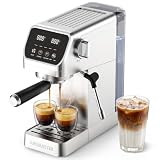
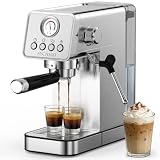

For a small machine priced in the roughly $70 to $140 range, a practical minimum is a counter area measuring 20 inches wide by 18 inches deep (51 by 46 cm). That is workable for occasional use, but it can feel crowded if the machine has a steam wand or a top-loading water reservoir.
Standard Sizes
See also: How to Replace Espresso Machine Water Filter (2026): Step-by-Step • How to Adjust Espresso Machine Brew Temperature (2026): Step-by-Step
The following table shows common home espresso machine footprints and the counter area each type usually needs. Dimensions are listed as width by depth by height. Always compare these measurements with the manufacturer’s specifications before buying, because removable tanks, handles, and steam wands can change the usable space.
| Machine type | Typical machine dimensions | Dimensions in centimeters | Recommended counter area | Best for |
|---|---|---|---|---|
| Ultra-compact semi-automatic | 8–9 W × 11–13 D × 11–13 H in | 20–23 W × 28–33 D × 28–33 H cm | 20 W × 18 D in (51 × 46 cm) | Small kitchens, apartments, occasional coffee |
| Standard compact semi-automatic | 9–11 W × 12–14 D × 12–15 H in | 23–28 W × 30–36 D × 30–38 H cm | 24 W × 20 D in (61 × 51 cm) | Daily espresso, cappuccinos, and lattes |
| Compact machine with larger tank | 10–12 W × 14–16 D × 13–16 H in | 25–30 W × 36–41 D × 33–41 H cm | 28 W × 22 D in (71 × 56 cm) | Frequent use and multiple drinks |
| Machine plus separate grinder | 18–24 W × 16–20 D × 14–17 H in | 46–61 W × 41–51 D × 36–43 H cm | 36 W × 24 D in (91 × 61 cm) | Freshly ground espresso and full setups |
| Dual-boiler or prosumer machine | 12–16 W × 18–24 D × 15–18 H in | 30–41 W × 46–61 D × 38–46 H cm | 40 W × 28 D in (102 × 71 cm) | Experienced users and entertaining |
Compact products such as Spacekey, Aromaster, AYCHIRO, and CASABREWS models generally belong in the compact or ultra-compact category. Their water tanks commonly hold about 37 to 39 ounces (1.1 to 1.15 liters), while power ratings often fall between 1,350 and 1,400 watts. Those specifications are convenient for home use, but the tank still needs enough vertical clearance to remove and refill it.
Do not use the machine’s advertised width as your entire counter requirement. A machine that is 9 inches wide may need another 3 to 5 inches on one side for the steam wand to swing, or additional room beside it for a milk pitcher. Leave at least 2 inches (5 cm) of open space on each side for ventilation and easier cleaning, unless the manual specifies otherwise.
How to Measure Your Space
- Measure the usable width. Measure between walls, cabinets, appliances, and backsplash obstructions. Subtract at least 2 inches from the total width so the machine does not sit tightly against neighboring objects.
- Measure the usable depth. Measure from the front edge of the counter to the backsplash. A machine listed as 14 inches deep may need 16 to 18 inches once you account for the power cord, rear water tank, and front cup clearance.
- Check the vertical clearance. Measure from the counter to the underside of the cabinet above it. Add the machine’s height and the clearance needed to remove its reservoir. A 13-inch-tall machine may need 18 to 20 inches of open space if the tank lifts straight up.
- Mark the service zone. Use painter’s tape to outline the machine footprint. Mark another 6 to 10 inches in front for cups, the portafilter handle, and the drip tray. This reveals whether the machine will interfere with a walkway or cabinet door.
- Plan for the water tank. Rear tanks need space behind the machine or enough room to pull the machine forward. If the tank is accessed from the top, prioritize overhead clearance. If it slides out from the front, leave the counter edge unobstructed.
- Locate the outlet. A 1,350- to 1,400-watt machine should plug directly into an appropriate wall outlet rather than an overloaded power strip. Make sure the cord can reach without crossing the sink or stove.
- Account for accessories. Add about 8 to 12 inches (20 to 30 cm) for a grinder, 6 inches (15 cm) for a knock box, and 4 to 6 inches (10 to 15 cm) for a tamper and milk pitcher.
By Room or Use Case
Small apartment kitchen
For a studio, apartment, or narrow galley kitchen, reserve at least 24 by 20 inches (61 by 51 cm). An ultra-compact machine can fit in less space, but the extra room makes it easier to fill the tank and empty the drip tray. Choose a front-access water tank if cabinets leave less than 18 inches of overhead clearance.
Dedicated coffee station
A dedicated station should be at least 36 by 24 inches (91 by 61 cm). This supports the espresso machine, grinder, tamper, scale, and cups without forcing you to move equipment between drinks. If you use a separate grinder, place it on the same surface so grounds do not spill across a walkway.
Home office
For an office coffee corner, allow 28 by 22 inches (71 by 56 cm), especially if several people will use the machine. Keep the setup away from paperwork and electronics, and leave an open area beside the machine for a milk pitcher. A compact semi-automatic model is usually easier to manage than a deep prosumer machine in this setting.
Butler’s pantry or beverage bar
A beverage bar can accommodate a larger arrangement. Plan for 40 inches of width (102 cm) if you want the machine, grinder, mugs, and storage on one counter. Depth of 24 to 28 inches (61 to 71 cm) is preferable. If the counter has upper cabinets, verify that the machine’s reservoir can be removed without hitting the cabinet bottom.
RV, dorm, or tiny kitchenette
Measure twice before choosing a machine for an RV or dorm. A usable minimum is about 20 by 18 inches (51 by 46 cm), but you may need to store the machine after use. Consider the machine’s weight, usually about 6 to 12 pounds (2.7 to 5.4 kg) for compact models, as well as its wattage and the capacity of the available electrical system.
Common Sizing Mistakes
- Measuring only the machine body: Handles, cords, steam wands, and drip trays can extend beyond the listed footprint.
- Ignoring top-loading tanks: A machine can fit beneath a cabinet but still be unusable if the reservoir cannot be lifted out.
- Leaving no front clearance: The portafilter, cup, and drip tray need working space, not just a narrow strip of counter.
- Forgetting the grinder: If you want freshly ground coffee, reserve another 8 to 12 inches of width or use a separate storage surface.
- Placing it beside a sink: Water splashes and steam can damage nearby items. Keep the machine away from the sink edge when possible.
- Overloading the outlet: Check the machine’s wattage and avoid sharing a circuit with several high-powered appliances.
- Buying for the smallest possible footprint: Saving 2 inches may not be worthwhile if the water tank is difficult to refill or the steam wand cannot move freely.
FAQ
How much counter space does an espresso machine need?
A compact home machine needs about 24 inches wide by 20 inches deep (61 by 51 cm) for comfortable use. The machine itself may be smaller, but the additional space accommodates cups, tank access, ventilation, and the portafilter.
Can an espresso machine fit under kitchen cabinets?
Often, yes, but measure the tank-access path rather than just the machine height. Leave enough open space to remove the reservoir. If the tank lifts vertically, 18 to 20 inches of clearance may be necessary; front-access tanks can work in tighter spaces.
How much space is needed for an espresso machine and grinder?
Reserve at least 36 inches wide by 24 inches deep (91 by 61 cm). This provides room for a compact machine and grinder, plus a small area for a tamper, scale, and knock box.
Is a 20-inch-deep counter enough for an espresso machine?
Usually, yes, for a compact model. A 20-inch counter can hold many machines that are 12 to 14 inches deep, but confirm that the power cord, rear tank, and front drip tray fit. If the machine is 16 inches deep, a 22- to 24-inch counter is more practical.
Ready to decide? Our #1 pick for 2026 is the Ultra-compact semi-automatic.
Live price & availability on Amazon.