Last updated: September 27, 2026
“Grind for espresso” sounds like a single setting, but the right grind size depends heavily on the type of machine you use. A pressurised-basket appliance, a traditional semi-automatic with a non-pressurised basket, a manual lever and a stovetop moka pot all need different particle sizes to produce a balanced cup. Using the wrong grind leads to gushing, choked or bitter shots. This chart and guide help you find a starting point for your machine type, with explanations of why each one behaves differently.
Quick answer: Our top pick in 2026 is the Entry-level appliance (pressurised) — our #1 rated choice. See the full ranked comparison, alternatives and buying advice below.
Why Machine Type Changes Grind Size
Espresso relies on resistance: the coffee puck must slow water enough to build pressure and extract flavour in 20-35 seconds. How much resistance the puck must provide depends on the machine. Pressurised baskets create resistance through a single small outlet hole, so coffee can be coarser. Non-pressurised baskets rely entirely on the coffee puck, so grind must be finer and more consistent. Lever machines let you control pressure manually, adding flexibility.
Grind Size by Machine Type
| Machine type | Basket type | Approx. particle size range | Texture reference | Grinder needed |
|---|---|---|---|---|
| Entry-level appliance (pressurised) | Pressurised / dual-wall | About 300-500 microns | Fine sand to fine table salt | Most burr grinders; some blade grinders |
| Semi-automatic, non-pressurised | Single-wall | About 200-300 microns | Flour-like but not powder | Espresso-capable burr grinder |
| Prosumer HX / dual-boiler | Single-wall, precision | About 180-280 microns | Fine, fluffy | High-quality espresso grinder |
| Manual lever (Flair, Robot) | Single-wall | About 180-300 microns | Fine; adjust with pressure | Espresso-focused hand or electric grinder |
| Capsule / pod machines | Pre-ground capsule | Fixed by manufacturer | N/A | None |
| Moka pot (stovetop) | Funnel filter | About 400-700 microns | Slightly coarser than espresso, like fine table salt | Most burr grinders |
| Portable manual (e.g., Picopresso) | Single-wall | About 180-300 microns | Fine | Espresso-capable grinder |
Microns are rough guides, not exact targets. Grinder settings do not translate between models; the same number on two grinders produces different results. Always dial in by taste and time.
Pressurised Baskets: Forgiving and Coarser
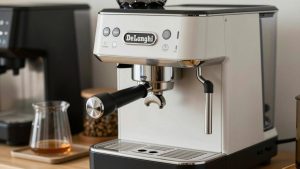
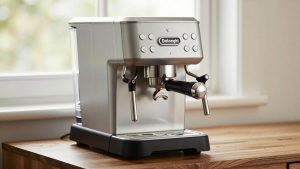
Machines like many entry-level Breville, De’Longhi and Gaggia models include pressurised baskets. The double wall with a single exit hole creates pressure regardless of grind, so pre-ground espresso coffee or a moderately fine grind works. Grinding too fine can actually choke these baskets. They are designed to produce crema-like foam even with imperfect grinding. The trade-off is less control over extraction.
Non-Pressurised Baskets: Precise and Fine
Traditional single-wall baskets depend on the coffee puck for resistance. Grind must be fine and consistent, usually achievable only with a quality burr grinder designed for espresso. Small changes make big differences: a single step on a good grinder can change shot time by several seconds. This is where dialing in matters most.
Precision baskets
Precision baskets from makers like VST and IMS have more consistent hole sizes and larger open areas. They often need a slightly finer grind than stock baskets because water flows through more freely.
Manual Lever Machines
Lever machines such as the Flair 58, Flair Pro series and Cafelat Robot let you control pressure by hand. You can compensate for slightly coarse grinds by pressing harder, or ease off for finer grinds. Most users grind fine, similar to a semi-automatic, and aim for 6-9 bar peak pressure. The Robot, for instance, often suits a fine grind with longer pre-infusion.
Moka Pots: Not Actually Espresso
Moka pots brew at around 1-2 bar, far below espresso’s 9 bar. Grinding espresso-fine clogs the funnel and over-extracts. Use a grind slightly coarser than espresso, and do not tamp.
Finding Your Starting Point
- Identify your basket type: pressurised or non-pressurised.
- Start at the manufacturer’s recommended espresso range on your grinder.
- Pull a shot with a standard recipe, such as 18 g in and 36 g out.
- If it runs fast (under 20 s), grind finer; if slow (over 35 s), grind coarser.
- Adjust by taste once time is in range.
FAQ
Can I use pre-ground coffee in a non-pressurised basket?
It rarely works well. Pre-ground espresso coffee is often too coarse and stale for non-pressurised baskets, producing fast, sour shots.
Do dark roasts need a different grind?
Dark roasts are more brittle and soluble, so they often need a slightly coarser grind than light roasts on the same machine.
Bottom line
Match grind to your machine: coarser for pressurised baskets and moka pots, fine and consistent for non-pressurised baskets and lever machines. Use the chart as a starting point, then dial in by shot time and taste. The right grinder matters most for non-pressurised setups, where small adjustments make a big difference.
Ready to decide? Our #1 pick for 2026 is the Entry-level appliance (pressurised).
Live price & availability on Amazon.