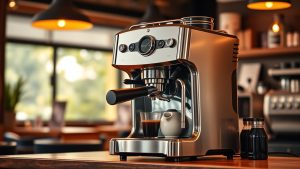
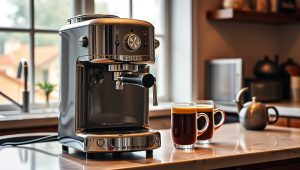
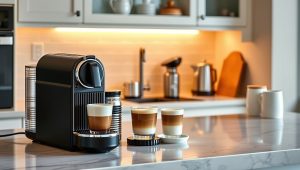
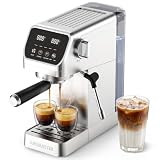
- Top Pick: Aromaster 1400W Espresso Machine with Milk Frother, Stainless Steel
- Best Value: CASABREWS CM5418 Compact Espresso Machine with Milk Frothing Steam Wand
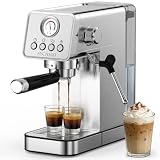
- Premium Choice: AYCHIRO 20 Bar Espresso Machine with Pressure Gauge, Compact Semi-Automatic Espresso Maker with Steam Wand, 1350W Fast Heating Coffee Machine with Removable 37oz Water Tank for Home Office
Last updated: September 18, 2026
The Short Answer
For most countertop espresso machines, plan for at least 18 to 24 inches of total vertical space. The machine itself commonly stands 11 to 14 inches tall, while a practical overhead clearance is another 6 to 10 inches. That extra room allows you to fill a removable water tank, open a bean hopper or reservoir lid, and lift out the portafilter without scraping a cabinet.
For a compact semi-automatic machine, reserve a countertop area about 6 to 9 inches wide and 11 to 14 inches deep. Leave at least 2 inches on each side for ventilation and handling, 2 to 3 inches behind the machine for the power cord and heat, and 6 inches above it as a minimum. If the water tank or hopper opens from the top, 10 to 12 inches of overhead clearance is more comfortable.
As an Amazon Associate we earn from qualifying purchases at no extra cost to you. Product prices and availability are accurate as of the date shown and are subject to change.


These espresso machine clearance height requirements matter even more under wall cabinets. A machine that technically fits beneath a 19-inch opening may be frustrating to use if its reservoir lid needs to swing open or lift straight up. Measure the usable opening, not just the advertised cabinet height, before buying.
Standard Sizes
See also: How to Replace Espresso Machine Water Filter (2026): Step-by-Step • How to Adjust Espresso Machine Brew Temperature (2026): Step-by-Step
Espresso machines vary by design, but the following measurements represent common countertop formats. Dimensions are listed as width × depth × height, excluding the extra operating clearance needed above and around the appliance.
| Machine type | Typical dimensions | Approximate metric size | Recommended total height | Typical power |
|---|---|---|---|---|
| Ultra-compact single-serve | 5.5 × 10.5 × 10.5 in | 14 × 26.7 × 26.7 cm | 17–19 in | 1,000–1,200 watts |
| Slim semi-automatic | 5.5–7 × 11–13 × 11.5–13 in | 14–17.8 × 27.9–33 × 29.2–33 cm | 18–23 in | 1,000–1,450 watts |
| Standard semi-automatic | 8–10 × 12–15 × 12–15 in | 20.3–25.4 × 30.5–38.1 × 30.5–38.1 cm | 20–25 in | 1,200–1,600 watts |
| Automatic bean-to-cup | 9–16 × 16–20 × 13–18 in | 22.9–40.6 × 40.6–50.8 × 33–45.7 cm | 22–30 in | 1,200–1,500 watts |
Compact examples such as the Aromaster 1400-watt model, CASABREWS CM5418, AYCHIRO 20-bar machine, and CHULUX slim model generally fit the slim or compact semi-automatic category. Their listed prices commonly range from about $70 to $140, but price does not reliably indicate the machine’s physical size. Check the manufacturer’s width, depth, and height listing for the exact version because trim, controls, and tank placement can change the measurements.
A machine’s listed height usually describes the appliance when closed. It does not include the height of a raised reservoir cover, bean hopper lid, cup-warming tray, or portafilter handle. For an under-cabinet location, add the manufacturer’s operating dimension when available. If no operating dimension is provided, use a conservative 10 to 12 inches above the closed machine.
How to Measure Your Space
- Measure the countertop width. Measure from left to right at the intended location, including any nearby wall, backsplash, outlet cover, or cabinet stile. Add 2 inches of side clearance whenever possible. A 7-inch-wide machine is more usable in a 9- to 11-inch-wide zone than in a tight 7-inch opening.
- Measure front-to-back depth. Start at the backsplash or wall and measure to the front edge of the counter. Subtract space occupied by the outlet, cord bend, and any rear controls. For a machine listed at 13 inches deep, a 15-inch-deep counter is a practical minimum.
- Measure closed height. Measure from the countertop to the lowest obstruction, such as the underside of a cabinet. Do not measure from the floor or from the top of a raised backsplash.
- Check the operating height. Open the water tank, hopper, or filter lid and measure the highest point. If the lid rises 5 inches and the machine is 12 inches tall, allow at least 17 inches before adding a small handling buffer.
- Confirm portafilter access. Leave enough room in front to lock and unlock the portafilter. A machine can fit dimensionally but still be difficult to use if the counter ends immediately at the machine’s drip tray.
- Locate the outlet. Keep the plug accessible and avoid pinching the cord behind the appliance. Most home machines draw about 1,000 to 1,600 watts, so use a properly rated grounded outlet and avoid overloading the same circuit with another high-wattage appliance.
- Account for movement. Water tanks, drip trays, and grounds containers often slide or lift out. Mark their removal path with painter’s tape so a cabinet edge or adjacent appliance does not block maintenance.
By Room or Use Case
Kitchen Counter Under Cabinets
This is the most challenging placement. A slim machine that is 12 inches tall may need 20 to 24 inches of total opening height once the reservoir lid is opened. If the cabinet clearance is less than 18 inches, choose a front-loading water tank or move the machine forward while filling it. Keep at least 2 inches behind the unit and avoid pushing it directly against the backsplash.
Kitchen Island
An island usually offers better overhead clearance, but depth and traffic flow become important. Reserve a counter zone at least 15 inches deep and 18 inches wide for a compact machine, accessories, and cup space. Leave the front edge clear enough to remove the drip tray safely. A heat-resistant mat can protect the surface, but it does not replace ventilation space.
Home Office or Workstation
Compact machines priced around $70 to $140 are often suitable for an office beverage station, provided the desk can support the weight and vibration. Plan for a 6- to 9-inch width, 12- to 15-inch depth, and at least 18 inches of vertical room. Keep water away from computers, power strips, and paper. A separate side table is safer than placing the machine beside a monitor or laptop.
Small Apartment or Kitchen Cart
Use a cart with a stable, level top at least 18 inches wide and 15 inches deep. Include the machine, grinder, mugs, and milk pitcher when estimating space. A cart with locking casters is preferable, but do not roll it while the reservoir is full. Check the cart’s weight rating; a filled water tank and accessories can add several pounds to the machine’s listed shipping or net weight.
Pantry or Appliance Garage
Appliance garages can hide an espresso setup, but the door must remain open during operation unless the manufacturer specifically permits enclosed use. Heat and steam need an escape path. Measure the garage opening separately from the interior cavity, since a wide interior does not help if the machine cannot pass through the door.
Common Sizing Mistakes
- Measuring only the appliance height: The machine may fit closed but fail when the reservoir or hopper is opened.
- Ignoring depth at the back: Plugs, adapters, and backsplash outlets can consume 1 to 3 inches of usable depth.
- Forgetting the front clearance: Drip trays and grounds bins need room to slide out, and portafilters need space to turn.
- Treating all compact machines as identical: Two narrow models can have very different tank locations and lid movements.
- Blocking ventilation: Do not surround the machine tightly with cabinets, towels, or other appliances. Follow the manual’s specific clearance instructions if they exceed these general guidelines.
- Using an unstable surface: Espresso machines need a level, sturdy counter. A narrow shelf may flex when the portafilter is locked into place.
FAQ
How much clearance does an espresso machine need above it?
Allow at least 6 inches above a closed machine, but 10 to 12 inches is better for a top-opening water tank or hopper. Always measure the lid in its fully open position.
Can an espresso machine go under a kitchen cabinet?
Yes, if the cabinet opening accommodates both the machine and its operating height. A front-loading or removable-tank design is easier under cabinets than a machine with a tall top lid. Pull the appliance forward before opening a reservoir if necessary.
How deep should a countertop be for an espresso machine?
A 15-inch-deep counter is a practical minimum for many compact models. It provides room for a machine roughly 12 to 13 inches deep plus cord and handling space. Standard 24-inch kitchen counters provide substantially more flexibility.
What size espresso machine is best for a small kitchen?
Look for a slim model about 5.5 to 7 inches wide, 11 to 13 inches deep, and 11.5 to 13 inches tall. Before buying, confirm the water-tank opening, portafilter clearance, and power requirements rather than relying on the word “compact” alone.
Ready to decide? Our #1 pick for 2026 is the Ultra-compact single-serve.
Live price & availability on Amazon.