Last updated: October 2, 2026
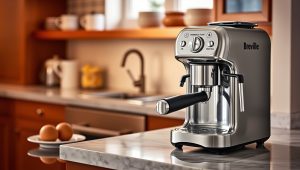
The Breville Barista Express in Red — usually listed as Cranberry Red, Red Velvet, or BES870XL-RV — is mechanically identical to the standard brushed stainless Barista Express. You are not paying for different internals, a better pump, or an upgraded grinder. You are paying for the finish. That is actually good news, because the standard BES870XL is the most proven sub-$800 home espresso machine for beginners who want to learn real puck prep without buying a separate grinder, and the red version gives you the same machine in a color that actually stands out on a kitchen counter.
If you like the look and find it at the same price as stainless (usually within $20-$40), buy it. If the red carries a big premium, skip it. Breville often does short runs of colors, so pricing swings with inventory.
What the Red Version Is (And Isn’t)
The Barista Express Red is a BES870XL with a powder-coated red housing. Everything that matters is underneath: 15-bar Italian pump with over-pressure valve limiting extraction to around 9 bar, PID-controlled 1600W thermocoil, 54mm portafilter, and an integrated conical burr grinder with 18 steps plus fine adjustment. Water tank is 67 oz, drip tray is typical Breville large, and the steam wand is a single-hole power wand that will take practice.
There is no “Red Edition” upgrade to the grinder, boiler, or electronics. Accessories are the same as stainless: single and dual-wall pressurized and non-pressurized baskets (four total), Razor dose tool, 54mm tamper, stainless milk jug, cleaning disc, tablets, brush, and water filter.
Where you will see a model difference is BES870XL vs. BES878 Barista Pro vs. BES880 Barista Touch. Those are different machines. The red color alone does not make it a Pro or Touch.
Daily Workflow: Grinder and Steam
See also: Breville Bench Saver • Rocket Espresso Coffee Machine
The Barista Express lives or dies on its built-in grinder. For a beginner, integration is the point. You grind directly into the portafilter, dose, tamp, and brew without juggling a separate grinder, scale, and funnel. It is fast, low-mess, and it produces acceptable espresso grind with fresh, medium to medium-dark beans.
The trade-offs are real:
Stepped adjustment is coarse. You will dial in with the main collar (numbers 1-16) and sometimes need the inner burr fine adjustment if you live between steps. Light roasts are the hardest here — the grinder can run out of fine range and produce thin, sour shots that you cannot fix without a better espresso grinder.
Retention is 8-12g in the chute if you don’t purge. If you single-dose or switch beans often, you need to purge 3-4g each time or your first shot is stale.
Speed and noise are moderate. It is not a quiet grinder, and it is slower than a dedicated Eureka or Baratza, but not painfully so.
Steaming is manual and powerful enough for proper microfoam, but not automatic. Expect 45-75 seconds to texture 6 oz of milk. The thermocoil needs about 20-30 seconds to transition from brew to steam temperature, and you cannot brew and steam at once. If you make 3-4 milk drinks back-to-back, that wait gets old. Technique matters more than power here — keep the tip just kissing the surface for air, then plunge to integrate.
In the Cup: What It Does Well
With fresh beans (roasted within 3-4 weeks) and a non-pressurized basket, the Barista Express pulls legitimate espresso. Body is good, crema is real, and you can get sweetness and chocolate notes reliably from medium roasts. PID holds brew temp stable enough that you are not chasing sour/bitter swings like on non-PID single-boiler machines.
Limitations show up with light, high-density beans. The thermocoil runs a bit cool compared to a brass boiler, and the grinder cannot always go fine enough without choking. You will get underextracted shots that taste sharp and hollow. That is not a defect — it is the ceiling of this price class. A pressurized basket hides the problem but gives you faux crema and thin flavor. If you live on light Nordic roasts, this is not the right platform.
For milk drinks, it is excellent for the price. Cortados, flat whites, and lattes are where most owners actually live, and the Barista Express does them well once you learn to texture.
Red vs. Other Breville Options
Color aside, your real decision is Express vs. its close siblings. This is where the money matters.
| Model | Key Difference | Best For | Downside |
|---|---|---|---|
| Barista Express BES870XL (Red or Stainless) | Integrated grinder, PID thermocoil, manual steam | Beginners who want all-in-one and to learn tamping/dosing | Stepped grinder, no auto milk, single thermocoil |
| Barista Express Impress BES876 | Adds assisted tamping and dose correction | People who struggle with consistent tamp pressure | $100-$150 more, same brew hardware |
| Barista Pro BES878 | Faster ThermoJet heat-up (3 sec), LCD, more grinder steps (30) | Busy households, quicker back-to-back milk drinks | Smaller water tank, still 54mm thermocoil |
| Bambino Plus + Separate Grinder | Compact brew unit, auto milk, no built-in grinder | Small kitchens, better long-term grinder upgrade path | You must buy a grinder; total cost higher |
If you already own a good grinder, do not buy any Express. Get a Bambino Plus or Infuser and keep your grinder. The integrated grinder is convenience, not quality. If you own nothing, the Express — in red or stainless — is still the cheapest honest way to start with fresh beans.
When you are comparing listings, check the exact model number. Some retailers list a Breville Barista Express in red as BES870XL-RV or BES870CRN. A deal on a Breville Barista Pro for the same money is a better buy on performance, even if you lose the red finish.
Who Should Buy It, Who Should Skip It
Buy the Barista Express Red if you want one box that makes real espresso and milk drinks, you drink mostly medium or medium-dark roasts, and you will actually weigh dose and learn to dial in. It is ideal for a first upgrade from a Nespresso, Keurig, or drip machine where you want hands-on control without a $1,200 separate grinder purchase.
Skip it if you: make 4+ milk drinks every morning for a family (a dual boiler or heat-exchange machine will save you time), prefer very light roasts (you will outgrow the grinder in weeks), need to fit under low cabinets (it is 15.5″ tall with the hopper), or want true single-dose workflow. Also skip if you hate cleaning — the grinder chute and group head need regular attention.
Honest cheaper option: If budget is tight, the regular stainless Barista Express on sale or a Bambino + Baratza Encore ESP combo often costs the same or less than a marked-up red unit and makes the same quality drink. Do not pay a $100+ premium just for paint.
Durability, Maintenance, and Failure Modes
Breville thermocoil machines are reliable for 3-5 years with care, but they are not tanks. The most common failures are grinder-related and solenoid/valve-related.
Grinder impeller wear and chute clogging: Oily dark roasts will eventually gum the grinder and trigger weak or inconsistent grinding. Clean the hopper and run Grindz or plain minute rice substitute (Breville recommends its own cleaning method — do not use actual rice) every 2-3 months, and avoid ultra-oily beans.
Solenoid and OPV scale: Hard water kills thermocoils. Use the included water filter and descale only when the machine prompts. If you ignore the descale light, you will get weak flow, long heat times, or the dreaded no-flow after steam. In hard water areas, use filtered water with 70-100 ppm hardness, not distilled.
Steam wand tip clogging: Milk baked inside the wand blocks the single hole fast. Purge and wipe after every use. Soak the tip weekly.
Portafilter and group seal wear: The 54mm group gasket hardens in 12-18 months. If the portafilter needs excessive force to lock or leaks around the edge, replace the gasket — it is a $10 part and 5-minute job.
Maintenance that actually matters: Backflush with water after each session, with a cleaning tablet every 150-200 shots, empty the drip tray before it triggers the float (it will overflow onto the counter), and keep beans in the hopper for no more than 3-4 days. The machine will tell you when to clean and descale — do not postpone it.
Red finish care: The powder coat chips if you drag the portafilter across the top or use abrasive cleaners. Wipe with a soft damp cloth only. The coating itself does not affect heat or taste, but chips around the cup warming tray look bad quickly.
FAQ
Is the Barista Express Red different inside from the stainless one?
No. Same pump, thermocoil, PID, grinder, and portafilter size. The only difference is exterior color and sometimes the SKU suffix. Performance and accessories are identical.
Do I still need a separate grinder or scale?
You do not need a separate grinder to start — that is the point of the Express. A 0.1g scale helps a lot for dosing 18-19g consistently, and most owners add one within a month. If you already own a good espresso grinder, buy a Bambino-style machine without a built-in grinder instead.
Can it make good espresso with pre-ground or grocery store beans?
It will make something drinkable with the pressurized (dual-wall) baskets, but it will not taste like cafe espresso. For real extraction with the non-pressurized baskets, you need beans roasted within the last 3-4 weeks and ground right before brewing. The integrated grinder handles that if the beans are fresh.
How long does it take to heat up and make a latte?
About 45-60 seconds to heat, 25-30 seconds to pull a shot, and another 45-75 seconds to steam milk after the thermocoil switches to steam. Total about 2.5-3 minutes for one latte once you have your grind dialed in. Add 30 seconds between milk drinks for temperature transition.