Last updated: October 21, 2026
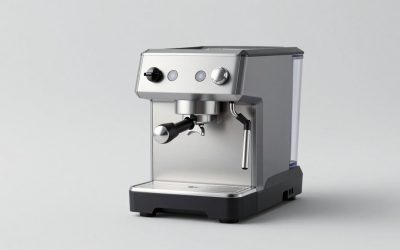
The SimplyGoodCoffee Brewer is the closest match to a plastic-minimized automatic drip machine in this group, with a borosilicate glass carafe and reservoir and a 304 stainless steel filter basket. If you would rather skip electronics that rely on silicone tubing, the Presto 02811 stainless percolator and the two manual brewers fill that role. “Non-toxic” has no regulated meaning for coffee makers, so this guide uses a narrow, checkable definition: which materials touch the hot water and the brewed coffee, based on what each listing and manufacturer page actually states.
Quick List
- SimplyGoodCoffee Brewer – best for an automatic drip machine built around glass and stainless steel
- Presto 02811 stainless percolator – best for an all-stainless coffee path at a modest size
- aarke Drip Coffee Maker – best for a stainless-bodied drip brewer with a design-forward look
- Bodum 34oz Pour Over – best for a no-electronics glass and steel brewer
- Stainless Steel French Press, 34oz – best for an immersion brew with no glass and no plastic claimed
- Ninja Fresh Brew CE251 – best for a mainstream programmable machine, with plastic parts you should check
Which One Is Right for You?
| If you… | Choose |
|---|---|
| Want a hands-off drip machine with glass and stainless steel where the water travels | SimplyGoodCoffee Brewer |
| Want the simplest all-stainless electric brewer and can live without a timer | Presto 02811 percolator |
| Want a stainless exterior, a full-carafe brew in under six minutes and a countertop-worthy design | aarke Drip Coffee Maker |
| Brew one or two cups by hand and already own a kettle | Bodum 34oz Pour Over |
| Want a durable immersion brewer with an insulated steel body | Stainless Steel French Press |
| Need a 12-cup programmable machine and accept that some parts are plastic | Ninja Fresh Brew CE251 |
Start by deciding how much convenience you need. Automatic drip machines are the most convenient and the hardest to make plastic-free, because they need tubing, reservoirs, switches and housings. Manual brewers and percolators have fewer parts, which makes them easier to evaluate but asks more from you at the counter.

Ninja Fresh Brew Coffee Maker, 12 Cup Glass Carafe, Stainless Steel, CE251 | Programmable, Classic & Rich brew, 70-oz. Removable Water Reservoir, Small Batch, 24-hr Delay Brew, Adjustable Warming Plate
Included for '6 Best Non Toxic Coffee Makers (October 2026) Buying Guide' because the listing specifies 12 Cup Glass Carafe and Stainless Steel, details this guide uses to compare options.
View on Amazon
Presto 02811 Stainless Steel 12-Cup Electric Coffee Percolator
Included for '6 Best Non Toxic Coffee Makers (October 2026) Buying Guide' as a relevant option in this category; details come from the product listing.
View on Amazon
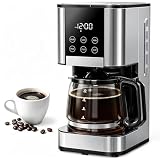
SimplyGoodCoffee THE BREWER - Plastic-Free. Coffee Maker/Coffee Machine. 8 Cup Automatic Drip Pour Over Coffee Brewer. Brewer Free of Plastic, Gold Cup Standard. Black/Stainless Steel
Included for '6 Best Non Toxic Coffee Makers (October 2026) Buying Guide' because the listing specifies Gold Cup Standard. Black/Stainless Steel, details this guide uses to compare options.
View on Amazon
aarke Drip Coffee Maker with 42oz Glass Carafe, Stainless Steel | Electric Drip Brewer, Automatic Drip-stop, Brews Full Pot in Under 6 Minutes, SCA Certified
Included for '6 Best Non Toxic Coffee Makers (October 2026) Buying Guide' because the listing specifies Stainless Steel and Electric Drip Brewer, details this guide uses to compare options.
View on Amazon
Bodum 34oz Pour Over Coffee Maker, High-Heat Borosilicate Glass with Reusable Stainless Steel Filter and Cork Grip - Made in Portugal
Included for '6 Best Non Toxic Coffee Makers (October 2026) Buying Guide' because the listing specifies Made in Portugal, details this guide uses to compare options.
View on Amazon
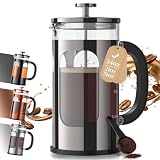
Non-Toxic Stainless Steel French Press, No Plastic or Heavy Metals, 34 oz | Surgical-grade steel. 4-layer filter. Double-wall insulated, stays hot for longer. Measure marks. Dishwasher safe. Portable.
Included for '6 Best Non Toxic Coffee Makers (October 2026) Buying Guide' because the listing specifies No Plastic or Heavy Metals and 34 oz, details this guide uses to compare options.
View on AmazonAll 6 Picks in Detail
1. SimplyGoodCoffee The Brewer – Best for a Plastic-Minimized Automatic Drip Machine
As an Amazon Associate we earn from qualifying purchases at no extra cost to you.

The Brewer is an 8-cup automatic drip machine marketed on a plastic-free design: the company describes a borosilicate glass carafe with a stainless steel lid, a borosilicate glass water reservoir, a stainless steel boiler and a 304 stainless steel filter basket. It targets brewing in the 195 to 205 degree Fahrenheit range and takes standard number four paper or metal filters. It suits anyone who wants set-and-forget convenience and is willing to pay for a machine built around material choices.
- Capacity: 8 cups (about 40oz) per the maker
- Carafe and reservoir: borosilicate glass
- Filter basket: 304 stainless steel, fits number four filters
- Brew temperature: 195 to 205 degrees Fahrenheit per the manufacturer
- Brew time: about six minutes for a full batch per the manufacturer
Pros
- Glass and stainless steel in the water path
- One-button operation with an optional bloom step
- Removable parts that the maker describes as dishwasher safe
Cons
- Published reviews have noted silicone tubing and plastic exterior parts, so “plastic-free” refers to what touches the water, not the whole machine
- Smaller 8-cup capacity than a 12-cup machine, and a first-generation model weighs more than many drip brewers
It sits above the aarke in material strictness, while the aarke lists some food-grade plastic parts; the Ninja is the most conventional of the three.
The maker’s pages cite SCA, ECBC and Gold Cup standards for the second-generation programmable model, while independent confirmation of those claims was not found in the sources reviewed, so treat them as manufacturer statements. Warranty terms are given differently by the maker and by the retailer listing, so read the one attached to the unit you buy.
2. Presto 02811 Stainless Steel 12-Cup Percolator – Best for an All-Stainless Coffee Path

The Presto 02811 is a classic electric percolator in stainless steel. Water heats at the base, rises through a tube and drips back over a basket of grounds, and the cycle repeats until the unit signals it is done. Presto describes it as making 2 to 12 cups at roughly a cup a minute, with a “12-cup” label based on small five-ounce cups, so a full batch is closer to 60oz. It suits campers, office kitchens and anyone who prefers metal to glass or plastic.
- Capacity: 2 to 12 cups, with the cup measured at about five ounces
- Body, basket and perk tube: stainless steel
- Power: 120 volts, about 800 watts, UL listed
- Features: ready light, detachable cord, cool-touch handle
- Filter: reusable basket; wrap or disc filters are suggested by the maker
Pros
- Steel construction with few non-metal parts in the water path
- Simple and repairable-feeling design with no timer or screen to fail
- Large capacity for a group
Cons
- Percolation repeatedly passes hot water through the grounds, which can taste harsh if left running
- No programmable start; sources disagree on whether it has a keep-warm mode, so confirm in the manual
Compared with the aarke, the Presto is lower-tech and tougher, but the aarke brews more gently and with more control over strength.
Treat the dishwasher status as unconfirmed, since retail pages contradict each other. Use a medium to coarse grind so the grounds stay in the basket, and remove the basket as soon as the brew finishes. As with any electric appliance, keep the base and cord dry, only immerse parts the manual says are immersible, and do not run it without water.
3. aarke Drip Coffee Maker – Best for a Stainless-Bodied Drip Brewer

The aarke is a Swedish-designed drip machine with a polished stainless steel body and a 42oz glass carafe. The brand cites a brew temperature between 197 and 205 degrees Fahrenheit, a full pot in under six minutes, an automatic drip-stop and an optional 30-second bloom mode. It suits someone who wants a dependable, good-looking machine and cares about stainless steel and glass on the main surfaces, while accepting that its parts list includes silicone and BPA-free food-grade plastic.
- Capacity: 2 to 10 cups on aarke’s smaller cup measure; the glass carafe holds 42oz
- Materials: stainless steel body, glass carafe, silicone and BPA-free food-grade plastic per the maker
- Brew temperature: 197 to 205 degrees Fahrenheit per the maker
- Filter: number four paper filter in a 360 degree basket
- Extras: water-level sensor, descaling program, dishwasher-safe carafe and basket per the maker
Pros
- Stainless exterior with glass carafe
- Descale reminder and automatic drip-stop
- Water tank is lit, so it is easy to read
Cons
- Not a plastic-free machine, because the maker lists food-grade plastic among the materials
- The water tank is not removable, so you fill it at the machine
It is the easiest of the drip machines to live with, though the SimplyGoodCoffee Brewer goes further on materials.
The “10 cups” label uses a 4.2oz cup, which is smaller than the roughly 6oz cup common on US machines, so read the carafe volume, not the cup count. Retailer pages quote slightly different wattages, so check the label if your circuit is shared with other appliances.
4. Bodum 34oz Pour Over Coffee Maker – Best for a No-Electronics Glass and Steel Brewer

The Bodum Pour Over pairs a one-liter borosilicate glass carafe with a permanent stainless steel filter and a cork grip. There is no heater, no reservoir and no tubing, so the only materials your coffee touches are glass and steel, with a plastic lid in the box according to one listing. It suits home brewers who already own a kettle and want a low-maintenance, repairable way to make a pot.
- Capacity: 34oz (about 1 L) carafe
- Carafe: high-heat borosilicate glass, made in Portugal per the listing title
- Filter: reusable stainless steel, so no paper is needed
- Grip: cork band; confirm how the grip attaches before washing
- Care: retail pages disagree on dishwasher use, so follow the instruction card
Pros
- Nothing electrical to fail
- Metal filter lets oils through for a fuller cup
- Easy to inspect and clean
Cons
- You need a separate kettle and ideally a scale
- Glass is breakable, and a metal filter gives a slightly silty cup
Compared with the stainless French press below, this brews a cleaner cup but demands more attention while pouring.
To use it, rinse the filter, add medium grounds, pour a small amount of hot water to bloom, wait about thirty seconds, then pour in stages. A rough starting ratio is 1:16, so 500 milliliters of water uses about 31 grams of coffee. Listing dimensions differ between color versions, so check the page if cabinet space is tight.
5. Non-Toxic Stainless Steel French Press, 34oz – Best for a Steel Immersion Brewer
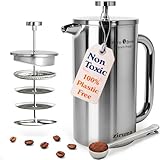
This listing describes a 34oz French press in surgical-grade stainless steel with a four-layer filter and a double-wall insulated body, with a message of no plastic or heavy metals. It suits people who want one sturdy pot for coffee and tea and who are fine with a brewer you cannot see into. The brand name and exact steel grade are not stated in the listing title, so verify them on the page, and check the lid and handle materials if avoiding plastic is the whole point.
- Capacity: 34oz
- Body: stainless steel, double-wall insulated per the listing
- Filter: four layers per the listing
- Claims: no plastic or heavy metals; confirm how the maker supports this
- Use: coffee and tea; immersion steeping, typically around four minutes
Pros
- No glass to break
- Insulation helps hold temperature
- Few parts to replace
Cons
- You cannot watch the brew
- Marketing claims should be verified, because “no plastic” often refers only to the body
It trades the Bodum Pour Over’s glass for steel and its cleaner cup for a fuller, more rustic body.
Remember that a metal screen passes fine particles. Use a coarse grind, press slowly and pour out the entire pot after pressing to prevent over-extraction. For a worked example, 800 milliliters of water at 1:15 needs roughly 53 grams of coffee.
6. Ninja Fresh Brew CE251 – Best for a Mainstream Programmable 12-Cup Machine
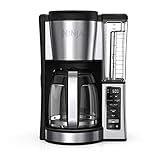
The CE251 is the conventional pick here. It makes up to 12 cups into a glass carafe, offers classic and rich strength settings, a small-batch option for one to four cups, a 24-hour delay start and an adjustable warming plate. It suits households who need volume and a timer first and who will accept that a typical drip machine uses plastic parts around the water. It does not claim a plastic-free design, and it is included here as the practical baseline against which the others should be measured.
- Capacity: up to 12 cups into a glass carafe
- Reservoir: the listing title says 70oz, while several retailers say 60oz; confirm before relying on it
- Filter: permanent reusable basket per retailer descriptions
- Controls: delay brew, classic and rich settings, small batch mode, pause
- Power: about 1100 watts per retailer pages
Pros
- Large capacity and a timer
- Glass carafe
- Reusable filter basket
Cons
- Reservoir and housing materials are not specified in the listing, so confirm them if plastic matters to you
- Not marketed as plastic-free
It is the opposite end of the list from the SimplyGoodCoffee Brewer: more features and capacity, fewer assurances about materials.
If you are considering it, decide what exactly you want to avoid and look up that specific part in the manual or the maker’s parts list. A reusable basket helps with paper waste but says nothing about the reservoir, tubing or housing, so it does not settle a materials question on its own.
Specs Compared
| Pick | Type | Capacity | Main contact materials | Filter | Electric |
|---|---|---|---|---|---|
| SimplyGoodCoffee Brewer | Automatic drip | 8 cups (about 40oz) | Borosilicate glass, 304 stainless steel | Number four paper or metal, stainless basket | Yes |
| Presto 02811 | Percolator | 2 to 12 cups (five-ounce cups) | Stainless steel | Reusable stainless basket | Yes, about 800 W |
| aarke Drip Coffee Maker | Automatic drip | 42oz carafe | Stainless steel, glass, silicone, food-grade plastic | Number four paper | Yes, about 1500 W per the maker |
| Bodum 34oz Pour Over | Manual pour-over | 34oz | Borosilicate glass, stainless steel, cork, plastic lid per one listing | Permanent stainless steel | No |
| Stainless Steel French Press | Immersion | 34oz | Stainless steel; confirm lid and handle | Four-layer stainless | No |
| Ninja Fresh Brew CE251 | Automatic drip | 12 cups; reservoir 60 or 70oz, confirm | Glass carafe; other materials, confirm on listing | Permanent basket | Yes, about 1100 W per retailers |
How We Chose These
This guide comes from document research, not product handling. We began with the six items in the current catalog set and read each title, specification field and available manufacturer page. We ranked them by how clearly the sources describe the materials that touch hot water, whether those materials are glass, stainless steel, silicone or plastic, and how much convenience the machine adds. Where sources disagree, such as the Ninja reservoir size or the Presto warming behavior, we say so and point you to the listing and manual. Nothing here makes a health claim.
What to Look For
Define What “Non-Toxic” Means to You
The phrase is marketing, not a standard. Some buyers mean no plastic where water is hot. Others mean no aluminum, no nonstick coatings or no lead in solder. Write down your own definition before shopping. A strict definition will point to glass, stainless steel and manual brewers; a looser one may accept food-grade silicone tubing and plastic housings that never touch the coffee.
The Water Path Is the Part That Matters
In an automatic drip machine, water moves from the reservoir through tubing to a heating element, then to a showerhead, over the grounds and into the carafe. Ask which of those parts are metal, glass, silicone or plastic. A glass reservoir and stainless boiler, as the SimplyGoodCoffee Brewer lists, change the answer. A percolator has an even simpler path, and a pour-over or press has none at all beyond your kettle.
Stainless Steel Grades and Glass Types
Food-grade stainless steel is commonly sold as 304, also called 18/8, or 18/10; both are widely used for kitchenware. Borosilicate glass resists thermal shock better than ordinary glass, which is why it appears in carafes and presses. Neither guarantees a better cup, but both are inert in the sense that they do not flavor coffee. Listings sometimes confuse the grade of the body with the grade of the lid or filter, so confirm each part.
Temperature, Ratio and a Worked Example
The Specialty Coffee Association guidance for filter coffee calls for about 55 grams of coffee per liter of water and water between 195 and 205 degrees Fahrenheit. Machines that cannot reach that range tend to under-extract. For a 42oz (roughly 1.2 L) carafe, 55 grams per liter means about 66 grams of coffee. Many people use slightly more, so adjust to taste.
Cleaning and Descaling
Mineral scale builds up in heating parts whatever the material. Follow the descale instructions in the manual, use the machine’s descale cycle when it has one, and rinse thoroughly afterward. A machine that is simple to take apart is easier to keep clean, and clean equipment matters more to flavor than almost any marketing claim.
Questions
Is any drip coffee maker completely plastic-free?
It is hard to find one. Even machines marketed as plastic-free usually have silicone tubing, switches or exterior parts that are not glass or metal. Read what the maker says touches the water, not just the headline.
Is a percolator better than a drip machine for materials?
A stainless percolator has fewer parts in contact with hot water, which is simpler to evaluate. It brews differently, though, and can taste stronger or harsher if it runs too long. Choose it for the materials and the simplicity, not because it makes better coffee.
Are glass carafes safer than steel ones?
Neither is a safety question in normal use. Glass lets you see the level and is easy to judge for cleanliness, while steel holds heat and survives drops. Check manufacturer care instructions for either.
Does a metal filter change the taste?
Yes. A permanent metal filter lets coffee oils and some fine particles through, so the cup is fuller and a little cloudier than one made with paper. If you want a cleaner cup, use paper in a basket that accepts it.
How often should I descale a coffee maker?
Follow the manual, and descale more often if your water is hard. Machines such as the aarke include a descaling program and an indicator. Rinse the system well after descaling.
Why do the listings disagree about some specifications?
Retail pages are often written by resellers and may mix model years, colors and packs. When capacity, wattage or dishwasher status conflict, trust the manual or the manufacturer page, and treat the listing as a starting point.
Update History
- October 20, 2026 – Initial publication; product set drawn from current catalog listings.
- Check the product page for current specifications and availability before buying.
Sources
- Manufacturer product and specification pages for SimplyGoodCoffee, aarke, Bodum, Presto and Ninja
- Retailer listing titles and specification fields
- Published product reviews, used only to note where sources disagree
- Specialty Coffee Association brewing guidance for ratio and water temperature