Last updated: October 2, 2026
Quick answer: For most people in 2026, the best homemade espresso machine is the Manual Lever — our #1 rated choice. See the full ranked comparison, alternatives and buying advice below.
What “Homemade Espresso” Actually Means
True espresso needs 9 bars of pressure, water around 195-205°F, and a fine, consistent grind. If your machine can’t do that reliably, you get strong coffee, not espresso. No crema, no body, and milk drinks taste thin. For home use, that narrows the field fast. Most cheap “espresso” machines that use pressurized baskets and steam wands fake it. They can still make decent milky drinks, but you won’t learn dialing in, and you won’t get café-level shots.
If you want real espresso at home, you need to decide how much control you want versus how much work you’ll actually do every morning. That’s the trade-off that should drive your purchase, not wattage or number of buttons.
The 4 Types That Matter for Home
See also: Breville Bench Saver • Rocket Espresso Coffee Machine
Forget marketing categories. For home buyers there are really four paths:
1. Manual lever: You provide the pressure by hand. No pump, no electronics. Extremely simple mechanically, which means almost nothing to fail, but you have to learn grind, dose, and pull technique. Great if you love process and want small footprint. Bad if you want to make four lattes fast before work.
2. Semi-automatic: The standard for making real espresso at home. You grind, dose, tamp, and start/stop the shot. The machine controls temperature and pressure. This is where you learn to dial in and get the best flavor for the money. A good semi-automatic espresso machine paired with a good grinder will outperform a more expensive automatic machine on shot quality.
3. Automatic / Super-automatic: Push a button, get espresso. Super-automatics grind, tamp, brew, and often froth milk internally. Convenience is unmatched, but you give up control over extraction, and there are more parts to clean and break. Milk systems and grinders inside super-automatics are the most common failure points after 2-3 years if you don’t clean them weekly.
4. Capsule / Pod: Fastest, cleanest, most consistent. Also the most expensive per shot and the ceiling on taste is lower. Fine if you drink one milk drink a day and hate any prep. Not really “homemade espresso” in the barista sense, but honest about what it is.
| Type | Control Over Shot | Learning Curve | Best For | Main Failure Mode |
|---|---|---|---|---|
| Manual Lever | Total | High | Hobbyists, small kitchens, travelers | User technique; seals/gaskets wear |
| Semi-Automatic | High | Medium-High | People who want café-quality at home and will buy a grinder | Scale buildup, pump/valve if descaling is ignored |
| Automatic / Super-Automatic | Low | Low | Households that want one-touch lattes for multiple people | Clogged grinder, milk circuit mold, brew group jams |
| Capsule | None | None | Convenience first, low volume | Pod costs add up, pump scale, limited repair options |
Best Picks By How You Actually Make Coffee
Best for learning real espresso without overspending: Semi-automatic with PID and 58mm portafilter. This is the sweet spot for most homes. Look for a PID controller for stable temperature, a 58mm commercial-size portafilter so accessories are easy to find, and a real steam wand if you make milk drinks. Single boiler means you wait between brewing and steaming. Heat exchanger or dual boiler lets you do both at once but costs and maintenance go up. Don’t buy a semi-automatic without budgeting for a burr grinder. The grinder matters more than the machine for taste. A $400 machine with a $250 grinder will beat a $900 machine with a cheap blade grinder every time.
Best for minimal effort and hands-off routine: Super-automatic. If everyone in the house wants a different drink and no one wants to learn tamping, this makes sense. A super-automatic espresso machine is a good fit for busy mornings, but be honest about cleaning. You need to empty the drip tray, wash the brew group weekly, purge the milk system daily, and use filtered water. If you won’t do that, you will get sour, bitter shots and eventually a service call. The cheaper option is not fine here — ultra-cheap super-automatics tend to have weak grinders and no spare parts.
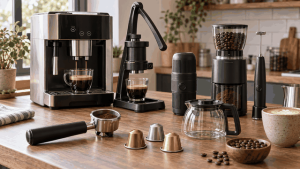
Best for tiny kitchen or tight budget: Manual lever press. A manual lever espresso maker costs less than most electric machines, makes surprisingly good shots once you learn it, and stores in a drawer. Trade-off: you need a way to heat water separately, and steaming milk requires a separate frother. Not ideal if you make back-to-back milk drinks for guests. Perfect if you make one or two straight shots a day and like the ritual.
Best for convenience with no learning: Capsule. No grinder, no mess. Taste is consistent but flat compared to fresh-ground beans, and you are locked into pods. For an office or a household where people won’t measure or tamp, this prevents wasted beans and frustration. Just know the cost per shot is 3-5x higher than beans.
What Matters More Than The Machine
Water and grinder decide 70% of your result. Use filtered water with some mineral content. Distilled water tastes empty and can damage sensors in some machines. Very hard tap water will scale a boiler in months. A simple carbon + softening filter pitcher is enough for most people if you descale on schedule.
For the grinder, you need stepless or micro-stepped adjustment for espresso. Standard drip coffee grinders can’t go fine enough or hold a setting. If you buy a semi-automatic or manual lever, plan to spend at least half what you spend on the machine for the grinder. Otherwise you will never get a 25-30 second extraction no matter how you tamp.
Also consider workflow. Where will you grind? Do you have counter space for tamping? Is there an outlet that isn’t under a cabinet where steam will peel the finish? Do you drink mostly milk drinks? Then prioritize a machine with a powerful, dry steam wand. If you drink straight espresso, prioritize temperature stability over steam power.
Common Failure Modes and How to Avoid Them
Most home machines don’t die, they clog. Scale is the number one killer. If your machine’s manual says descale every 2-3 months, do it. If you have hard water, do it monthly and use filtered water. Don’t ignore the blinking descale light.
Second is the grinder. Cheap built-in grinders jam on oily dark roasts and light roasts that are very hard. If you go super-automatic, stick to medium roasts and clean the grinder chute weekly.
Third is the steam wand and milk circuit. Dried milk bakes onto the wand and inside auto-frothers. Purge with steam for 2-3 seconds after every use and wipe immediately. For auto-frothers, run the rinse cycle daily and take the carafe apart weekly. If milk starts tasting cooked or the foam turns bubbly, it’s usually buildup.
Gaskets and shower screens are wear items. On semi-automatics, replace the group gasket once a year and backflush with water weekly if the manual allows it. If the portafilter starts leaking around the edges or you need to overtighten it, the gasket is shot — a $10 part that prevents a $150 service call.
Who Should Buy What
Buy a semi-automatic if you enjoy tweaking and want the best shot for under $1,000 total. You will make bad shots for the first week while you learn, then great shots for years. Buy it if you drink 1-3 drinks a day and don’t mind a 5-minute routine.
Buy a super-automatic if convenience is non-negotiable or you make 4+ milk drinks in a row. It is worse value per shot, but better value for households where no one wants to become the barista.
Buy a manual lever if you want great shots with minimal cost and counter space, and you are fine heating water in a kettle and frothing milk separately.
Buy capsule if you know you won’t maintain anything else. The cheaper option is fine here if you actually use it. An unused $800 machine is more expensive than a $150 capsule machine you use daily.
Don’t buy any espresso machine if you mostly drink large drip coffee or cold brew. A good drip brewer or pour-over setup will taste better and cost less to maintain.
FAQ
Do I need a separate grinder or is a built-in grinder good enough?
If you’re buying a semi-automatic, a separate burr grinder is better. Built-ins in that price range are usually stepped and inconsistent for espresso. For super-automatics, the built-in is part of the system, so you don’t have a choice. Just keep it clean and avoid very oily beans.
Can I make good espresso with pre-ground coffee?
Not consistently. Pre-ground is too coarse for non-pressurized baskets and it stales within minutes after opening. You can use it with pressurized baskets to get something drinkable, but you won’t get real crema or control over extraction time. If you won’t grind fresh, a capsule system will taste better.
Single boiler vs. heat exchanger vs. dual boiler — which do I need at home?
Single boiler is fine if you make one or two drinks and can wait 30-60 seconds between brewing and steaming. Heat exchanger and dual boiler let you brew and steam at the same time for back-to-back milk drinks. They cost more, take longer to heat up, and use more energy. Most homes don’t need dual boiler unless you regularly make drinks for 3+ people at once.
How loud and big are these machines really?
Vibration pumps are loud for 25 seconds per shot — similar to a blender on low. Rotary pumps are quieter but rare under $1,500. Size-wise, semi-automatics are about as wide as a toaster oven and need 12-16 inches of vertical clearance for the steam wand and lid. Super-automatics are larger and heavier. Measure your counter depth and check where the water tank pulls out.
Ready to decide? Our #1 pick for 2026 is the Manual Lever.
Live price & availability on Amazon.