Last updated: October 18, 2026
The best pitcher for cold brew is the Takeya Deluxe 2-quart if you want a light, airtight pitcher that survives drops, and the Takeya Glass Cold Brew Coffee Maker if you prefer glass that will not hold flavors. Both are 2-quart pitchers with a built-in fine-mesh filter, and both fit on a standard refrigerator shelf. For a bigger batch, the Aquach 68 oz borosilicate pitcher gives you extra height for concentrate you plan to dilute into lattes. This guide is for home espresso drinkers who use cold brew as a second drink: iced lattes, cold brew tonics and milk drinks made from a concentrate that lives next to the espresso machine. It focuses on the pitcher itself, meaning material, size, lid and filter mesh, rather than on machines. It is based on manufacturer specifications, retailer listings and independent reviews, and we did not personally use these products. If you are looking for a full cold brew maker comparison for the fridge, that is a related but different question.
- Top Picks at a Glance
- Comparison Table
- Why the Pitcher Matters More Than You Think
- 1. Takeya Deluxe Cold Brew Coffee Maker (2 qt): Best Overall
- 2. Takeya Glass Cold Brew Coffee Maker (2 qt): Best Glass Pitcher
- 3. Aquach 51 oz Cold Brew Coffee Maker: Best Borosilicate Family Pitcher
- 4. Aquach 68 oz Extra Tall Cold Brew Pitcher: Best for Tall Concentrate Batches
- 5. Hario Mizudashi Cold Brew Coffee Maker (1000 ml): Best Slim Fridge-Door Bottle
- 6. Primula Burke Deluxe Cold Brew Iced Coffee Maker: Best Budget Carafe
- 7. QHH 64 oz Cold Brew Coffee Maker: Best Large Mason Pitcher
- Also Consider
- Glass, Tritan or Borosilicate: A Quick Comparison
- Sizing a Pitcher for Lattes and Espresso Tonics
- Making Concentrate in a Pitcher: A Method for Espresso Drinkers
- Pairing Cold Brew With Espresso Drinks
- Common Pitcher Problems and Fixes
- How We Chose
- Buying Guide
- Frequently Asked Questions
- Which One Should You Buy?
- Sources
Top Picks at a Glance
- Best Overall: Takeya Deluxe Cold Brew Coffee Maker (2 quart), a Tritan pitcher with an airtight lid.
- Best Glass Pitcher: Takeya Glass Cold Brew Coffee Maker (2 quart), with a black lid and handle.
- Best Borosilicate Family Pitcher: Aquach 51 oz Cold Brew Coffee Maker, dishwasher safe.
- Best for Tall Concentrate Batches: Aquach 68 oz Extra Tall Cold Brew Pitcher.
- Best Slim Fridge-Door Bottle: Hario Mizudashi Cold Brew Coffee Maker (1000 ml).
- Best Budget Carafe: Primula Burke Deluxe Cold Brew Iced Coffee Maker.
- Best Large Mason Pitcher: QHH 64 oz Cold Brew Coffee Maker with a pour-spout lid.
Comparison Table
See also: Machine for Cold Brew Coffee: Fast Electric vs Slow Steep Systems • Best Cold Brew Coffee Maker for Fridge in 2026
| Pitcher | Best for | Key specs | Watch for | Price tier |
|---|---|---|---|---|
| Takeya Deluxe (2 qt) | Light and durable | Tritan; fine-mesh filter; airtight lid; 12-24 hour steep | Plastic may hold odors | Mid-range |
| Takeya Glass (2 qt) | Odor-free storage | Glass; airtight pitcher; black lid and handle | Filter details not listed in the title | Mid-range |
| Aquach 51 oz | Family batches | Borosilicate glass; dishwasher safe; up to 2 weeks freshness per listing | Check lid fit | Mid-range |
| Aquach 68 oz Extra Tall | Concentrate for milk drinks | Extra tall borosilicate glass; dishwasher safe | Needs tall shelf clearance | Mid-range |
| Hario Mizudashi (1000 ml) | Fridge door storage | Heatproof glass; permanent mesh filter; 8-12 hour fridge steep | Filter sits partway down the bottle | Budget |
| Primula Burke Deluxe | Simple glass carafe | Glass carafe; removable mesh filter; comfort-grip handle | Capacity not listed in the title | Budget |
| QHH 64 oz | Large pour-friendly batch | Mason jar pitcher; stainless filter; pour-spout handle lid | Lid has more parts | Budget |
Why the Pitcher Matters More Than You Think
Espresso drinkers tend to focus on grinders and machines, but a cold brew pitcher is where flavor is won or lost over many hours. Four pitcher features have an outsized effect: the filter mesh, which decides how much sediment ends up in your latte; the lid, which decides whether the fridge smells like coffee; the material, which decides whether the pitcher keeps tasting like last week’s batch; and the shape, which decides whether it fits in the fridge and whether you can pour without a mess. A concentrate batch has to be strong enough to stand up to milk and ice, so you also want a pitcher where coffee and water have good contact, with a basket or mesh that is wide rather than a narrow tube. The picks below are organized around those four features.

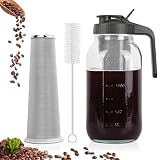
JunVpic Cold Brew Coffee Maker, 64 oz Glass Mason Pitcher | 100μm stainless steel filter, wide mouth design, leak-proof lid with handle, pour spout for iced coffee, tea and cold drinks
Included for 'Pitcher for Cold Brew: Glass vs Tritan, Sizes and Filter Mesh' because the listing specifies 64 oz Glass Mason Pitcher and 100μm stainless steel filter, details this guide uses to compare options.
View on Amazon
QHH Cold Brew Coffee Maker, 64 oz Mason Jar Pitcher with Stainless Steel Filter, Pour Spout Handle Lid, Airtight & Leak-Proof for Iced Coffee,Tea & Lemonade
Included for 'Pitcher for Cold Brew: Glass vs Tritan, Sizes and Filter Mesh' because the listing specifies 64 oz Mason Jar Pitcher with Stainless Steel Filter and Pour Spout Handle Lid, details this guide uses to compare options.
View on Amazon
JunVpic Cold Brew Coffee Maker, 64 oz Glass Mason Jar Pitcher | 100μm stainless steel filter, wide mouth design, leak-proof lid with handle, pour spout for iced coffee, tea and cold drinks
Included for 'Pitcher for Cold Brew: Glass vs Tritan, Sizes and Filter Mesh' because the listing specifies 64 oz Glass Mason Jar Pitcher and 100μm stainless steel filter, details this guide uses to compare options.
View on Amazon
County Line Kitchen 64oz Cold Brew Coffee Maker with Leak Proof Lid - Gray | Glass Cold Brew Coffee Maker - Wide Mouth Mason Jar, Stainless Steel Filter & Leak-Proof Lid (64 oz)
Included for 'Pitcher for Cold Brew: Glass vs Tritan, Sizes and Filter Mesh' because the listing specifies Gray and Glass Cold Brew Coffee Maker, details this guide uses to compare options.
View on Amazon1. Takeya Deluxe Cold Brew Coffee Maker (2 qt): Best Overall
- 2-quart BPA-free Tritan pitcher with an airtight leakproof lid and silicone grip handle.
- Fine-mesh filter: add about 7 cups of cold filtered water, lower the filter, seal and shake for 30 seconds.
- Refrigerate 12-24 hours; the concentrate keeps up to 2 weeks in the sealed pitcher.
- Tritan tolerates heat, so it can also brew hot; made in the USA.
Best for: a home that wants a pitcher that is easy to handle and store. Skip if: you want glass.
The reason to start here is that the Takeya solves the practical problems: it seals, it stores on its side, it does not break if you bump it against the sink, and the filter is part of the pitcher. It makes about 2 quarts of finished coffee at the maker’s recipe. If you like concentrate, you can use more coffee in the filter, but remember that a heavier load can slow the extraction and make the filter harder to lift.
The downsides are plastic and mesh. Tritan is clear and tough, but plastics can retain coffee oils. Rinse the lid and filter after every batch and let them air-dry. Fine mesh passes a little sediment, so if you drink black cold brew and dislike grit, pour through a paper filter into a second pitcher.
Pros:
- Shatter-resistant
- Airtight and stores on its side
- Heat tolerant
Cons:
- Plastic can hold odors
- Fine mesh needs rinsing
- Dimensions differ by listing
2. Takeya Glass Cold Brew Coffee Maker (2 qt): Best Glass Pitcher
- 2-quart glass pitcher with an airtight lid; black lid and handle.
- Marketed for iced coffee.
- Filter material and mesh rating are not listed in the title.
Best for: people who want glass without giving up the Takeya format. Skip if: you need documented filter details.
Takeya makes this model for the buyer who likes the Deluxe’s concept but would rather store coffee in glass. Glass does not absorb flavors, so a weekly batch of light roast will not carry traces of a dark roast from last week. The airtight lid is the same idea as the Deluxe. Because glass is breakable, handle it with care near hard sink edges.
Pros:
- Glass resists odors
- Airtight pitcher
- Familiar brand
Cons:
- Breakable
- Fewer specs in the title
3. Aquach 51 oz Cold Brew Coffee Maker: Best Borosilicate Family Pitcher
- 51 oz borosilicate glass pitcher, listed as dishwasher safe.
- Marketed for cold brew coffee and iced tea; listing mentions up to 2 weeks of freshness.
- Filter mesh rating and weight are not listed in the title.
Best for: a family that drinks both cold brew and iced tea. Skip if: you want a pitcher with a published micron rating.
Borosilicate glass is the same type used in laboratory glassware and good-quality coffee carafes because it resists thermal shock better than ordinary glass. That makes it more forgiving if you wash it with hot water after chilling. At 51 oz, it holds enough for four to five glasses of ready-to-drink coffee. Dishwasher safety is a practical advantage, since lids and filters are what make most pitchers a chore.
Pros:
- Thermal-shock resistant glass
- Dishwasher safe
- Good family size
Cons:
- Breakable
- Specs limited in the title
4. Aquach 68 oz Extra Tall Cold Brew Pitcher: Best for Tall Concentrate Batches
- 68 oz extra tall borosilicate glass pitcher.
- Listed as dishwasher safe and suited to iced tea.
Best for: espresso lovers who make concentrate for lattes. Skip if: your fridge shelf is shorter than the pitcher.
Tall pitchers need shelf clearance, but they can be narrower, which is useful in a crowded refrigerator. A 68 oz pitcher can hold a large batch of concentrate: if you brew at 1 part coffee to 4 parts water by weight and dilute 1:1, you can turn a batch into twice the volume. The maker lists the pitcher for iced tea as well. Measure your shelf height before you buy.
Pros:
- Large capacity
- Narrower footprint
- Borosilicate glass
Cons:
- Needs tall shelf space
- Heavy when full
5. Hario Mizudashi Cold Brew Coffee Maker (1000 ml): Best Slim Fridge-Door Bottle
- 1000 ml bottle made of heatproof Hario glass with a permanent fine mesh filter.
- Typically steeped 8-12 hours in the refrigerator.
- Parts are dishwasher safe; made in Japan.
Best for: one or two people who want a ready-to-drink batch that fits in a door. Skip if: you want strong concentrate.
The Mizudashi is a bottle more than a pitcher. It is slim, easy to rinse and easy to store. A reviewer at HomeGrounds notes the filter basket only reaches part of the way down the bottle, so it is better for a ready-to-drink batch than for concentrate. For espresso drinkers, that means it is a good black cold brew bottle, but less suitable as a base for lattes.
Pros:
- Slim
- Inexpensive
- Fits in the door
Cons:
- Not for concentrate
- Breakable
6. Primula Burke Deluxe Cold Brew Iced Coffee Maker: Best Budget Carafe
- Durable glass carafe with a comfort-grip handle.
- Removable mesh filter.
- Capacity and weight are not listed in the product title.
Best for: a first cold brew pitcher at a low cost. Skip if: you want to know the exact volume without reading the full listing.
The Burke comes in several sizes, so check the listing for the capacity you are buying. It has a classic carafe shape that is easy to pour and fits many refrigerator doors. It is a sensible, low-risk way to try cold brew before investing in a larger setup.
Pros:
- Low cost
- Easy to pour
- Removable filter
Cons:
- Specs in title limited
- Glass breaks
7. QHH 64 oz Cold Brew Coffee Maker: Best Large Mason Pitcher
- 64 oz mason jar pitcher with a stainless steel filter.
- Pour-spout handle lid; listed as airtight and leak-proof.
Best for: larger households. Skip if: you prefer a lid with few parts.
Mason jar pitchers have a wide mouth that is easy to fill and clean, and the pour-spout lid helps control the stream. The lid is more complex than a plain screw top, so soak it regularly. Filter micron rating is not listed in the title.
Pros:
- Large capacity
- Pour spout
- Wide mouth
Cons:
- More lid parts
- Heavy when full
Also Consider
- JunVpic 64 oz Cold Brew Coffee Maker: a glass mason pitcher with a 100 micron stainless steel filter and a wide mouth.
- County Line Kitchen 64 oz Cold Brew Coffee Maker: a wide-mouth glass pitcher with a leak-proof lid.
- OXO Brew Cold Brew Coffee Maker (32 oz): a drain-through tower making 24-28 oz of concentrate from about 10 oz of coffee, for people who want a stronger base for milk drinks.
Glass, Tritan or Borosilicate: A Quick Comparison
| Material | Strengths | Weaknesses | Good fit |
|---|---|---|---|
| Tritan (copolyester) | Shatter-resistant, light, tolerates heat | Can hold odors and scratch | Busy kitchens, families, travel |
| Borosilicate glass | Resists thermal shock, no odors, dishwasher friendly | Breakable, heavier | Households that clean pitchers often and value clean taste |
| Standard (soda-lime) glass, as in many mason jars | No odors, inexpensive | More sensitive to sudden temperature change | Cold-only use; avoid hot water shocks |
Sizing a Pitcher for Lattes and Espresso Tonics
Here is a worked example for a home espresso drinker. A latte made from concentrate typically uses about 3 to 4 oz of concentrate, 4 to 6 oz of cold milk and ice. An espresso tonic style drink might use 2 oz of concentrate over tonic water. If you make one latte a day, a week uses about 21 to 28 oz of concentrate. That is a single batch from the OXO 32 oz tower or a half-full 51 oz Aquach pitcher if you brew concentrate at 1 to 4.
| Use | Concentrate per drink | Drinks per week | Concentrate per week |
|---|---|---|---|
| One latte a day | 3-4 oz | 7 | 21-28 oz |
| Two lattes a day | 3-4 oz | 14 | 42-56 oz |
| Black cold brew, 12 oz diluted 1:1 | 6 oz | 7 | 42 oz |
If your pitcher does not hold at least the weekly concentrate amount at your preferred ratio, plan to brew twice a week. These figures are illustrative and depend on taste.
Making Concentrate in a Pitcher: A Method for Espresso Drinkers
Most pitchers are designed for a ready-to-drink recipe, but you can use many of them for concentrate if you respect the filter’s limits. The goal is a base strong enough that two or three ounces survive a pour of cold milk and a handful of ice. A practical method follows.
- Pick a ratio. Start with about 1 part coffee to 5 parts water by weight. That is weaker than a hardcore concentrate but safe for a pitcher filter. For a 2-quart (64 oz) Takeya, that is roughly 250 g of coffee for about 1.2 kg of water; the maker’s own recipe is lighter, so treat this as an experiment and check the manual.
- Grind coarse. A grind similar to French press keeps the mesh from clogging. If you also own an espresso grinder, resist using it for this; its fine setting is the wrong tool.
- Wet the grounds evenly. Pour water slowly and make sure all the coffee is submerged. In a filter basket, stir gently or tap the pitcher so air pockets rise.
- Steep 14 to 18 hours in the fridge. Concentrate often tastes best at the shorter end of the 12 to 24 hour range, since a heavy dose extracts quickly.
- Lift the filter slowly and let it drain. Do not squeeze it; squeezing pushes fines through the mesh.
- Dilute to taste. Try 1 part concentrate to 1 part cold water for black coffee, or 1 part concentrate to 2 parts milk for a latte.
If you find a pitcher will not hold enough coffee in its filter for your preferred ratio, that is a sign to move to a tower, such as the OXO Brew 32 oz, which is built for concentrate, rather than overfilling the pitcher.
Pairing Cold Brew With Espresso Drinks
Because you already own espresso gear, it helps to think of cold brew as a second house ingredient. Cold brew concentrate works as the base for iced lattes, where you pour milk over ice and add a measured pour of concentrate; as a cold brew tonic, where you top a short pour of concentrate with tonic water; and as an iced Americano substitute when the espresso machine is off. It is smoother and lower in perceived acidity than a shot over ice, which many people prefer with sweet or flavored milk. It will not replicate the crema and body of espresso, and it does not need a machine, which is why it suits warm months and large gatherings.
A cold brew pitcher can also double as a place to store iced coffee made from leftover espresso beans: grind the beans coarsely and steep as normal. If you roast or buy beans by the pound, a lighter roast generally brings out fruitier notes in cold brew, while dark roasts give a chocolatey, rounder cup. Because the pitcher is a long-steep tool, it does not demand your freshest, most expensive beans, but stale beans will taste flat.
Common Pitcher Problems and Fixes
| Problem | Likely cause | Fix |
|---|---|---|
| Gritty or silty cup | Fine mesh passing fines, or a grind that is too fine | Go coarser; pour through a paper filter into a second container |
| Fridge smells like coffee | Lid not airtight or gasket worn | Replace or reseat the gasket; store on a lower shelf in a sealed pitcher |
| Flavors carry over between batches | Oils in plastic or the lid | Soak parts weekly; consider glass if the problem returns |
| Pitcher is hard to pour | Wide lid with no spout | Choose a spout lid, or pour slowly with the lid slightly open |
| Filter clogs | Too much coffee or too fine a grind | Use less coffee per batch and a coarser setting |
How We Chose
This is a research-based guide. We did not personally use these pitchers. We compared manufacturer information, retailer listings and independent reviews, looking at the four features that matter in practice: material, lid and seal, filter and capacity. We included two Takeya models because they represent the two material choices, and two Aquach sizes because they cover family and tall concentrate batches. Where details are missing from the listing, we say not listed. We avoided prices and used tiers instead.
Buying Guide
Filter mesh and sediment
Mesh sizes around 100 microns are common. They keep most grounds out but pass a little silt. If you want a very clean cup, pour through a paper filter or use a coffee sock after steeping. Paper filters also help if you are making concentrate for espresso-style drinks, where clarity matters.
Lid and gasket
Airtight lids reduce fridge odors and let you lay the pitcher on its side. Look for a gasket you can remove to clean. Soak lids weekly to remove oils.
Shape and shelf fit
Measure your fridge shelf height and depth. Tall pitchers such as the Aquach 68 oz need more height; wide mason pitchers need more depth. A pitcher that fits in the door is easier to use daily.
Capacity and ratio
Choose a size that matches your weekly use at your preferred ratio. If you brew ready-to-drink at 1:8, the pitcher volume equals the finished drink. If you brew concentrate at 1:4, the finished drink volume is about double after dilution.
Cleaning
Rinse the filter immediately, wash with warm soapy water, and dry fully. Replace any filter that is bent or torn. Check whether each part is dishwasher safe.
Frequently Asked Questions
What is the best pitcher for cold brew?
The Takeya Deluxe 2-quart is the best all-rounder for most homes, because it is light, airtight and shatter-resistant. If you prefer glass, the Takeya Glass or an Aquach borosilicate pitcher are better choices.
How big should a cold brew pitcher be?
Match it to your weekly use. A 2-quart pitcher suits one or two drinkers, while 64 to 68 oz pitchers suit larger households or concentrate batches.
Can I use any pitcher for cold brew?
You can steep coffee in any clean food-safe container, but you need a filter. A pitcher with a built-in filter is much easier to use.
Glass or plastic?
Glass resists odors and is easy to clean. Tritan resists breaking. Pick based on how you use your kitchen.
How long can cold brew sit in the pitcher?
Makers such as OXO and Takeya describe about two weeks for sealed concentrate in the refrigerator. Aquach lists up to two weeks of freshness for its pitcher. Drink sooner for the best taste.
Why does my cold brew taste weak in lattes?
Most likely your ratio is too lean. Make a concentrate at roughly 1 part coffee to 4 parts water by weight, then dilute with milk or water to taste.
Do I need to use filtered water?
Filtered water is generally recommended because water makes up most of the drink and any off taste carries through.
Which One Should You Buy?
Choose the Takeya Deluxe for a durable, easy pitcher and the Takeya Glass if you want to avoid plastic. Pick the Aquach 51 oz for family batches and the Aquach 68 oz Extra Tall for concentrate, the Hario Mizudashi for a slim bottle, the Primula Burke for a low-cost glass carafe and the QHH for a large pour-friendly mason pitcher. Whatever you choose, keep a coarse grind, steep in the fridge, and rinse the filter right away.
Sources
- Takeya Deluxe and Glass Cold Brew Coffee Maker product information
- Aquach cold brew pitcher product listings
- Hario Mizudashi product information and HomeGrounds review
- OXO Brew Cold Brew Coffee Maker product pages
- Primula and QHH product listings
Last updated: October 2026