Last updated: October 11, 2026
Short answer: the Cable Matters 2-Pack Premium XLR to XLR Cable (6 ft) is the best overall pick for most home studios, because a properly balanced twisted-pair build, decent strain relief and a 6 ft length cover the two most common desktop jobs — microphone to interface, and interface to powered monitors — with a spare-length margin that does not turn into a floor tangle. It suits anyone running a one- or two-input interface on a desk or small rack. If you are wiring a first setup on the smallest possible outlay, the Amazon Basics XLR Microphone Cable is the budget answer, and it is genuinely fine for short, quiet runs. If you need cables that survive load-ins, load-outs and being walked on, the Pig Hog XLR 25 Foot 2 Pack is the premium choice. Between those three sit ten more options that make sense in specific situations — short rack patches, 50 ft throws to a tracking room, six colour-coded 25 ft runs for a drum kit, or heavy-gauge 16 AWG runs. The rest of this article maps those situations to a cable, and explains the four things that actually separate a good XLR cable from a bad one: conductor and shield construction, connector quality, length, and jacket flexibility.
Quick answer: For most people in 2026, the best xlr cables for clear, reliable audio is the Cable Matters 2-Pack Premium XLR to XLR — our #1 rated choice. See the full ranked comparison, alternatives and buying advice below.
- Top 3 Picks
- Quick Comparison
- How We Chose
- 1. Cable Matters 2-Pack Premium XLR to XLR Cable – Best for Everyday Home-Studio Runs
- 2. Amazon Basics XLR Microphone Cable – Best for the Tightest Budgets
- 3. Tnlaile 6-Pack 25 ft Color-Coded XLR Cables – Best for Multi-Mic Sessions and Colour Coding
- 4. AuxLink XLR 25 ft 6 Pack – Best for Bulk Long-Run Installations
- 5. Amazon Basics XLR Male to Female Microphone Cable – Best for Spares and Second Setups
- 6. AA AUDIO ACCESSORY XLR 10 ft with Neutrik REAN Connectors – Best for Connector Quality on a Budget
- 7. VANDESAIL XLR 3 ft 2 Pack – Best for Short Rack and Patch Runs
- 8. VANDESAIL XLR 25 ft 2 Pack Nylon Braided – Best for Stage Durability at a Mid-Range Price
- 9. Gearlux XLR Microphone Cable 25 ft 2 Pack – Best for Live Sound Value
- 10. MIKIZ XLR Cables 50 ft 2-Pack – Best for Long Throws to a Tracking Room
- 11. Pig Hog XLR 25 Foot 2 Pack Tour Grade – Best for Touring and Heavy Handling
- 12. Monoprice XLR Male to Female Cable 10 ft Premier Series – Best for Heavy-Gauge Permanent Runs
- How to Choose
- Frequently Asked Questions
Top 3 Picks
Best overall: Cable Matters 2-Pack Premium XLR to XLR Cable, 6 ft
The default recommendation for a home studio. Balanced male-to-female wiring, a pair in the bag so you are never one cable short, and a length that fits desk setups without coiling excess behind the interface. It is the cable to buy when you want the question settled and you are not chasing a specific length or connector brand.
Best budget: Amazon Basics XLR Microphone Cable
Copper conductors, a standard male-to-female balanced configuration and a price that lets you buy several. For runs under roughly 15 ft in a room with normal electrical noise, the audible difference between this and cables costing three times as much is very small. Buy it in multiples and treat them as semi-disposable.
Best premium: Pig Hog XLR 25 Foot 2 Pack Tour Grade
Built for the road rather than the desk. Heavier jacket, chunkier connector bodies and strain relief designed to survive being yanked out of a stage box by someone in a hurry. If your cables live in a bag, get stepped on, and get coiled by people who do not care, this is where the money goes.
Quick Comparison
See also: Best Women’s Leather Boots: Styles Worth Buying • Reign Energy Drink Flavors Ranked
| Product | Best for | Key specs (per listing) | Price tier |
|---|---|---|---|
| Cable Matters 2-Pack Premium XLR to XLR | Everyday home-studio runs | 6 ft, 2-pack, male-to-female, balanced | Mid-range |
| Amazon Basics XLR Microphone Cable | First setup, tight budget | Copper conductors, low-noise build, single cable | Budget |
| Tnlaile 6-Pack 25 ft Color-Coded XLR | Multi-mic sessions, colour coding | 25 ft, 6-pack, colour-coded, male-to-female | Premium |
| AuxLink XLR 25 ft 6 Pack | Bulk long-run installs | 25 ft, 6-pack, gold-plated 3-pin connectors, balanced | Premium |
| Amazon Basics XLR Male to Female Microphone Cable | Spares and second setups | Copper conductors, single cable, male-to-female | Budget |
| AA AUDIO ACCESSORY XLR 10 ft | Connector quality on a budget | 10 ft, Neutrik REAN connectors, dual shielded | Mid-range |
| VANDESAIL XLR 3 ft 2 Pack | Short rack and pedalboard patches | 3 ft, 2-pack, OFC conductors, noise reduction build | Budget |
| VANDESAIL XLR 25 ft 2 Pack Braided | Stage durability at mid price | 25 ft, 2-pack, nylon-braided jacket, OFC | Mid-range |
| Gearlux XLR Microphone Cable 25 ft | Live sound value | 25 ft, 2-pack, fully balanced, male-to-female | Mid-range |
| MIKIZ XLR Cables 50 ft 2-Pack | Long throws to a tracking room | 50 ft, 2-pack, male-to-female, balanced | Premium |
| Pig Hog XLR 25 ft 2 Pack Tour Grade | Touring and heavy handling | 25 ft, 2-pack, tour-grade jacket and connectors | Premium |
| Monoprice XLR Male to Female 10 ft Premier Series | Heavy-gauge permanent runs | 10 ft, 16 AWG conductors, gold-plated connectors | Budget |
How We Chose
This roundup is built from published product specifications, manufacturer documentation and the established electrical behaviour of balanced audio cable — not from bench testing, measurement or hands-on use. Every pick had to clear four filters. First, configuration: it must be a genuine balanced three-conductor XLR cable with pin 1 to shield, pin 2 hot and pin 3 cold, which rules out the adaptor-style “XLR speaker cables” that appear in search results and are not interchangeable with microphone cable. Second, construction stated on the listing: conductor material (oxygen-free copper versus unspecified copper), shield type (foil, braided, or dual shield), gauge where given, and jacket material. Third, connector quality: metal-shell connectors with real strain relief, and named connector brands such as Neutrik or its REAN line where the listing claims them, since those are the parts that fail first on cheap cable. Fourth, fit to situation: length, pack quantity and jacket flexibility decide whether a cable is usable in a rack, on a desk or on a stage, so the same cable can be a great pick in one context and a poor one in another. We also weighted upgrade path — whether the cable makes sense as a starter purchase or as a long-term keeper — and avoided recommending anything whose value depends on a claim the listing does not actually make. Where an exact figure was not published, we describe the cable by spec class rather than guessing a number.
1. Cable Matters 2-Pack Premium XLR to XLR Cable – Best for Everyday Home-Studio Runs

Cable Matters 2-Pack Premium XLR to XLR Cable, Microphone Cable, M-F, 6ft
Included for 'Best XLR Cables for Clear, Reliable Audio' because the listing specifies Microphone Cable and M-F, details this guide uses to compare options.
View on AmazonThis is the cable most people reading this article should buy first. Cable Matters sells a huge range of interconnect and network cable, and this particular product is a straightforward, correctly specified balanced microphone cable in a two-pack at a mid-range price. Six feet is the sweet spot for a desk: long enough to reach from a microphone boom on the far side of a keyboard to an interface on the near side, short enough that you are not looping two feet of spare cable behind the desk where it collects dust and gets rolled over by a chair. The two-pack matters more than it sounds. A single-cable purchase almost always ends with a second order two weeks later, and having a spare means you can swap a suspect cable out in seconds when you are chasing a hum instead of stopping the session.
Key specifications as listed:
- Length: 6 ft per cable
- Quantity: 2 cables per pack
- Connectors: XLR male to XLR female, three-pin
- Configuration: balanced, shielded
- Intended use: microphone to interface or mixer, and interface to powered monitors
- Price tier: mid-range
The strengths here are boring in the best way. It is a balanced cable doing balanced-cable work, with a metal-shell connector body and a moulded strain relief that takes the load when the cable is pulled rather than letting the solder joints inside the shell absorb it. For a home studio at typical distances — say a microphone two to four feet from the interface, with the cable routed away from a wall wart and a laptop power supply — the electrical differences between this and a premium touring cable are effectively unmeasurable in the mix. Where it separates from the cheapest options is in handling: the jacket stays round rather than kinking, the connectors seat with a positive click, and the pins do not develop the loose, intermittent contact that shows up on budget cables after a year of plugging and unplugging.
Pros
- Two cables for roughly the cost of one and a half, which covers the standard mic-plus-monitor job
- 6 ft is the most useful single length for a desktop interface setup
- Balanced, shielded construction with metal-shell connectors and real strain relief
- Readily available in longer lengths from the same product line if the studio grows
Cons
- 6 ft is too short for a floor-standing boom to a rack across the room, or for anything stage-facing
- No named connector brand, so the connector is generic rather than Neutrik-grade
- Not a colour-coded set, which makes multi-mic cable tracing fiddlier than it needs to be
Against the nearest alternative in this list, the AA AUDIO ACCESSORY XLR 10 ft is the upgrade for people who care about the connector specifically: it is a longer cable with Neutrik REAN connectors and dual shielding, and it costs a step more per cable with no spare in the box. The Cable Matters pair wins on value and on having a second cable on hand; the AA Audio Accessory cable wins on the two components most likely to fail. If your interface lives on a desk, buy the Cable Matters pair. If it lives in a rack and you re-patch constantly, the REAN connectors are worth the premium.
2. Amazon Basics XLR Microphone Cable – Best for the Tightest Budgets

Amazon Basics XLR Microphone Cable for Speaker or PA System, Recording Studio, All Copper Conductors, Low Noise, 10 ft, Black
Included for 'Best XLR Cables for Clear, Reliable Audio' because the listing specifies Recording Studio and All Copper Conductors, details this guide uses to compare options.
View on AmazonAmazon Basics exists to make the cheapest credible version of a common product, and this XLR microphone cable is exactly that. The listing is specific about what matters: all-copper conductors and a low-noise build, in a standard male-to-female balanced configuration for microphones, speakers and PA systems. For someone assembling a first home studio — an interface, one microphone, one pair of monitors — this is the cable that keeps the total under control without forcing a compromise you will hear. It suits a bedroom producer on a strict budget, a podcaster who needs three cables rather than one, and anyone building a small PA or rehearsal rig where cables get lost.
Key specifications as listed:
- Connectors: XLR male to XLR female, three-pin, balanced
- Conductors: all copper
- Construction: low-noise design with shielding
- Intended use: microphone, speaker or PA system, recording studio
- Quantity: sold individually
- Price tier: budget
The honest assessment of a budget cable is that it is not where the problems usually are. A balanced XLR connection works by sending the signal down two conductors with opposite polarity and subtracting them at the destination, so any noise the cable picks up on the way is common to both conductors and cancels. That means a cheap balanced cable in a quiet room performs very close to an expensive one. What you give up at this price is longevity and handling, not tone. The jacket is thinner, the connector shell is lighter, and the strain relief is more likely to be a moulded boot than a proper chuck — all of which matter when the cable is being plugged and unplugged weekly rather than living permanently behind a desk.
Pros
- Lowest cost per cable of anything in this roundup, which matters when you need four or six
- All-copper conductors and a shielded balanced build, not a two-conductor compromise
- Sold individually, so you can buy exactly the number you need instead of a fixed pack
- Good enough for short, quiet runs where cable noise is not the limiting factor
Cons
- Connector and strain relief quality are the weak points and the first things to fail
- No colour coding, and no length options as broad as the dedicated cable brands
- Not the choice for a cable that will be coiled, bagged and thrown in a van every week
Compared with the other Amazon Basics cable in this list, this one is the general-purpose microphone and PA cable, while the Amazon Basics XLR Male to Female Microphone Cable is the same idea sold as a single recording-studio-oriented cable. They are near-identical in role; the practical difference is which listing happens to be in stock in the length you want. Compared with the VANDESAIL XLR 3 ft 2 Pack, the VANDESAIL gives you a fixed short length and a two-pack, which is better for rack patching and worse for anything that needs reach. If you need one cable to reach a mic across a desk, buy this; if you need two short patches inside a rack, buy the VANDESAIL pair.
3. Tnlaile 6-Pack 25 ft Color-Coded XLR Cables – Best for Multi-Mic Sessions and Colour Coding

Tnlaile 6‑Pack 25ft Color‑Coded XLR Cables, Male to Female Microphone Cable
Included for 'Best XLR Cables for Clear, Reliable Audio' because the listing specifies Male to Female Microphone Cable, details this guide uses to compare options.
View on AmazonSix 25 ft cables in different colours is a specific solution to a specific problem: a drum kit, a multi-mic podcast setup, or a rehearsal room where six microphones feed one interface or mixer and you need to know at a glance which cable goes where. Trace one cable back from the snare mic through a tangle of five others and colour coding stops being a gimmick and starts being the reason the setup takes ten minutes instead of forty. The 25 ft length is the standard for a reason — it reaches from a floor stand to a rack across a small room without leaving a coil of slack, and it is short enough to coil neatly for storage. At a premium tier for the pack, you are paying for six cables at once, matched colour coding and a consistent build across the set.
Key specifications as listed:
- Length: 25 ft per cable
- Quantity: 6 cables per pack, colour-coded
- Connectors: XLR male to XLR female, three-pin, balanced
- Intended use: microphone to interface, mixer or stage box
- Price tier: premium
The value of a matched pack is consistency. When all six cables come from the same production run, they behave the same way — the same capacitance per foot, the same shield coverage, the same connector tension. That matters more than people expect in a multi-mic session, because a single odd cable with a different shield construction or a damaged pin can introduce a hum on one channel that you then spend an hour hunting through gain staging and grounding. Buying six at once also forces you to buy enough, which is a real benefit: the most common failure mode in a home studio is not a bad cable, it is running out of cables and stretching a 6 ft one across the room where it gets stepped on.
Pros
- Six cables in one purchase, enough to mic a full drum kit or a small ensemble
- Colour coding makes patching, troubleshooting and cable management dramatically faster
- 25 ft reaches across a room without a slack coil, and coils cleanly for storage
- Consistent build across the set, so a fault is easier to isolate
Cons
- Premium pack pricing means a real outlay up front, even though the per-cable cost is reasonable
- 25 ft is too long for a desk setup and too short for a cable run to a separate iso room
- If you only ever use two microphones, you are buying four cables you will not use
The closest alternative here is the AuxLink XLR 25 ft 6 Pack, which is the same shape of product — six 25 ft cables — with gold-plated connectors and a different colour scheme. Both solve the multi-mic problem; the Tnlaile set leans on colour coding as its organising principle, while the AuxLink set leans on connector plating and the larger bulk-buy economics. If cable identification is your pain point, Tnlaile is the more useful set. If you are installing once and never re-patching, the AuxLink pack is the more economical route to the same six runs. Neither is the right answer for a two-input desk setup — that is Cable Matters territory.
4. AuxLink XLR 25 ft 6 Pack – Best for Bulk Long-Run Installations
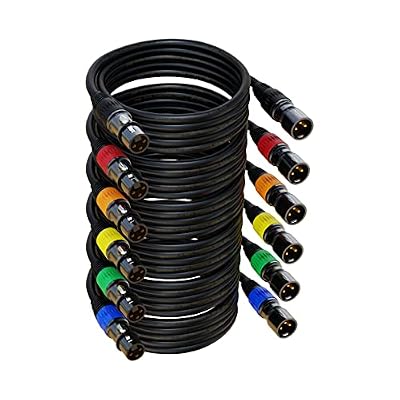
AuxLink XLR Cables, XLR Microphone Cable 25 ft 6 Pack, Gold-Plated 3-pin XLR Speaker Cable Male to Female Balanced Mic Cable
Included for 'Best XLR Cables for Clear, Reliable Audio' because the listing specifies XLR Microphone Cable 25 ft 6 Pack, details this guide uses to compare options.
View on AmazonThis is the bulk-buy option for someone wiring a room and leaving it wired. Six 25 ft balanced cables with gold-plated three-pin connectors covers a permanent install: a drum room, a rehearsal space, a small church or school PA, a podcast table with six seats, or a home studio where the interface lives in a rack and the microphones live on stands across the room. The gold plating on the connector pins is the headline feature, and it is worth understanding rather than dismissing. Gold does not improve the audio signal; it resists the oxide layer that forms on bare or nickel-plated contacts over time, which is what causes the crackle and intermittent dropout on a connector that has been sitting in a humid room for three years.
Key specifications as listed:
- Length: 25 ft per cable
- Quantity: 6 cables per pack
- Connectors: gold-plated three-pin XLR male to female, balanced
- Intended use: microphone to mixer, interface or PA system
- Price tier: premium
The practical argument for buying a six-pack in this length is that it is the cheapest way to get to a fully wired room, and a fully wired room is the single biggest quality-of-life upgrade in a small studio. Once every stand has a cable already run to the interface, setup time collapses and you stop making decisions based on which cable is free. The gold plating is a longevity feature rather than a sound feature, and it is most valuable in exactly the scenario these cables are sold for — semi-permanent connections that are made once and left alone, where oxidation is the slow failure mode rather than physical abuse.
Pros
- Six 25 ft runs in one order, enough to wire a small room permanently
- Gold-plated contacts resist oxidation on connections that stay plugged in for years
- Balanced three-pin configuration suitable for microphone and line-level use
- Economical per cable compared with buying six cables individually at this length
Cons
- Large up-front outlay for anyone who only needs two or three cables
- 25 ft of slack is wasted in a desktop setup and becomes a trip hazard if not dressed
- Gold plating offers no advantage on cables that are plugged and unplugged constantly, where mechanical wear dominates
Against the Tnlaile 6-Pack, the trade is plating versus colour. AuxLink gives you gold contacts and a slightly more installation-flavoured set; Tnlaile gives you colour coding that makes an active patch bay readable. If the cables will be labelled and left in place, the plating is the more durable choice. If you re-patch between sessions and need to know which cable is the overhead left, the colours are worth more than the plating. Either way, both are the wrong purchase for a two-cable desk — that job belongs to the Cable Matters pair or a single budget cable.
5. Amazon Basics XLR Male to Female Microphone Cable – Best for Spares and Second Setups
Amazon Basics XLR Male to Female Microphone Cable for Recording Studio, Speaker or PA System, All Copper Conductors, 3-Pin, Shielding, 6MM PVC Jacket, 25 Foot, Black
Included for 'Best XLR Cables for Clear, Reliable Audio' because the listing specifies Speaker or PA System and All Copper Conductors, details this guide uses to compare options.
View on AmazonThis is the second budget Amazon Basics XLR cable in the roundup, sold as a single male-to-female microphone cable for recording studios, speakers and PA systems with all-copper conductors. Functionally it overlaps heavily with the other Amazon Basics cable above, and the reason to include both is that in practice they behave as two stock listings for the same job: whichever is available in the length you need at the moment you need it is the one you buy. The case for this cable is not that it is better than anything else — it is that it is the cheapest sane way to solve the “I need one more cable” problem, and that problem comes up constantly.
Key specifications as listed:
- Connectors: XLR male to XLR female, three-pin, balanced
- Conductors: all copper
- Intended use: recording studio, speaker or PA system, microphone
- Quantity: sold individually
- Price tier: budget
Where a single budget cable genuinely earns its place is as a designated spare. Keep one coiled in the rack drawer. When a channel goes quiet mid-session, the fastest diagnostic in audio is to swap the cable — if the problem follows the cable, you have your answer in fifteen seconds instead of twenty minutes of gain-staging and interface troubleshooting. A spare cable is the cheapest piece of diagnostic equipment a home studio can own, and there is no reason for it to be an expensive one. The same logic applies to a second setup: a rehearsal space, a second desk, a travel bag, or a friend’s project that needs one cable to get running.
Pros
- Lowest-cost way to add a spare cable to an existing setup
- All-copper conductors and a standard balanced configuration
- Sold singly, so you are not forced into a multi-pack
- Good enough for the short, quiet runs that dominate home use
Cons
- Overlaps almost entirely with the other Amazon Basics XLR cable, which can cause confusion when ordering
- Generic connectors with no named brand and no published shield specification
- Not built for repeated coiling and transport
Versus the Monoprice XLR Male to Female 10 ft Premier Series, the Monoprice cable is the better-engineered budget option: 16 AWG conductors and gold-plated connectors at a similar price tier, in a fixed 10 ft length. If you know you need 10 ft and you want the heavier gauge, buy the Monoprice. If you need a specific odd length or you are adding a single spare to an order, this Amazon Basics cable is the simpler purchase. Versus the other Amazon Basics XLR cable, the difference is packaging and availability rather than performance — treat them as interchangeable.
6. AA AUDIO ACCESSORY XLR 10 ft with Neutrik REAN Connectors – Best for Connector Quality on a Budget

AA AUDIO ACCESSORY XLR Cables 10ft, Neutrik REAN Connectors, Dual Shielded
Included for 'Best XLR Cables for Clear, Reliable Audio' because the listing specifies Neutrik REAN Connectors and Dual Shielded, details this guide uses to compare options.
View on AmazonThis is the cable for people who have already had a cheap XLR fail on them and do not want it to happen again. The two features that matter are in the listing name: Neutrik REAN connectors and dual shielding. Neutrik is the reference standard in professional audio connectors, and REAN is its sibling line aimed at cost-conscious buyers — same engineering philosophy, less expensive materials and construction, still a genuine step above generic moulded connectors. Dual shielding means the cable carries both a foil and a braided shield layer, which improves rejection of radio-frequency interference and of the high-frequency noise that nearby switching power supplies and LED drivers produce. At 10 ft, it sits between a desk cable and a stage cable, which makes it the most flexible single length in this roundup.
Key specifications as listed:
- Length: 10 ft
- Connectors: Neutrik REAN, three-pin XLR male to female
- Shielding: dual shielded
- Configuration: balanced
- Price tier: mid-range
The reason to pay attention to the connector rather than the cable is failure statistics. In practice, the overwhelming majority of XLR cable failures happen at the connector — a broken solder joint where the conductor meets the pin, a cracked shell, or a strain relief that has stopped gripping so the cable flexes inside the housing until a wire breaks. A cable with a proper chuck-style strain relief and a metal shell resists that far longer than a moulded plastic boot. Dual shielding is the second half of the argument: in a room with a computer, a monitor, an LED lamp and a wireless router, RF pickup is a real possibility, and a foil-plus-braid shield gives you two different mechanisms of rejection instead of one.
Pros
- Neutrik REAN connectors, which is the most meaningful quality signal on any XLR listing
- Dual shielding for better rejection of RF and switching-supply noise
- 10 ft is the most versatile single length — long enough for a floor stand, short enough for a rack
- Mid-range price for a genuinely better-built cable than the budget tier
Cons
- Sold individually, so a full studio setup costs more than a matched multi-pack
- No colour coding, which is a real limitation once you have more than three of them
- 10 ft is still too short for a run to a separate room or across a stage
The nearest alternative is the Cable Matters 2-Pack: shorter at 6 ft, cheaper per cable, and sold as a pair, but with generic connectors. The trade is straightforward — the AA Audio Accessory cable buys you better connectors and dual shielding for one cable, while the Cable Matters pack buys you two cables and a spare. If you patch and re-patch, or if you have ever chased an intermittent dropout, spend the extra on the REAN connectors. If your cables live permanently behind a desk, the spare is worth more than the connector brand. Against the Monoprice Premier Series 10 ft, the Monoprice wins on gauge and gold plating, the AA Audio Accessory wins on connector brand — and connector brand is the more consequential of the two.
7. VANDESAIL XLR 3 ft 2 Pack – Best for Short Rack and Patch Runs

VANDESAIL XLR Cables 3ft 2 Pack,Short Microphone Cable OFC Noise Reduction
Included for 'Best XLR Cables for Clear, Reliable Audio' because the listing specifies Short Microphone Cable OFC Noise Reduction, details this guide uses to compare options.
View on AmazonThree-foot cables are the least glamorous and most under-bought item in a home studio. They are what you need inside a rack — interface to patch bay, patch bay to preamp, preamp to monitor controller, DI box to interface — and they are what you need on a pedalboard or a small desk where anything longer becomes a coil of slack that loops around your feet. VANDESAIL sells these in a two-pack with oxygen-free copper conductors and a noise-reduction build, at a budget price. If your rack has ever been a wall of six-foot cables folded into a bird’s nest, this is the fix.
Key specifications as listed:
- Length: 3 ft per cable
- Quantity: 2 cables per pack
- Conductors: oxygen-free copper (OFC)
- Configuration: balanced XLR male to female, noise-reduction construction
- Price tier: budget
Short cables have one genuine technical advantage beyond tidiness: less cable means less opportunity to pick up interference, and less capacitance loading the source. In a rack where six devices sit within a foot of each other and a wall of power supplies, keeping signal cable runs short and physically separated from mains cable is the single most effective noise-reduction measure available. Three feet is also short enough that you can route it cleanly around the back of a rack without crossing power runs, which a six-foot cable almost never allows. The OFC conductor claim is standard for this category and worth having, though at three feet the conductor material is far less significant than it is at fifty.
Pros
- Solves rack patching properly, where longer cables create clutter and noise risk
- Two-pack covers the typical interface-to-patch-bay and patch-bay-to-preamp pair
- Oxygen-free copper conductors and a balanced configuration at a budget price
- Short runs minimise interference pickup and cable capacitance
Cons
- Three feet is unusable for anything microphone-related outside a rack
- Only two cables per pack, so a full rack needs several packs
- No named connector brand and no published shield specification
Compared with the Cable Matters 6 ft 2-Pack, the choice comes down to geometry. Six feet is right for a desk; three feet is right for a rack. Buying a 6 ft cable for a rack patch means two feet of slack coiled behind the unit, which is exactly where it can drape across a power supply. Buying a 3 ft cable for a desk means it will not reach. Many studios need both, and buying one of each is not wasteful — it is the correct answer. If you can only buy one pair, buy based on where your interface physically sits, not on which length sounds more versatile.
8. VANDESAIL XLR 25 ft 2 Pack Nylon Braided – Best for Stage Durability at a Mid-Range Price

VANDESAIL XLR Cables 25ft 2Pack, Durable Nylon Braided XLR Microphone Cable
Included for 'Best XLR Cables for Clear, Reliable Audio' because the listing specifies Durable Nylon Braided XLR Microphone Cable, details this guide uses to compare options.
View on AmazonThis is the second VANDESAIL entry in the roundup and a completely different proposition from the 3 ft pair. Two 25 ft cables with a nylon-braided outer jacket and oxygen-free copper conductors, at a mid-range price. The braided jacket is the defining feature. Standard PVC and rubber jackets abrade, scuff and eventually split where a cable rubs against a stand base or a stage edge; a braided nylon sleeve takes that abrasion instead, and it also resists the tangling that makes PVC cables such a nuisance to coil. It costs you a little flexibility, which matters if the cable needs to bend tightly around a corner, but for a cable that lives on a floor it is a clear net win.
Key specifications as listed:
- Length: 25 ft per cable
- Quantity: 2 cables per pack
- Jacket: nylon braided, durable outer sleeve
- Conductors: oxygen-free copper (OFC)
- Configuration: balanced XLR male to female
- Price tier: mid-range
Twenty-five feet is the industry’s default stage length because it covers the distance from a floor microphone to a stage box at the side of the stage without leaving a pile of slack. Two of them is the right starter quantity for a solo performer or a duo: one for the vocal mic, one for a guitar or a second vocal. The braided jacket’s other practical benefit is that it stays visually distinct from your other cables, which sounds trivial until you are troubleshooting at a gig with limited light and need to know which run goes to the vocal channel.
Pros
- Nylon braid resists abrasion and tangling far better than a plain PVC jacket
- 25 ft is the standard stage length and coils neatly
- Oxygen-free copper conductors and a balanced configuration
- Two-pack covers a typical solo or duo performance setup
Cons
- Braided jacket is stiffer than rubber, which is awkward in tight rack bends
- Only two cables, so a full band needs multiple packs
- Braided outer sleeves can snag on hook-and-loop ties and on rough flight-case edges
The direct comparison is with the Gearlux XLR 25 ft 2-Pack, which is the same length and pack quantity at the same price tier without the braided jacket. If your cables are handled roughly — stepped on, dragged across a floor, coiled by other people — the braid is the difference that extends service life, and it justifies choosing VANDESAIL here. If the cables live in a studio and are handled carefully, the Gearlux set is the simpler and equally capable option. Against the Pig Hog 25 ft 2 Pack, the VANDESAIL is the lighter-duty choice: Pig Hog is built around touring abuse, and its connector bodies and strain relief are the parts that reflect it.
9. Gearlux XLR Microphone Cable 25 ft 2 Pack – Best for Live Sound Value

Gearlux XLR Microphone Cable, Fully Balanced, Male to Female, 25 Feet - 2 Pack
Included for 'Best XLR Cables for Clear, Reliable Audio' because the listing specifies Fully Balanced and Male to Female, details this guide uses to compare options.
View on AmazonGearlux is a value-focused audio accessory brand, and this is its straightforward answer to the question “what do I buy for a small live rig without overspending?” Two fully balanced 25 ft male-to-female microphone cables at a mid-range price, in the standard stage length. It suits a small band, a house of worship, a school music department, or a solo performer building a first PA. There is nothing exotic here and that is the point — it is a correct, conventional balanced cable at a sensible price, and the two-pack means you can leave one permanently patched and keep one in the bag.
Key specifications as listed:
- Length: 25 ft per cable
- Quantity: 2 cables per pack
- Configuration: fully balanced, XLR male to XLR female
- Intended use: microphone to mixer, interface or PA system
- Price tier: mid-range
The specific claim worth evaluating is “fully balanced.” In XLR marketing this phrase sometimes distinguishes a real three-conductor cable — two signal conductors plus a shield — from a two-conductor cable with an XLR shell on each end, which looks identical from the outside and does not reject noise the way a balanced cable should. A genuine balanced cable carries the signal on pins 2 and 3 with opposite polarity and ties the shield to pin 1, so interference couples equally onto both signal conductors and cancels at the differential input. That is the entire mechanism behind XLR’s noise rejection, and it is why the connector type alone tells you nothing about whether a cable is actually balanced.
Pros
- Fully balanced three-conductor construction, which is the feature that actually matters
- 25 ft covers the standard floor-stand-to-stage-box distance
- Two-pack at a mid-range price is good value for a small live rig
- Conventional build that behaves predictably and coils without memory
Cons
- Plain jacket with no abrasion-resistant braid for rough handling
- Only two cables, which is not enough for a full band without repeat purchases
- No published shield specification or named connector brand
Against the VANDESAIL 25 ft braided 2-Pack, the decision is entirely about handling. Same length, same quantity, same price tier — the VANDESAIL adds a nylon braid that resists abrasion and tangling, while the Gearlux keeps a conventional jacket that is slightly more flexible and slightly less tough. For a fixed install or a studio, the Gearlux is fine and marginally easier to dress. For anything that travels, the braid earns its keep. Against the MIKIZ 50 ft 2-Pack, the Gearlux is the more practical choice for normal stage distances; 50 ft is only worth buying when you genuinely have a long run, because the extra length has to be managed.
10. MIKIZ XLR Cables 50 ft 2-Pack – Best for Long Throws to a Tracking Room
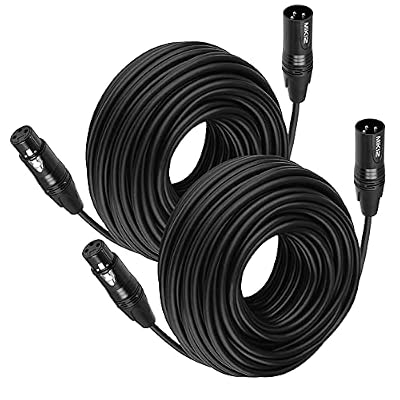
MIKIZ XLR Cables for Microphone 50 Feet 2-Pack
Included for 'Best XLR Cables for Clear, Reliable Audio' as a relevant option in this category; details come from the product listing.
View on AmazonFifty feet is a deliberate purchase, not a default. You buy a 50 ft XLR cable when the microphone and the interface are in genuinely different rooms, or when the stage box is at the back of a hall and the performer is at the front. MIKIZ sells these in a two-pack at a premium tier, which is the right way to buy them — long cables are the ones you least want to be one short of. This suits a home studio with a separate tracking room or a converted garage, a church or school with a fixed long run, and any setup where a 25 ft cable would leave the performer tethered to a rack.
Key specifications as listed:
- Length: 50 ft per cable
- Quantity: 2 cables per pack
- Connectors: XLR male to XLR female, three-pin, balanced
- Intended use: microphone to interface, mixer or stage box over long distances
- Price tier: premium
The technical question with long cable is whether the added capacitance and resistance degrade the signal. For a balanced microphone-level connection, the answer is generally no at this scale: a low-impedance dynamic or condenser microphone feeding a balanced input will happily run a few hundred feet of decent cable before the high-frequency roll-off becomes audible, and 50 ft is comfortably inside that envelope. The practical issues with 50 ft are not electrical, they are physical. Fifty feet of cable on a floor is a trip hazard and a coil that takes two people to manage, and it will pick up more interference than a short cable simply because it presents a longer antenna. Routing it away from mains runs and using cable ties matters more at this length than at any other.
Pros
- Enough length to put a performer in a genuinely separate room from the interface
- Two-pack means both the mic and the headphone or talkback run can be covered
- Balanced construction keeps long-run noise rejection intact at this distance
- Removes the need to chain shorter cables together, which is a common source of faults
Cons
- Premium pricing and a large physical footprint for a cable you may rarely use
- Long runs need careful routing and cable management to avoid picking up interference
- Coiling and storing 100 ft of cable takes real space and technique
Compared with the Pig Hog XLR 25 Foot 2 Pack, the difference is length and ruggedness rather than quality. Pig Hog is built for abuse; MIKIZ is built for distance. If your problem is that the room is far away, buy the 50 ft set. If your problem is that the cable keeps breaking, buy the Pig Hog and move the rack closer. Against the AuxLink 25 ft 6 Pack, the MIKIZ pair is the specialist purchase — six medium cables cover a room, two very long cables cover a specific long run, and buying the wrong one wastes money in opposite directions.
11. Pig Hog XLR 25 Foot 2 Pack Tour Grade – Best for Touring and Heavy Handling

Pig Hog XLR 25 Foot 2 Pack Tour Grade Microphone Cables
Included for 'Best XLR Cables for Clear, Reliable Audio' as a relevant option in this category; details come from the product listing.
View on AmazonPig Hog builds cables for the road, and the “tour grade” label is a claim about the physical parts rather than the electrical ones. Two 25 ft XLR cables, heavier jacket, chunkier connector bodies, strain relief designed for cables that get yanked out of a stage box by a stranger in a hurry. It suits a working musician, a rental company, a venue with a permanent PA, a school with a stage that gets used by people who did not set it up. If your cables are the ones that fail, this is the tier that stops the failure.
Key specifications as listed:
- Length: 25 ft per cable
- Quantity: 2 cables per pack
- Build: tour-grade jacket, heavy-duty connector housings and strain relief
- Configuration: balanced XLR male to female
- Price tier: premium
The argument for premium cable is not audio quality — it is total cost of ownership. A budget cable at a fifth of the price is a false economy if it fails after a year of gigging, because the failure almost always happens at the worst possible moment and the replacement cost includes the gig. Working out cost per use makes the case concrete: a cable that survives five years of weekly use has been used roughly 260 times, so even at several times the budget price the per-use cost is small change. A budget cable that dies after twenty uses and has to be replaced is more expensive per use and considerably more annoying. Tour-grade cable is bought for reliability, and reliability is a feature you pay for once.
Pros
- Heavy-duty jacket and connector housings built for repeated handling and transport
- Strain relief designed to survive being pulled out by the cable rather than the connector
- 25 ft is the standard stage length, and a two-pack covers a typical performer
- Low cost per use over a long service life compared with replacing budget cables
Cons
- Highest price tier here, and the weight and bulk are noticeable when coiling
- Overkill for a studio where cables never leave the room
- Heavier jacket is stiffer, so it is less pleasant in tight rack routing
The nearest alternative is the VANDESAIL 25 ft braided 2-Pack, which also targets durability with a nylon braid but at a lower tier. The VANDESAIL protects the outside of the cable; the Pig Hog also addresses the connector and strain relief, which is where most failures actually occur. If you are hard on cables but mostly indoors, the VANDESAIL is the better value. If your cables go into a van, get dropped and get coiled by other people, the Pig Hog is the one that survives the season. Against the MIKIZ 50 ft 2-Pack, the choice is ruggedness versus reach — buy the Pig Hog if the rack is close and the handling is rough, the MIKIZ if the rack is far away.
12. Monoprice XLR Male to Female Cable 10 ft Premier Series – Best for Heavy-Gauge Permanent Runs

Monoprice XLR Male to XLR Female Cable - for Microphone, Gold Plated, 16AWG, 10 Feet, Black - Premier Series
Included for 'Best XLR Cables for Clear, Reliable Audio' because the listing specifies for Microphone and Gold Plated, details this guide uses to compare options.
View on AmazonMonoprice’s Premier Series is the enthusiast tier of a brand known for inexpensive, well-specified cable, and this XLR cable carries a specification that stands out in this list: 16 AWG conductors. For context, most microphone cable uses conductors in the 20 to 24 AWG range, so 16 AWG is substantially heavier copper. Heavier conductors mean lower resistance over distance, which matters most on long runs and on line-level connections where the source impedance is not as low as a microphone’s. The cable also has gold-plated connectors and comes in a fixed 10 ft length at a budget price, which is a genuinely unusual combination.
Key specifications as listed:
- Length: 10 ft
- Conductors: 16 AWG
- Connectors: gold-plated XLR male to XLR female
- Series: Premier Series
- Intended use: microphone and line-level balanced connections
- Price tier: budget
Heavy gauge is a real advantage in specific circumstances and a non-issue in others, and it is worth being precise about which. Lower resistance reduces signal loss over distance, so a heavier cable is measurably better on a long run than a thin one. On a 10 ft cable between a microphone and an interface, the difference in resistance between 16 AWG and 22 AWG is small enough that you will not hear it. Where 16 AWG pays off is durability and mechanical robustness — thicker copper is harder to break — and in line-level and passive situations where a slightly higher source impedance makes the cable’s contribution more significant. It also makes the cable stiffer, which is a trade you notice immediately when trying to route it around a tight corner.
Pros
- 16 AWG conductors, substantially heavier than typical microphone cable
- Gold-plated connectors resist oxidation on permanent connections
- Budget price tier despite the heavier specification
- 10 ft length works for both desk and shallow rack use
Cons
- Heavier gauge makes the cable noticeably stiffer and harder to route tightly
- Sold individually, with no multi-pack option at this specification
- Heavy gauge offers little audible benefit on a 10 ft microphone run
Against the AA AUDIO ACCESSORY XLR 10 ft, this is the most interesting head-to-head in the roundup because both are 10 ft and both target the quality-conscious budget buyer from opposite directions. Monoprice puts the money into copper — 16 AWG conductors and gold-plated contacts. AA Audio Accessory puts it into connectors — Neutrik REAN, dual shielding. If the cable will be installed and left, the heavier gauge and gold plating are the more relevant strengths. If it will be plugged and unplugged, or if you are fighting interference in an electrically noisy room, the REAN connectors and dual shield are worth more. Against the Amazon Basics single cable, the Monoprice is simply the better-specified budget cable and the one to choose when both are available at the same length.
How to Choose
Four variables decide which XLR cable is right for you: length, connector quality, shielding and conductor construction, and jacket flexibility. Almost every bad XLR purchase comes from getting one of those four wrong for the situation, not from buying a cable that sounds bad — because at line and microphone level, over short distances, well-made cables do not sound meaningfully different from each other. Here is how to think about each one, with the numbers that matter.
Length: match the cable to the distance, not to the future
Length is the single most common mistake. Buy for the distance you actually have, plus about 10 to 20 percent for routing slack — not for a hypothetical larger room later. A cable with two feet of spare slack behind a rack is a cable that will drape across a power supply and pick up hum; a cable that is one foot too short is a cable you will stretch across a doorway.
- 3 ft: rack patching only — interface to patch bay, patch bay to preamp, DI to interface. Two per device pair.
- 6 ft: desktop studio. Microphone boom to interface, interface to powered monitors. The most common home-studio length.
- 10 ft: the versatile middle. Reaches a floor stand, fits a shallow rack, works on a small stage. Best single length if you only want one.
- 25 ft: the stage standard. Floor microphone to a stage box or a rack on the far side of a room.
- 50 ft: separate rooms. A tracking room, a hall, a fixed long run. Only buy when the distance is real.
Electrically, balanced microphone cable handles distance well. A low-impedance microphone into a balanced input will run a couple of hundred feet of decent cable before high-frequency roll-off becomes a practical concern, so 25 ft and 50 ft runs are not a signal-quality problem — they are a cable-management problem. The one caveat is capacitance: cables with a star-quad construction have noticeably higher capacitance per foot than standard twisted-pair, which is a non-issue at 10 ft and worth thinking about at 100 ft.
Connector quality: where cables actually fail
If you spend more on one thing, spend it here. The overwhelming majority of XLR failures happen at the connector — a broken solder joint, a cracked shell, a strain relief that stopped gripping. A metal-shell connector with a proper chuck-style strain relief, where the housing clamps the jacket rather than the conductors, will outlast a moulded plastic boot by years. A named connector brand is the clearest signal available: Neutrik is the professional reference, and its REAN line is the cost-conscious version of the same engineering. Generic connectors are not automatically bad, but they carry no guarantee, and the listing rarely tells you anything about their construction. Gold-plated contacts resist oxidation, which matters on connections that stay plugged in for months or years in a humid room; on cables that are plugged and unplugged daily, mechanical wear matters more than plating.
Shielding and conductors: what the specifications mean
A balanced XLR cable needs three conductors: pin 2 hot, pin 3 cold, pin 1 shield. The shield does not carry audio; it intercepts interference and dumps it to ground. Shield coverage comes in three common forms — a foil wrap, a braided copper mesh, or both layered together as a dual shield. Braid is more durable and easier to terminate; foil gives higher percentage coverage; dual shielding combines both mechanisms and is the best choice in electrically noisy rooms. Watch out for cables marketed with XLR connectors that are not actually balanced microphone cable — some are two-conductor speaker cables with XLR shells, which are not interchangeable and should never be used for microphones or line-level signals.
On conductors, oxygen-free copper is the standard claim and is worth having. Gauge is usually in the 20 to 24 AWG range for microphone cable; heavier 16 AWG appears in some products and offers lower resistance, which is most relevant on long runs and line-level connections and largely irrelevant on a short microphone run. Heavier gauge also makes the cable stiffer, which is a genuine downside in a rack.
Flexibility and jacket material
Jacket material decides how the cable behaves in your hand. Rubber and soft PVC are the most flexible and best for tight rack bends and desk use, but they abrade and tangle. Nylon braid resists abrasion and tangling and is the right choice for cables that live on a floor, at the cost of stiffness. Heavier gauge conductors inside any jacket make the whole cable less pliable. If you are routing around tight corners behind a rack, prioritise flexibility; if the cable is going on a stage floor, prioritise the braid.
Matching budget to situation
| Your situation | What to prioritise | Typical market range | Look at |
|---|---|---|---|
| First setup, one mic, one interface | Correct length, balanced construction, low cost | Budget, under roughly $15 per cable | Amazon Basics, Monoprice Premier |
| Desktop studio, two to four inputs | 6 ft length, metal connectors, a spare | Mid-range, roughly $15–$30 per cable | Cable Matters 2-Pack, AA Audio Accessory |
| Rack with patch bay | Short lengths, flexibility, tidy routing | Budget to mid-range | VANDESAIL 3 ft 2 Pack |
| Multi-mic sessions (drums, podcast, ensemble) | Six matched cables, colour coding, 25 ft | Premium, roughly $60–$120 per pack | Tnlaile 6-Pack, AuxLink 6-Pack |
| Small live rig or rehearsal PA | 25 ft, balanced, durability | Mid-range per cable | Gearlux 2-Pack, VANDESAIL braided 2-Pack |
| Touring or heavy handling | Connector and strain relief quality above all | Premium, roughly $40–$80 per pack | Pig Hog Tour Grade |
| Separate tracking room or long fixed run | 50 ft, balanced, careful routing | Premium per cable | MIKIZ 50 ft 2-Pack |
Two ownership realities are worth planning for. First, cables fail at the connector, so the practical lifespan of a cable is mostly a function of how often it is plugged and unplugged and how it is pulled out — always grip the connector body, never the cable. Second, cables get lost, borrowed and left at venues, so buy one more than you need. The most common studio problem is not a bad cable; it is being one cable short at the moment you need to record. Coil cables over-under rather than wrapping them around your elbow, store them in a bag or a drawer rather than a tangled pile, and keep them away from mains runs and power supplies when routed. Do those three things and a mid-range cable will outlast a premium cable that is treated badly.
Frequently Asked Questions
Do XLR cables actually change the sound?
Far less than marketing suggests, and only under specific conditions. A balanced XLR connection rejects noise by sending the signal on two conductors with opposite polarity and subtracting them at the input, so a well-made cable in a quiet room sounds the same as an expensive one. Where cables do make a difference is in high-interference environments, over very long runs, and when a cable is faulty — a broken shield or a damaged pin can introduce hum, crackle or dropout. If you are chasing a tone problem, look at the microphone, the room and the preamp before the cable.
How long can an XLR cable be before signal loss matters?
Longer than most people assume. A low-impedance microphone feeding a balanced input will typically run a couple of hundred feet of decent cable before high-frequency roll-off becomes audible, and 25 ft and 50 ft runs are comfortably inside that range. The practical limits at long distances are physical rather than electrical: capacitance accumulates per foot, long cables pick up more interference because they present a longer antenna, and they are harder to route away from mains power. For most home and stage use, cable length is a cable-management decision, not a signal-quality one.
What is the difference between a microphone cable and a cable with XLR ends sold as a speaker cable?
They are not interchangeable. A genuine microphone cable is balanced, with two signal conductors plus a shield, and is designed to carry low-level signals. A speaker cable carries a high-current, low-impedance signal and typically uses much heavier conductors with no shield, even when it is fitted with XLR connectors at each end. Using a speaker cable as a microphone cable can result in hum, noise and unpredictable behaviour, and using a microphone cable as a speaker cable risks damage. Always check the listing describes a balanced microphone or line-level cable.
Does gold plating on XLR connectors matter?
It matters for longevity, not for sound. Gold does not improve the signal passing through the connector; it resists the oxide layer that forms on bare or nickel-plated contacts over time, which is what causes crackle and intermittent dropouts on connections that sit unused in a humid room for months or years. Gold plating is most valuable on permanent installs and patch connections that are made once and left alone. On cables that are plugged and unplugged daily, mechanical wear at
Ready to decide? Our #1 pick for 2026 is the Cable Matters 2-Pack Premium XLR to XLR.
Live price & availability on Amazon.