Last updated: October 7, 2026
The best precision espresso baskets for most home users are a 58 mm ridgeless VST or IMS Competition basket sized within 1–2 grams of your normal dose; owners of Breville machines should instead choose a verified 54 mm basket, because diameter and portafilter fit matter more than the brand name.
A precision basket is manufactured with a more uniform hole pattern than a standard or pressurized basket. That can improve repeatability, but it also makes puck preparation less forgiving: uneven distribution, an unsuitable grind, or a dose that is too small for the basket can produce fast, channelled shots. The right choice depends on your portafilter, usual dose, coffee style, and willingness to adjust your workflow.

IMS Big Bang Precision Filter Basket for 58mm portafilters, 18-20g. double espresso (h23.5)
Included for 'Best Precision Espresso Baskets for Better Extraction' because the listing specifies 18-20g. double espresso (h23.5), details this guide uses to compare options.
View on Amazon
MHW-3BOMBER 58mm Espresso Filter Basket, 18g Double-layer Stainless Steel High Precision Extraction Portafilter Basket Filter Fits Most 58mm Portafilter/Tamper, Ridged, FB5628
Included for 'Best Precision Espresso Baskets for Better Extraction' because the listing specifies Ridged and FB5628, details this guide uses to compare options.
View on AmazonBest precision espresso baskets by situation
- Best overall for a 58 mm machine: a VST Precision or IMS Competition ridgeless basket matched to your dose.
- Best for a traditional 18 g recipe: an 18 g basket with a straight-sided design and a bottomless portafilter.
- Best for larger modern shots: a 20–22 g basket, provided your group head has enough clearance.
- Best for Breville 54 mm machines: a basket explicitly listed for the Breville/Sage 54 mm portafilter, such as a compatible IMS-style precision basket.
- Best for a small budget: a reputable 18 g competition basket rather than an oversized basket you cannot dose correctly.
- Best for frequent cleaning: a stainless-steel ridgeless basket with a simple, polished interior and no coating to scratch.
Head-to-head: what separates precision baskets
See also: 6 Best Milk Frothing Pitchers for Latte Art (October 2026) Honest Reviews • Protein Shaker Bottle Under $100: 6 Picks for Coffee Protein Shakes
| Basket type | Common diameter | Typical dose range | Construction | Preparation demand | Best use |
|---|---|---|---|---|---|
| Standard single-wall basket | 51, 54, or 58 mm | 7–18 g | Stainless steel; less uniform perforation | Moderate | Stock replacement and forgiving everyday brewing |
| VST Precision | 58 mm | 7–25 g, depending on model | Precision-formed stainless steel | High | Repeatable recipes and careful puck preparation |
| IMS Competition | 58 mm; some 54 mm and other sizes | About 14–22 g, depending on model | Perforated stainless steel | High | Dense, even hole patterns and modern espresso recipes |
| Precision basket for Breville/Sage | 54 mm | About 14–18 g | Stainless steel; manufacturer-specific fit | Moderate to high | Upgrading a 54 mm home machine |
| Pressurized basket | Machine-specific | Usually 7–18 g | Stainless steel with restricted outlet | Low | Pre-ground coffee or limited grinder control |
Capacity figures are not universal standards. An “18 g” basket may hold 16–20 g depending on the coffee’s density, roast level, and the headspace your machine requires. Treat the printed dose as a starting point, not a fixed rule.
Diameter and compatibility come first
A 58 mm basket is common in commercial-style machines from brands such as La Marzocco, Rancilio, Gaggia, Profitec, ECM, Lelit, and Rocket, but “58 mm” alone does not guarantee compatibility. The basket must also have the right outer rim, internal taper, depth, and retaining-ring relationship for the portafilter.
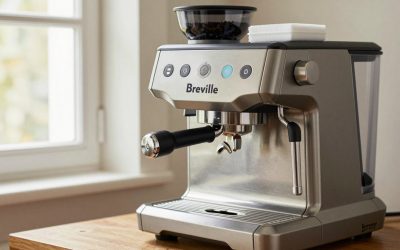
Breville and Sage home machines commonly use a 54 mm portafilter. A 58 mm basket cannot be made compatible with an adapter alone because the basket must lock into the portafilter and seal correctly against the group gasket. Some machines use 51 mm baskets, including many compact and entry-level models. Measure the existing basket or check the machine’s exact model before ordering.
Compatibility also includes the portafilter spring. A ridgeless precision basket can sit loosely in a weak or oversized spring, while a ridged basket may be difficult to remove from a particular portafilter. If you use a bottomless portafilter, confirm that it accepts the same basket diameter and depth as the original.
Choosing the right dose and diameter
Dose matching is more important than buying the largest basket available. A practical starting point is to choose a basket whose nominal capacity is close to your recipe:
- Use a 14–16 g basket for smaller milk drinks or a traditional double with a compact machine.
- Use an 18 g basket if your grinder and recipes normally produce 17–19 g in.
- Use a 20–22 g basket for larger beverages or modern recipes that use a higher dose.
- A 25 g basket is useful only if the machine has sufficient headspace and your grinder can produce a consistent, manageable puck.
For a quick fit check, lock in the dry puck and inspect the surface after removing the portafilter. A light shower-screen mark can be acceptable on some machines, but a deep imprint or compressed puck indicates insufficient headspace. Reduce the dose by 0.5–1 g or choose a deeper basket. If the puck is thin, watery, and leaves excessive space, increase the dose only if the basket and group clearance allow it.
VST versus IMS Competition
VST Precision
VST baskets are known for published capacity options and tight manufacturing tolerances. They are a strong choice when you want to repeat a recipe across multiple baskets or keep dose, grind, and yield records. Their consistent perforation rewards careful distribution, but a partially clogged or dirty basket can change flow noticeably. Cleaning needs to be thorough.
IMS Competition
IMS Competition baskets are widely available in multiple diameters and shapes, including versions made for specific machine families. Their hole patterns and internal geometry can differ between product lines, so the exact code matters more than the IMS name alone. They are often a practical choice when you need a compatible 54 mm basket or a particular depth that fits your portafilter.
Neither brand automatically makes poor coffee better. A precision basket exposes grinder inconsistency and distribution errors; it does not correct them. Choose VST when dose documentation and repeatability are your priority. Choose IMS when machine-specific fit, availability, or a particular shape is more important.
How precision baskets change puck preparation
- Grind directly into the basket. A dosing cup can work, but transfer carefully to avoid creating a dense layer on one side.
- Break up clumps. Use a thin-needle distribution tool with light, even movements. Do not scrape aggressively against the steel.
- Level before tamping. A level surface helps the tamper compress the puck evenly, especially in a straight-sided basket.
- Tamp consistently. Force matters less than keeping the tamper level and repeating the same motion.
- Check the first shot. If the shot runs fast with spraying, improve distribution before changing several grind settings at once.
Precision baskets commonly need a finer grind than a pressurized basket because they rely on the coffee puck, rather than a restricted outlet, to create resistance. Start with the same dose and target yield you normally use, then adjust grind size to reach the desired flow. A common starting ratio is 18 g in and 36 g out, but coffee and machine preferences vary.
Ownership, cleaning, and durability
Quality baskets are generally made from stainless steel and can last for years. The first problems are usually not metal failure but blocked holes, a bent rim, a weakened portafilter spring, or a basket that no longer suits a changed dose. Coated baskets may show scratches or wear if cleaned with abrasive tools; uncoated stainless steel is simpler for long-term ownership.
After each use, knock out the puck, rinse the basket, and inspect the holes against a light occasionally. Backflush the machine according to its manual, and periodically soak the basket in espresso-machine detergent. Rinse exceptionally well afterward. Avoid drilling or enlarging blocked holes: one altered opening can disrupt the intended flow pattern.
Hard water scale is less likely to form inside a clean basket than coffee oil residue, but both can affect flow. Replace the basket if the rim is visibly distorted, the portafilter no longer locks normally, or repeated cleaning cannot restore an even stream.
Final buying checklist
- Confirm 51, 54, or 58 mm diameter from the exact machine model.
- Match the nominal basket size to your actual dose, not to the largest drink you occasionally make.
- Choose ridgeless for easy puck removal and consistent positioning, or ridged if your portafilter spring needs it.
- Prefer uncoated stainless steel for durability and straightforward cleaning.
- Check depth and group-head clearance before selecting a 20 g or larger basket.
- Plan to improve distribution and grinding after upgrading; precision holes increase the value of a consistent workflow.
For most 58 mm home machines, an 18 g VST Precision or IMS Competition basket is the safest starting point. For a 54 mm machine, a correctly modelled 54 mm IMS-style precision basket is the better choice than forcing a commercial 58 mm option. Fit first, dose second, and brand third: that order gives you the best chance of more even extraction without creating unnecessary preparation problems.